Wobegone Boy

Keillor, Garrison. Wobegon Boy. New York: Viking, 1997.

It is strange to (finally) read something written by Garrison Keillor. For years and years and years I have heard wonderful things about Lake Wobegon Days and it seems,  for even longer, I have heard Keillor on NPR radio. Yet – nothing in print has been before my eyes or in my hands. Ever. Go figure.

John Tollefson is the manager of an academic public radio station. He has an idyllic life that is boring him to tears. His job, his home, his relationships, all are going well – so well that he no longer feels like he is in the drivers seat. Coasting through everything his life lacks depth and more importantly, it lacks meaning. John, with the help of his can’t-commit-to-marriage girlfriend Alida, sets out to make his life more interesting by opening a farm restaurant and other daring risks. John is perpetually guided by history, the life stories of his ancestors – a butcher, publisher, politician, among a wild cast of others, and a philosophical slant unlike any other.

While the plot of Wobegon Boy is a little slow and laborious, the voice is exceptional. As John Tollefson tells his story you cannot help but often laugh out loud. The sly wit and juicy humor radiate from every page. I wanted to quote line after line until I realized I what I really wanted was to quote the entire book.

Here are a few of my favorites: “Lake Wobegon was a rough town then, where, all on one block, for less than five dollars, you could get a tattoo, a glass of gin, and a social disease, and have enough left over to get in a poker game” (p2). See, by page 2 it’s funny! Here’s another one, “You could romp naked in periodicals and copulate on the carpet, and the librarians would be grateful if, after climax, you took down a magazine and thumbed through it” (p 7-8). Knowing the importance of circulation statistics, yes. Yes, we would be grateful.

BookLust Twist: From More Book Lust in the chapter called, “Big Ten Country: The Literary Midwest (Minnesota)” (p 28).

Samuel Johnson is Indignant

Davis, Lydia. Samuel Johnson is Indignant: stories. Brooklyn: McSweeney’s Books, 2001.

I always love it when I get a collection of short stories to read. For some reason I like idea of the simplicity of keeping something short when sometimes, nothing could be further than the truth; especially when it comes to a short story. A short story might be short on words or sentences or even paragraphs, but long on meaning and, in the end might turn out to be a little thought provoking or dare I say didactic? In other words, I might learn something!

Lydia Davis is funny. But, more importantly she has an amazing range of subject material. So much so that I found myself asking what subject does Lydia Davis NOT cover in a short story? What’s more, Lydia Davis has a wide range of writing styles. Everything she writes has a common theme: strange and wonderful, but no two stories could be characterized as “the same.” Her stories are eerie and contemplative, funny and sad, wise and irreverent.

Favorite lines, “You can’t tell everyone the truth all the time, and you certainly can’t tell anyone the whole truth, ever, because it would take too long” (p 7).

BookLust Twist: From  Book Lust in the chapter called simply, “Short Stories” (p 221). Duh.

You Make Me Feel…

Newman, Judith. You Make Me Feel Like an Unnatural Woman: Diary of a New (Older) Mother. New York: Miramax Books, 2004.

There are three reoccurring themes in You Make Me Feel Like an Unnatural Woman. Judith likes to portray herself as an over-forty, unhappily married,  yet wealthy woman with a moral on parenting: be careful what you wish for. While she is extremely funny about it, she is constantly criticizing her husband, John, for not being around more to help with twins, born after seven years and & $70,000 worth of IVF procedures. As an over-sixty man living at a different address, what exactly did she expect? He’s not about to change. Judith handles the trials and tribulations of raising twins with more aplomb and name dropping than any new mom I know. Having a $250 a day nanny certainly helps!

Favorite funny lines, “If he’s like most men I’ve known he’ll spend the rest of his life thinking of his dick as a masterpiece anyway. “Yes, honey, that’s art,” I said” (p 215).

My only complaint? Newman tries so freakin’ hard to be funny all the time that the tenderness of what she has (supposedly) longed for for so long gets lost. There were glimpses of caring at times, like, when she describes thinking her babies are beautiful. But, on the whole, it was if Newman was constantly “on” all the time. I never really thought I saw the real mother because she was veiled behind a thousand jokes.

BookLust Twist: From More Book Lust in the chapter called, “Nagging Mothers, Crying children” (p 172). Appropriate for Mother’s Day, don’t you think?

Endless Love

Spencer, Scott. Endless Love. New York: Alfred A. Knopf, 1987.

At the center of Endless Love is David Axelrod. David starts his story remembering how, as a 17 year in love, he set fire to his girlfriend’s house. Not as an out-of-anger act of revenge but more of an uncontrollable response to an all-consuming love for his girlfriend, Jade Butterfield, and her family. Having been banished from the Butterfield home David’s plot is to ignite the house in the hopes the fire will give him the perverse opportunity to become the hero and ultimately rescue the entire family from the inferno he started. His desire to be needed by the entire family is blinding. Of course David’s plot doesn’t work out so smoothly…and thus begins Unless Love. It is a dark and tangled tale about obsessions and the inability to see past them. It is about dysfunctional families that use one another to seem normal. It is about struggling relationships set against the ever turbulent late 1960s. In the middle is confused, young, obsessed David Axelrod. He reminds me of Llyod Dobler from ‘Say Anything’ – an all-around nice guy with little direction and not much more ambition who can sum up his life in one sentence, “I just want to be with your daughter….sir.”

My favorite quotes are on the subject of love: “Love gives us a heightened consciousness through which to apprehend the world, but anger gives us a precise, detached perception of its own” (p 40) and, “If endless love was a dream, then it was a dream we all shared, even more than we all shared the dream of never dying or of traveling through time, and if anything set me apart it was not my impulses but my stubbornness, my willingness to take the dream past what had been agreed upon as the reasonable limits, to declare that this dream was not a feverish trick of the mind but was an actuality at least as real as that other, thinner, more unhappy illusion we call normal life” (p 162).

I think the reason why I liked Endless Love so much is because every character was a head-scratcher. It wasn’t just David Axelrod who had a personality worth paying attention to. the story of his parents held mysteries to be explored. Every member of Jade Butterfield’s family kept the story alive and buzzing with intrigue. The questions most asked – who would defend David? Who would forgive him? Who wouldn’t forget?

BookLust Twist: From Book Lust in two different chapters. First, in the chapter called, “First Lines to Remember” (p 87), and again in “Sex and the Single Reader” (p 218).

Terms of Endearment

McMurtry, Larry. Terms of Endearment. New York: Signet, 1975.

I really should have a “on a whim” category because this was not on my list to read this month. In fact, this was not on my list to read until May 2010. Here’s what happened. I was home, had no desire to slog through Herzog, saw Terms of Endearment on my mother’s bookshelf (saw it there for years and years), knew it was on The List somewhere, and in a split second decided to read it. I don’t regret the decision. I was able to read it, start to finish, within two days.

Terms of Endearment is the kind of book that makes you feel things. Larry McMurtry has the ability to make you change your mind about the people you meet…several times over. In the beginning I saw Terms as a story about a bunch of miserable people. I was shocked by the hatred these people carried around (see ‘shocking quotes’ below). I didn’t think I would like a single character. I saw Aurora as nasty and Emma as just plain pathetic. By the end of the book I had completely changed my mind about everything and everyone.
The premise for Terms of Endearment is really quite simple. It’s the story of a mother and daughter and the relationships that orbit around them. Aurora is a Boston widow transplanted to Houston, Texas. She has five different “suitors” who tolerate her abrasive tongue and haughty manner and despite all that, continuously vie for her hand in marriage. At first she appears caustic and self-centered. Selfish and conniving, she bends situations to suite her ever-changing needs. Her story takes up the first 324 pages and by the end of it you realize she is a woman of conviction who simply tells it like it is. Emma, her daughter, at first appears to be one of Aurora’s victims – always manipulated and belittled. The strength of their relationship and the depth of their love for one another isn’t readily apparent until life gets complicated for Emma. Emma hasn’t married well. She hasn’t been educated and she has bad hair. On the surface she is poor and pathetic. But, true to McMurtry form, by the end Emma is a strong, defiant woman.
My only disappointment about Terms of Endearment is the inclusion of Book II, Emma’s story. 324 pages are dedicated to Aurora while Emma gets the last 47. I don’t really understand the need for separate “books” when Emma’s story – her bad marriage to Flap, her pregnancy, her lifestyle and relationship with her mother – are all woven seamlessly into Aurora’s story. Emma’s portion of the book seems weak and it’s inclusion, an afterthought.

Shocking quotes: “She was convinced that she could have stood in the driveway dripping blood, both arms amputated at the elbow, and Cecil would still have driven up, said “Hi Toots,” smiled broadly, and squeezed her stump” (p 16).
“She would have liked to have a heavy chain in her hand, and if she had had one she would have hit him with it, right across the lower part of his spine. If it broke his back, so much the better” (p 32).

BookLust Twist: In Book Lust in the chapter called, “Three-Hanky Reads” (p236).

Where the Pavement Ends

BikesWarmbrunn, Erika.  Where the Pavement Ends: One Woman’s Bicycle Trip Through Mongolia, China & Vietnam. Seattle: Mountaineers Books, 2001.

Reading books such as Where the Pavement Ends has a confusing effect on me. On the one hand, I start to think of my personal landscape as being too small, too confining. The need for movement and travel start to stir within me. On the other hand, I realize I am coddled, comfortable – too careful to conquer the great unknown. The idea of going where I don’t speak the language has always intimidated me. Okay. Scares the pants off me.

Where the Pavement Endsis not only a memoir about one woman’s eight month trek across Mongolia, China and Vietnam. It is also a  compassionate commentary on Erika Warmbrunn’s five (and sometimes sixth) senses. She relates everything she sees (sharing some gorgeous photographs throughout the book), everything she hears, touches, smells and tastes. From learning to enjoy Mongolian tea to ignoring sheep’s tail and demanding to eat like the natives rather than a coddled Western tourist. From the spanning the vast landscapes and bustling cities mostly by bicycle (accepting rides every so often). Every leg of Warmbrunn’s journey reflects the culture she encounters. She relies on the kindness of strangers to have decent meal, a roof over her head and to expand her social awareness. She is eager to learn the language, drink in the customs, and learn something from everyone she meets.

A small sampling of the favorite lines: “…to make things new, you have to keep going further and further away from what you know” (p 11). This is the perfect definition of bravery, “I was completely intimidated, and I was absolutely at peace” (p 13). Another one, “In the absence of language, ritual becomes a way of communication, of making yourself a little less foreign” (p 42).

BookLust Twist: From Book Lust in the chapter called simply, “Bicycling” (p 35).

Off Keck Road

Simpson, Mona. Off Keck Road. New York: Alfred A. Knopf, 2000.

I didn’t realize this book is a novella. 167 pages long. A piece of cake to read on a quiet Sunday. The sad thing is I didn’t really get into it, despite it being a quick read. The story starts off being about Bea Maxwell but then veers away to take in other members on and off Keck Road. The character placement seems jumbled. New characters appear without clear introduction or connection to Bea. I felt I needed a chart to keep characters straight. However, character development was brilliant, intimate even. When we first meet Bea, she is a college girl, home on vacation in the 1950s. She has certain definable traits that stay with her throughout the rest of the novella, ending in the 1980s. It’s a portrait of a woman who never leaves her small town. Her life never really takes her beyond Green Bay, Wisconsin’s city limits without reeling her back in.

Favorite lines, “He was the kind of man who ceded his place in traffic. He never asserted himself in conflicts over lanes or parking spaces” (p 80).

BookLust Twist: From More Book Lust in the chapter, “Big Ten Country: The Literary Midwest (Wisconsin).
Also in the chapter, “Two, or Three, Are Better Than One” (p 226). Note: in this chapter Pearl suggests reading Off Keck Road together with Our Kind: a Novel in Stories by Kate Walbert; two stories about the lives of women.

Speak

Anderson, Laurie Halse. Speak. New York: Scholastic, 2003.

You have to admire Melinda. From day one of school she is harrassed and hated. She storms through the first marking period of high school, gnashing her teeth and muttering to herself. She has no friends and is openly tormented by everyone from peers to parents. Melinda has a secret that not only eats away at her little at a time, but by the end of the third marking period, steals away her voice until she is practically mute. While she puts on a good act of wit and sarcastic humor on the outside, inside she is a girl trapped by confusion and fear. As her grades plummet and her family life slowly falls apart, Melinda struggles to keep her sanity. Speak took me only a few hours to read. Anderson does an amazing job capturing the voice of a tormented teen. She portrays the relationships every young adult has to endure: teachers, principals, parents, ex-best friends…with such honesty I found myself cringing…

Favorite funny parts: “Our boys are unbeatable as long as they are the only team on the floor” (p 76). “We are reading The Scarlet Letter one sentence at a time, tearing it up and chewing on its bones” (p 100). And one sad line: “I stuff my mouth with old fabric and scream until there are no soulds left under my skin” (p 162).

BookLust Twist: From Book Lust in the chapter “Best for Teens” (p 23).

Rise of David Levinsky

Cahan, Abraham. The Rise of David Levinsky. Glouster: Peter Smith, 1969.

Written in 1917 The Rise of David Levinsky is the story of Russian born immigrant David Levinsky and his rise to riches in the garment industry in New York City. Cahan’s depiction of Levinsky remains one of the best accounts of not only immigrants seeking opportunity and fortune in America at the turn of the century, but also the Jewish experience on New York’s East Side as well. Cahan illustrates social attitudes towards poverty, religion, ethnicity and economic status through David’s character. Using his situation as an orphan, David accepts pity from those with means. He has an uncanny ability to sense the heart of others and use it to his advantage. It is interesting to watch his rise to wealth over the course of David’s lifetime.

Good lines: “I had a notion that a married woman, no matter how young, must have a married face, something quite distinct from the countenance of a maiden, while this married woman did not begin to look married” (p 67), and “Shall I turn my heart out to show you how hard it is to live without you?” (p 301). Both of these quotes evoke so much psychology!

BookLust Twist: From Book Lust in the chapter, “The Jewish American Experience” (p 132).

Flashman

Fraser, George MacDonald. Flashman. New York: Harper Collins, 1993.

This is one of those giggly books. The main character is so awful you can’t help but laugh at him and dare I say, even like him a little for his brazen attitude. The premise is Flashman is the first installment of the “Flashman Papers 1839-1842” a sort of journal of Harry Flashman’s. Readers get a taste of Harry’s storytelling from the very start: British boy Harry Flashman manages to get himself drunk, expelled from school and into his father’s mistress’s bed in less than the first dozen pages. What first appears as a punishment for another indiscretionary roll in the hay ultimately becomes Harry’s greatest triumph. He is sent to be a secret agent in Afghanistan and manages to emerge a brave hero after the Retreat from Kabul. Harry is so shameless he basks in the honor despite the fact his cowardice is the only thing that saved him. But, his story is told with such honest sarcasm you can’t help but enjoy his villainy.

Two of Harry’s lesser laughed at traits are his womanizing and his racial comments. One has to keep in mind the Victorian era in which these events take place. Women and minorities are not seen as equals on any level.

Typical Flashy moment: “She stood glaring at me. Her bosom was what the lady novelists call agitated, but if they had seen Judy agitated in a negligee they would think of some other way of describing feminine distress: (p 29).

BookLust Twist: From Book Lust in the chapter, “George MacDonald Fraser: Too Good To Miss” (p 94).

Things They Carried

O’Brien, Tim. The Things They Carried. New York: Broadway Books, 1998.

I admit it. I have picked this book up three different times now. Technically, I should have read it in March to celebrate the day U.S. troops pulled out of Vietnam (March 1975), but as you can tell, there were plenty of other things to reach for in March…
Nope, I cracked this book open for no other reason than sheer boredom. I finished Peter Pan and The Ground Beneath Her Feet and decided I wasn’t up for The Joy Luck Club…at least not right now. The Things They Carried has been hanging around my office for months now. It just seemed to say “read me” and the time was right. I am so very glad.

This was an amazingly moving book. I had a hard time getting into it the first two times I picked it up, but the third time was a charm because after that I couldn’t put it down. Tim O’Brien writes with such ferocious honesty. He calls it a fiction but it easily could have been the truth. The shocking violence, the depths of sadness, the urgency to survive, the humble efforts to maintain sanity and the humor that survives it all…each chapter is a short story of all of these things. Each story stands alone, complete as it is, yet connects beautifully to the story before it as well as the one after it. Peter S. Prescott from Newsweek said the stories “bounce off each other…” and I would agree.
I could quote nearly each story, but here are my favorites:
“They carried all they could bear, and then some, including a silent awe for the terible power of the things they carried” (p 7). The reason why this quote stuck with me is because O’Brien spends the opening chapter listing everything a soldier carried in the Vietnam war. Both the physical and mental, the essential and the sentimental. This quote sums up how they never forgot why they were carrying everything else.
“The problem, though, was that a draft board did not let you choose your war” (p 44). I found this to be one of the most humanitarian statements of the book. O’Brien had just finished explaining that some wars were justified, like stopping Hitler, but in this case he was drafted to fight a war he didn’t understand.

BookLust Twist: From Book Lust in the chapter “Vietnam” (p 239).
ps~ one of the reasons for starting the Book Lust challenge was to find writers I could fall in love with. I wanted one book that would spark an obsession. Much like Margaret Atwood’s The Handmaid’s Tale or Barbara Kingsolver’s Animal Dreams or Katherine Weber’s Objects in the Mirror are Closer than They Appear. All of these books created a rabid need to read anything else written by the authors. I found such an obsession with The Things they Carried. I will go on to get my hands on any and everything Tim O’Brien has written before and since.

May Was…

A month of allergies. Lilacs. The end of the school year (yay). Dreams coming true. The final Chuck Lelas walk. A new haircut. The serious house hunt. Family time. Natalie Merchant performing with the Boston Pops and ten good books (Nine and a half…).

  • Educating Esme: Diary of a Teacher’s First Year by Esme Raji Codell (National Education Month)
  • Plain Speaking by Merle Miller (Harry Truman’s birthday, Merle Miller’s birthday, on the heels of a book about Roosevelt…it just made sense).
  • True Confessions: a Novel by Mary Bringle (Mothers & Daughters)
  • Dreamland by Kevin Baker (History. I have to admit, tail between my legs, that I didn’t finish this one. Once I found out what the reader doesn’t find out I didn’t want to continue. BooHiss).
  • Ground Beneath Her Feet by Salman Rushdie (Music month)
  • Murder on the Leviathan by Boris Akunin.

Books added to the list because I gave up on Dreamland:

  • Peter Pan by J.M. Barrie (celebrating Barrie’s birthday)
  • The Things They Carried by Tim O’Brien for no ther reason than it was a great book!

For LibraryThing & the Early Review Program~two books!:

  • Best Girlfriends Getaways Worldwide by Marybeth Bond (really, really fun travel guide)
  • Home Girl: Building a Dream House on a Lawless Block by Judith Matloff. Interesting, considering I’m dreaming of houses these days…


Peter Pan

Barrie, J.M. Peter Pan. Toronto: Bantam books, 1980.

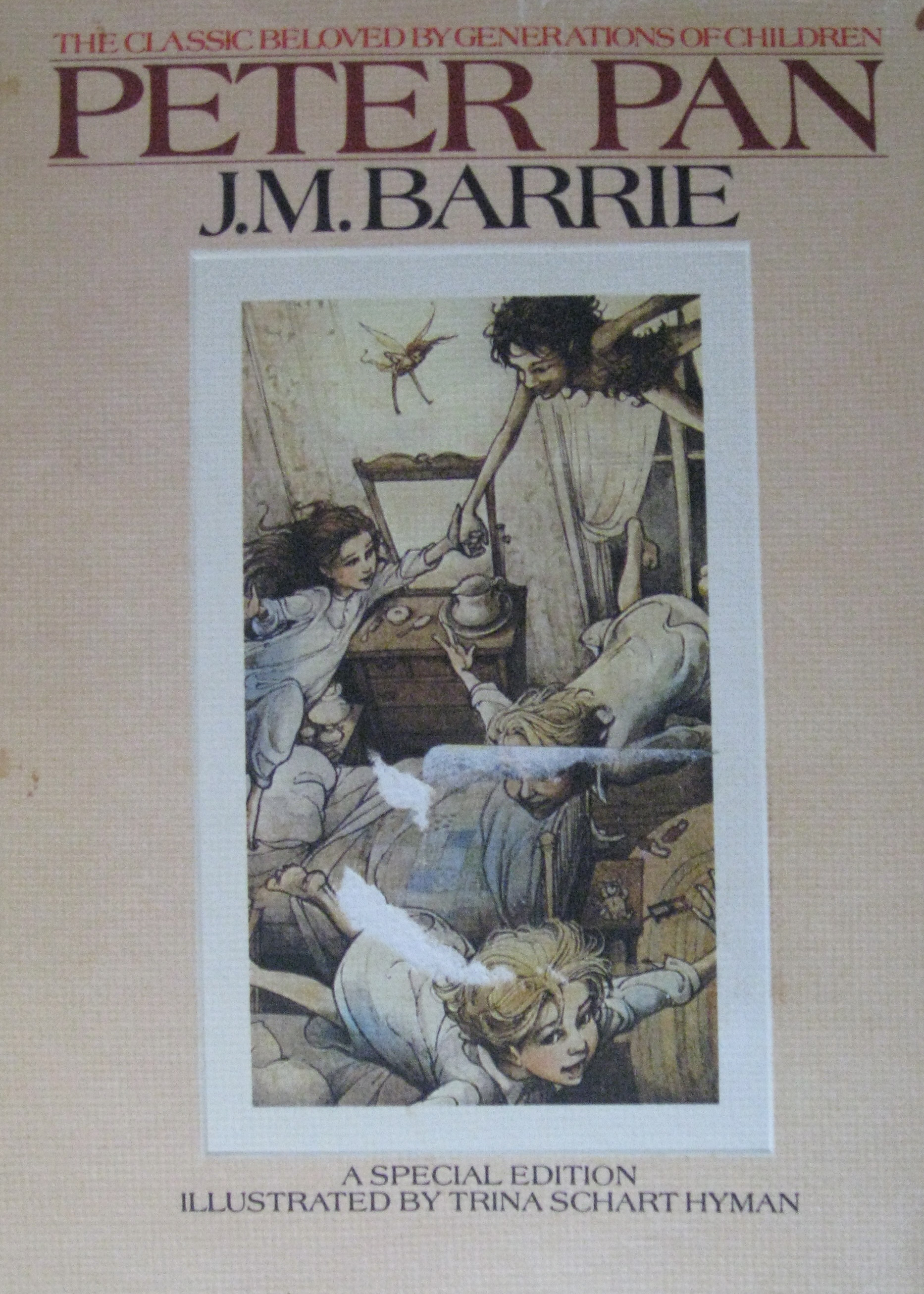
Barrie was born in May. I needed a quickie read for the end of the month. Choosing Peter Pan was a no-brainer. The version I chose to read was an illustrated deluxe addition. Full of both color and black and white illustrations: “Special edition illustrated by Trina Schart Hyman.” Really.

Because Peter Pan is such a well loved, well (over?) produced story, everyone knows the basic plot: three kids unhappy with the way their father has treated the family dog run away with an orphan boy to his Neverland (not to be confused with Michael’s Never Land Ranch). Peter and his Lost Boys are looking for a mother and they think they have such a figure in Wendy, one of the Darling children. It’s a magical adventure full of danger in the form of pirates, “redskins” and a ticking crocodile. Even the fairies and mermaids are not to be trusted.

Upon rereading Peter Pan I was surprised by how slow the story moved in certain sections. Because of the glossed-over, dumbed-down, glitzed-up theater/movie/storybook versions that have popped up over the years I had forgotten Barrie’s original 1911 language and long since deleted details. It was hard to picture reading this aloud to a young child. Peter Pan seemed slightly evil (being described as cunning and sly), Tink seemed downright dirty as she responded to her own jealousy over Wendy (gleefully leading Wendy to her death). True to fairy tale form, it does have a happy ending. Sort of.

One of my favorite images from the book that I’ve never forgotten is how Peter describes fairies as being the shattered pieces of a baby’s first laugh, “You see, Wendy, when the first baby laughed for the first time, its laugh broke into a thousand pieces. and they all went skipping about, and that was the beginning of the fairies” (p 29).

BookLust Twist: From More Book Lust in the chapter “Fantasy for Young and Old (p 83). 

Ground Beneath Her Feet

IMG_1374
Rushdie, Salman. The Ground Beneath Her Feet. New York: Henry Holt & Co., 1999.

May was deemed National Music Month by someone out there so, in honor of that tidbit I chose The Ground Beneath Her Feet as my “music book.” This was my first time reading Salman Rushdie & I have to confess, if all his other books are so lengthy and detail driven, I am going to have a hard time getting through them. This one was a whopping 575 pages long and and and! I knew the ending in the first chapter!

The Ground Beneath Her Feet is an epic rock and roll love story. Spanning several lifetimes Rushdie tells the love story of Ormus and Vina, two musicians from Bombay. Their story is like a gigantic flood, catching up and describing in detail: cultures, mythologies, histories, industries (agriculture (goats!), music and beyond), the landscapes of India, England and America, their societies, religions, ancestries of families, personalities, births, deaths, emotions, tragedies, triumphs, anything and everything from  the mid 1950s until the early 1990s.  This is a sweeping story that cannot be pigeon-holed into a romance, mystery, or comedy. It is all these things and thensome. Suicides and secrets, miscarriages and murders, wealth and poverty, sane and strange, greedy and generous, brothers and sisters, twins and torture, and of course, sex, drugs and rock and roll.

My favorite quotes circled and scrutinized love:
“In love one advances by retreating” (p 15).
“when it comes to love there’s no telling what people will convince themselves of” (p 30).
“But as the years passed we became each other’s bad habit” (215).

And one quote about my fave, the drums: “It is as if the drums have been yearning to speak to him, and he to them. Finally, he thinks: at long last, here are friends” (p 287).

BookLust Twist: From Book Lust in the chapter “Music and Musicians” (p 164).


Home Girl

Matloff, Judith. Home Girl: Building a Dream House on a Lawless Block. New York: Random House, 2008.

I could not put this book down. From start to finish it had me looking to answer that What Happened Next? question.
Matloff trades in one adventurous life (as a foreign correspondent) for another (home owner and wife in New York City). The exchange seems benign until the reader (and Matloff herself) realizes the Victorian she is buying is decrepit; in need of repair in every possible way, the new neighborhood is a one of the biggest drug zones in the country, and on a daily basis she must protect her property from the addicts who have called it home. If that wasn’t enough, Matloffmust walk a fine line of graceful respect and distance with the dealers on the street while becoming a mother, a crime fighter and witness to the tragedies of September 11th. Throughout it all, Matloff remains humbled and humorous.

Other observations: The picture on the inside cover indicates the title would have been Home Girl: Building a Dream Home in a Drug Zone. Not sure what I think about that.
I hope they keep the author’s note. Matloff’s sentiment about wishing the events weren’t true really intrigued me…really made me want to read the book.
Of course, there were quotes I absolutely loved, but I’ll keep them to myself until the book is published.