Nothing Right

Nelson, Antonya. Nothing Right: short stories. New York: Bloomsbury, 2009.

Antonya Nelson’s humor comes at you in a slow and subtle way, almost like a Mona Lisa sly smirk. The entire collection of short stories is what a peepshow is to an adolescent boy; the reader is allowed in the living rooms and lives of the characters for only so long before the curtain is dropped and the scene goes dark. Nothing Right leaves you wanting more and always asking, “what happened next?” The perfect hook for a sequel. The one drawback to leaving so much to the imagination? The characters didn’t stay long enough for me to truly garner an interest in them personally. I wanted to know what happened next in terms of plot but not character. All of the stories circle around family dynamics; the good, the bad and most certainly, the ugly.

  • “Nothing Right” (title story) starts tongue-in-cheek although the reader is yet to see the irony. Hannah stares at brochures about taking care of babies while her own baby, 15 year old trouble-maker Leo, sees the district attorney  about a bomb threat he made at school. Hannah’s troubles only deepen when Leo goes on to father a child…
  • “Party of One” is a rather bizarre story about a woman trying to convince a married man to end his affair…with her sister.
  • “Obo” bothered me the most. I didn’t understand Abby at all. A pathological liar, she convinces her professor to take her to his wife’s family home for Christmas; all because she has fallen in love with the professor’s wife.
  • “Falsetto” – Michelle tries to cope with her parents’s devastating car accident while caring for her much younger brother and simultaneously re-evaluating her perfect relationship with her boyfriend.
  • “Kansas” is about a family’s drama when 17 year-old niece Kay-Kay disappears with her three year-old cousin.
  • “Biodegradable” is about a married woman who has an affair with a scientist.
  • “DWI” is about a married woman who loses her lover in a drunk-driving accident.
  • “Shauntrelle” is about a married woman who admits to an affair thinking her lover will be happy with taking her in. She is wrong and loses both men.
  • “Or Else” is about a man who misses the life he had with his childhood friend’s family so much that he pretends he is still part of their lives.
  • “We and They” is about a family in competition with their neighbors until they adopt a child who sides with the enemy.
  • People People” is about two sisters who couldn’t be any more different from one another.

July ’09 Was…

July ’09 was yesterday, but it was also a really fun month (despite the pool letting go). First there was meeting a friend for dinner and asking her to come work for me! Then there was Rebecca Correia’s Iron Horse show. Of course I rallied the troups (all 12 of us!) and we had a great time. I really need to blog about the three-way Kisa had with the girls and who can forget the Wicked Wally?
How could I forget Boston? The trip into the city was amazing because the company couldn’t have been more perfect. They caught the mandarin fish! I have a few pictures from the day of my way, but I’m dying to see theirs!
July was also the return to running. I am proud to say I logged 35.21 miles in July.

  • The Skull Mantra by Eliott Pattison ~ this one stayed with me for awhile. I think it should be a movie.
  • The Stillmeadow Raod by Gladys Taber ~ cute.
  • Close Range: Wyoming Stories by Annie Proulx ~ ugly.
  • The Enemy by Lee Child ~ fascinating. Can’t wait to read the others!
  • Morningside Heights by cheryl Mendelson ~ middle class society in Manhattan.
  • The Light That Failed by Rudyard Kipling ~ a little tough to get into at first.
  • The Scarlet Letter by Nathaniel Hawthorne ~ back to a classic!

For the fun of it:

  • Up the Down Staircase by Bel Kaufman

I was supposed to read a couple of Early Review books but only one arrived in July. I will have to review it in August (I’m reading it now).

Close Range

Proulx, Annie. Close Range: Wyoming Stories. New York: Scribner, 1999.

I am fascinated by Wyoming. Have been ever since I was a teenager. I think it started when a boyfriend of mine enthralled me with stories of Coffin Lake. It sounded so beautiful and wild and so far away. Close Range is a collection of short stories that take place in Wyoming. Here is a list of the short stories:

  • “The Half Skinned Steer” ~ a creepy story about an over-eighty year old man who travels from New England to Wyoming by car for his brother’s funeral. It’s an odd story because he and his brother weren’t close. Favorite line, “He wanted caffeine. The roots of his mind felt withered and punky” (p 29) and “He traveled against curdled sky” (p 34).
  • “The Mud Below” ~ a desperate tale about a man obsessed with bull riding because it’s all he knows how to do.
  • “Job History” ~ Literally, a fast-forward version of the job history of Lee Leland.
  • “The Blood Bay” ~ okay, I admit it. I don’t know how to describe this story. Just read it for yourself!
  • “People in Hell Just Want a Drink of Water”
  • “The Bunchgrass Edge of the World” ~ Girl talks to a tractor.
  • “Pair a Spurs” ~ favorite line, “I get the rough end a the pineapple every day” (p 153).
  • “A Lonely Coast”
  • “The Governors of Wyoming”
  • “55 Miles to the Gas Pump”
  • “Brokeback Mountain” ~ I think everyone knows this story, thanks to the movie.

Confessional: I read Close Range at the same time as Stillmeadow Road by Gladys Taber. Bad idea. Not because one made the other worse. It was just that they were too completely different books and the contrast made it difficult for me to concentrate.

Close Range: Wyoming Stories sets a very harsh, violent, sad landscape for its characters. Poverty and a sense of futility is in every story. Every situation is a lesson in survival and dealing with the crappy hand you have been dealt. Words like stark and bleak and depressed come to mind. The characters are born into a way of life that has barely any opportunity for change. There is no easy means of escape. The brutality of the landscape is matched only by the grit of its inhabitants.

BookLust Twist: From Book Lust in the chapter called, “Companion Reads” (p 64).

Dubliners

Joyce, James. Dubliners. New York: Signet, 1991.

When I was in high school I fell in love with James Joyce’s style of writing. We share the same birthday. The Dead, a short story from Dubliners was my all time favorite. Gabriel became my favorite name; a long lost child.

Dubliners is comprised of 15 short  and simple stories all centered around the people of Dublin. To sum up the collection it is a portrait of a city as seen from the eyes of the people living there. The very first story, The Sisters, is nothing more than a family’s reaction to a priest’s death. While the characters are not connected, their stories are. Life and death, love and loss, youth and aging, poverty and wealth. Joyce does a remarkable job capturing the spirit of the Irish while revealing universal truths about mankind as a whole. It is as if we, as readers, get to peek into the character’s lives and are witness to moments of our own circumstances.

What I find so remarkable about Dubliners is that Joyce originally had great trouble getting it published. And even after he finally did it didn’t sell that well.

BookLust Twist: From Book Lust in the chapter “Irish Fiction” (p 125). Where else? Edited to add: I’ll tell you where else…Book Lust To Go in the chapter called “Ireland: Beyond Joyce, Behan, Beckett, and Synge” (p 110). I guess you could say Dubliners shouldn’t be included in this chapter because it’s supposed to be about “beyond Joyce.” Something to think about.

Cask of Amontillado

Poe, Edgar Allan. The Cask of Amontillado. Mahwah: Troll Publications, 1982.

Okay, okay. I admit it. The version I read of Edgar Allan Poe’s Cask of Amontillado was from my library’s Education Curriculum Library – a kids version. Only 32 pages long and brightly illustrated, it was a pleasure to read… in about five minutes. But, that’s not to say I haven’t read it before in it’s original text. And…I reread it online again thanks to the Gutenberg project.

The Cask of Amontillado is a psychological, creepy thriller. Perfect for October. Montressor has had his ego wounded badly by Fortunato. Looking for revenge Montressor waits until Fortunato is well in the drink and can be lured away to his death. The entire story is a study in human failings.
Montressor is able to convince Fortunato to come with him because Fortunato cannot bear the idea of another man playing the expert in identifying Montressor’s Amontillado wine. Montressor uses this jealousy to spur Fortunato deeper into the catacombs. At the same time Montressor showers Fortunato with concerns for his health in an effort to steer Fortunato away from suspicion. For Fortunato cannot suspect a trap if he is the one insistent on continuing deeper into Montressor’s underground chambers.
The reader never does find out what insults Montressor has suffered at the hands of Fortunato. The wrong doing is certainly not as important as the revenge.

Favorite scene: Fortunato questions Montressor’s membership as a brother, a mason. Montressor unveils his trowel as a sign but Fortunato never questions why he would have such a thing with him at that moment.

BookLust Twist: From More Book Lust in the chapter, “Horror for Sissies” (p 119).

Friend of My Youth

Munro, Alice. Friend of My Youth. New York: Alfred A. Knopf, 1990.

In the very first chapter of Book Lust Nancy Pearl talks about the Alices. Alice Adams, Alice Hoffman, Alice Munro, Alice McDermott…to name a few. I recognized all, and read most of the names except one: Alice Munro. The stranger Alice of the group. Now, two years after starting the project I am finally reading an Alice Munro book.

Friend of My Youth is a collection of short stories all based on the lives of women.
“Friend of My Youth” is the opening story. Imagine hearing a story from your mother, something that happened long before you were born, but has stayed in your mother’s mind all this time and important enough to be told to you when you were old enough. But, and this is the catch, you don’t know how it ends, even after your mother’s death. You simply don’t know the end. And so begins Friend of My Youth. The connection through all of the stories are women. They have lead roles emotionally as well as physically.

The best lines: “Her hair was freshly done to blind the eye with brassy reflections, and her face looked as if it would come off on a man’s jacket, should she lay it against his shoulder in the dancing” (Friend of My Youth, p 18).
“‘Watch out for him,’ Barbara told the other clerks. ‘He’s a jerk, but he knows how to stick things to his fingers'” (Oranges and Apples, p 107).
There were other charming details like the winter and summer kitchens in “Friend of My Youth” & the watching for satellites in “Oranges and Apples.”

BookLust Twist: From Book Lust in the chapter “A…My Name is Alice” (p 1).

Age of Grief

Smiley, Jane. The Age of Grief. New York: Fawcett Columbine, 1987.

A collection of short stories. Instead of summarizing them I have decided to quote my favorite lines instead because there was one from every story.

  • Pleasure of her company~ “I felt like your child or your sister or something”    (p 25).
  • Lily~ “Love was like an activity, you had to put in the hours” (p 33).
  • Jeffrey, Believe Me~ “Who can tell the lifelong effect of a cacophonous conception” (p 60), and “you would indeed be spending the night but in a near coma” (p 64).
  • Long Distance~ “Can a melancholy sound have a quality of desperation?” (p 71)
  • Dynamite~ “When they would ask me, I was fine, too, but I had the excuse of making bombs, something, I told myself, they didn’t want to know (p 96).
  • And finally, the novella, The Age of Grief~ I couldn’t find one or two quotesI liked best -too many to mention so I won’t mention at all; and I can’t tell you what I think of this final story. A dentist and his wife (also a dentist) go through the ups and downs of marriage & parenting. It’s haunting because I can’t imagine this kind of grief.

BookLust Twist: From More Book Lust in the chapter “Big Ten Country: The Literary Midwest (Iowa)” (p 26).

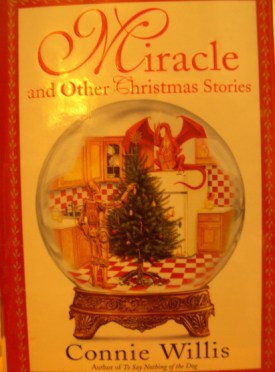
Miracle

Willis, Connie. Miracle and Other Christmas Stories. New York: Bantam, 2000.

A collection of short stories centered around Christmas.
image0001.jpg

  • Miracle ~ Lauren reminds me of me. She’s well-meaning yet corner cutting when it comes to Christmas. Her cards go out on time and she buys gifts for everyone in the office yet something is missing. Enter Spirit of Christmas Present, a environmentally exuberant specter sent to show Lauren the real meaning of Christmas.
  • Inn ~This is an odd little story about a woman who, while in choir practice for her church pageant, discovers a homeless couple who turn out to be Joseph and Mary. That Joseph and Mary, lost on their way to Bethlehem.
  • In Coppelius’s Toyshop ~ This is one of my favorites. It’s so reminiscent of Will from About a Boy lost in a crazy, confusing, chaotic toystore. Throughout the whole thing I could imagine rows and rows and floors and floors of toys, games, puzzles, colors, lights, noises, and the sounds of children everywhere.
  • Pony~ Moral of the story: it is never too late to get the ultimate present of your dreams…even if you no longer want it.
  • Adaptation ~ An interesting twist on A Christmas Carol. A divorced father wants nothing more than to give his daughter the ultimate Christmas but work and his exwife have other plans.
  • Cat’s Paw ~ A famous detective has been sent to solve a mystery on Christmas Eve. A weird tale involving monkeys and murder. “We are all capable of murder. It’s in our genes” (p 208).
  • Newsletter ~ Has the world been taking over by a parasite that causes goodness and peace of earth? How can we take humanity that’s just a little more…well…human? Turns out, we can’t.
  • Epiphany ~ Another twist on a classic tale. Mel is convinced he has had an epiphany about the Second Coming. He gets a friend and a stranger involved in his travels and suddenly they are the three wise “men.” It’s funny.
  • A Final Word~
  • BookLust Twist: From Book Lust  in the chapter “Connie Willis: Too Good To Miss” (p 248).

    After the Plague

    After the plagueBoyle, T. Coraghessan. After the Plague and Other Stories. New York: Viking, 2001.

    After finishing A Diary from Dixie, Band Land, and The Crossley Baby I still had time for a couple more “November” reads. The topics already covered for November were: the month the civil war ended, the month Montana became a state, national train month, and national adoption month. I chose After the Plague because I hadn’t recognized National Writers Month yet (and if there is time I’ll also recognize November as the month World War I ended and read Storm in Flanders). The only thing I won’t get around to is honoring Winston Churchill’s birthday (born in November).

    So, onto After the Plague. This is a collection of sixteen short stories. Pearl calls them “Boyle’s best.” They hang open, unfinished and unresolved like a to-be-continued drama on television. Each story is like being dropped into the middle of a movie, watching for a scene or two, and then being ushered away before the conclusion. If you like to hang in the balance this collection of short stories is for you. Even stories within stories are left unfinished. Boyle shows off diversity in every story. Some will shock you, some will make you remember something from your own life, but all of them will be a pleasure to read.
    Some favorite lines: “I started smoking two or three nights a week, then it was five or six nights a week, then it was everyday, all day, and why not?” (p 48), and “I just watched her, like some sort of tutelary spirit, watched her till she turned over and I could see the dreams invade her eyelids” (p 164).

    BookLust Twist: From Book Lust in the chapter called “Growing Writers” (p 107) and “Short Stories” (p 219). I love how Pearl describes Boyle’s work, “…nervy and disconcerting, and often very funny, leaving you uncomfortable with yourself and the world” (p 219). So true!

    Absent Friends

    Absent FriendsBusch, Frederick. Absent Friends: Stories. New York: Alfred A. Knopf, 1989.

    “From the New World”
    Norman is a man returning to his childhood home after his father’s passing to divy up belongings with his sister, his last surviving family member. I found myself yawning through this short story as it’s a well-known plot. Son is disowned for marrying outside his color (although they blame it on something else). His father leaves him $2,000 while his sister, Anna, gets everything else. Norman feels disconnected from Anna. The clever parts: Norman is a film producer so the story is told in script language, from Norman’s p.o.v. One particular scene is played out like a poker game, with conversation acting as the card values – bluffing and backstabbing. My favorite line: from page 61, Tess (Norman’s wife) is talking about love, “that shows you…how chewed up and spat out and stepped on on the sidewalk that word can be.” 

    “Ralph the Duck”
    You never learn his name. He’s some security / maintenance guy at a college taking classes on the side. He calls himself “the world’s oldest college student” even though he knows he’s not. When he gets a ‘D’ on an assignment (called Ralph the Duck) he lets the disappointment leak out.

    “Comrades”
    I pictured a tightrope walker when reading this story. The walker carries a pole called “Relationship” and when he waivers to the right he is feeling loving towards his wife. When he teeters to the left, he has animosity. The couple decides to divorce as amicably as possible but the tension and anger is always just below the surface.

    “Orbits”
    A commentary on getting old. On parenting. On life slipping away, unstoppable. My favorite line, “Her mother limped into the house and they sat in the memory of her tension” (p 100).

    “Greetings From a Far-Flung Place”
    I could relate to this story. She is a singer in a second rate band. She travels around with a group of men and no one in her family can understand her life. Her sister is married, has a kid, lives the suburban life, and is lonely. Mom is widowed and can understand sis better than singer.

    “Naked”
    Seen through the eyes of a 13 year old boy. He witnesses adult relationships and experiences changing loyalties. My favorite line, “And I still don’t know if he meant wait for seconds or for years” (p 125).

    “In Foreign Tongues”
    A group of people in therapy talk their way through their problems outside of sessions. Lonely in the middle of Manhattan.

    “Gravity”
    The gravity of growing old, getting older. The gravity of weight, of life. The gravity of death. Seriousness and weight.

    “Dog Song”
    What’s that Harrison Ford movie where he’s a lawyer, gets shot, and has to relearn his life (only to discover he’d been leading the double life of infidelity)? “Dog Song” is like that. Richard is a judge who gets into a horrible car accident (on purpose?). As he slowly remembers the accident, details start to surface. He was in the car with his mistress…

    “One More Wave of Fear”
    Family life in Brooklyn. One kid’s memory of growing up – from catching squirrels in the attic to going on nature walks with the fam. My favorite line sums up that age, “I didn’t want to be mistaken for someone who cared about birds” (p 201).

    “North”
    I could mistake “North” for so many things. Kelly divorces her husband because he won’t look North of her female features, She wants to head North – two hours to the Adirondaks – but she doesn’t. “North” is the story of a woman who needs an internal compass.

    “Reruns”
    “Reruns” was tricky. A doctor’s estranged wife is kidnapped by terrorists in the Middle East. The doctor could care less if she is released but for the sake of his children he plays the part of concerned father. In the end the reader is left wondering how much does he not care?

    “Name the Name”
    This was actually one of my favorite stories. Told from a traveling teacher’s point of view, he travels to children who can’t be in school for whatever reason. A 12 year old is 7 months pregnant, a girl tries to commit suicide and is on a ventilator, his own son is in jail for nearly two weeks. It’s about commitment and responsibility – owing up to the name.

    “To the Hoop”
    After his wife commits suicide a father and son struggle to get back on track. Using basketball as for “getting back into the game” both literally and figuratively, both father and son learn to try again. I think this passage sums it up,”He was on the stairs, and something like “good night” trailed his slow and heavy-footed climb. So I was alone, with ham and good intentions, and the usual fears that ranged from drugs to teenage schizophrenia. Jackie had died alone, and in silence. She had left us no word” (p 267).

    BookLust Twist: From Book Lust and the chapter “Frederick Busch: Too Good To Miss” (p 48). This is the second collection of short stories I have read from Busch so far.

    Child of Darkness

    Child of DarknessFurui, Yoshikicki. Child of Darkness; Yoko and Other Stories. Ann Arbor: University of Michigan, 1997.

    I’ll be the first to admit it. In the beginning pages I wasn’t connecting to this book at all. The first story, “Yoko”,  opens with a nameless, faceless, ageless man hurrying down a mountain. He comes across a women sitting on a rock in a ravine. She’s stuck, not by a force of nature, but a force of her own mind. She can’t move from her perch and needs him to help her get down. Later she blames the incident on acrophobia. What’s interesting is this is the one place in the entire story where the same scene is described from both her and his point of view. Later her issues are only described as an “illness” and the word acrophobia never resurfaces. It is suspected that the illness is shrouded in vagrity because the Japanese view mental illness as a taboo subject. Yoko is a strange woman. Sane one minute, paralyzed by her illness the next. The rest of the story is how the nameless, faceless (now we know he is young) man copes with a relationship with Yoko. Half accepting her mental state as is, half wanting to “cure” her.

    The next story also deals with mental illness but from the perspective of someone who is dying of cancer (also a taboo subject in Japan). I am more sympathetic towards the cancer victim. There is a sense of insanity when you have been told you have the disease. I can only imagine what depths your psyche would sink to when you are told it’s terminal.

    The third and final story is also about sinking into insanity. This time a
    These stories, translated by Donna George Storey, also includes her critiques. It’s interesting to rewalk the stories with an analytical map. It’s like seeing a city for the second time after you learn it’s history. Everything looks different.

    BookLust Twist: Under the heading “Japan Fiction” Nancy Pearl calls Child of Darkness “dark.” Yup (p. 32).

    Collected Fictions

    Borges, Jorge Luis. Collected Fictions. Trans. by Andrew Hurley. New York: Penguin, 1998.Borges

    I think anytime I read too many short stories in a row I tend to want each story to connect to the last. Like a string of pearls, cars of a train. It’s the wrong way to read them, I admit it. The cure for what ails me is to read slowly, digesting each story as if it were a single meal, designed to be eaten without accompaniment. As with any piece of written work, I am struck by phrases. Here is one of my favorites, “…said goodbye to myself in the mirror…” (p. 121). This stuck me not because it is am overly thought provoking statement(it is not), but rather because of it’s comment on society. We stop to stare at our image in the mirror (however critically), but how often do we say anything? I know me, myself & I. We just stare.

    Other favorite parts include a short, short paragraph on toenails on p.296 (I thought of my husband for silly reasons) and a story called, ‘Captive’. ‘Captive’ is the story of a young boy who disappeared from home. After many years he is found and returned to his family. While happy to be home he “could not live a life that was hemmed about by walls and one day he went off in search of his wilderness” (p. 300). This all takes place in a handful of lines. Recently I read an article about a Cambodian woman found after 19 years in the wilds. She is having a hard time adjusting to society. Is it any wonder? I love it when fiction comes before reality.

    All in all, I enjoyed Borges’s collection. The fact that he is a premier Latin American writer sweetened the deal because I was treated to cultures, ways of thinking, societies beyond these 50 states. In addition, Borges creates stories around Shakespeare, the Odyssey, and Quixote. A real pleasure to digest.

    Booklust Twist: Mentioned in Book Lust in a list of Latin American authors (p.145)

    Breathing Trouble

    BuschBusch, Frederick. Breathing Trouble, and other stories. London: Calder and Boyars. 1973.

    I know Frederick Busch is on Nancy Pearl’s list of “Too Good To Miss” authors (Book Lust p.49). I try not to let that influence me as I try to read through his short stories. I have to stop myself from thinking, “you really should enjoy this stuff more than you do.” I can’t help it. Stories seem connected, some more than others. I slip in and out of making connections, imaginary and real. Then there are lines like this, “I would say stop chewing my throat” (p. 97) and I’m not sure what to make of it. The stories are definitely abstract in a Sort It Out Yourself kind of way. I think of each story more like poetry. What exactly is the author trying to say in this heavily veiled sentence? Stop chewing my throat. Stop choking what I want to say? Hmmm…I’m not sure.

    Speaking of chewing, I guess I would say some stories go down easier than others.

    BookLust Twist: From Book Lust in the chapter called, “Frederick Busch: Too Good To Miss” (p 49).