
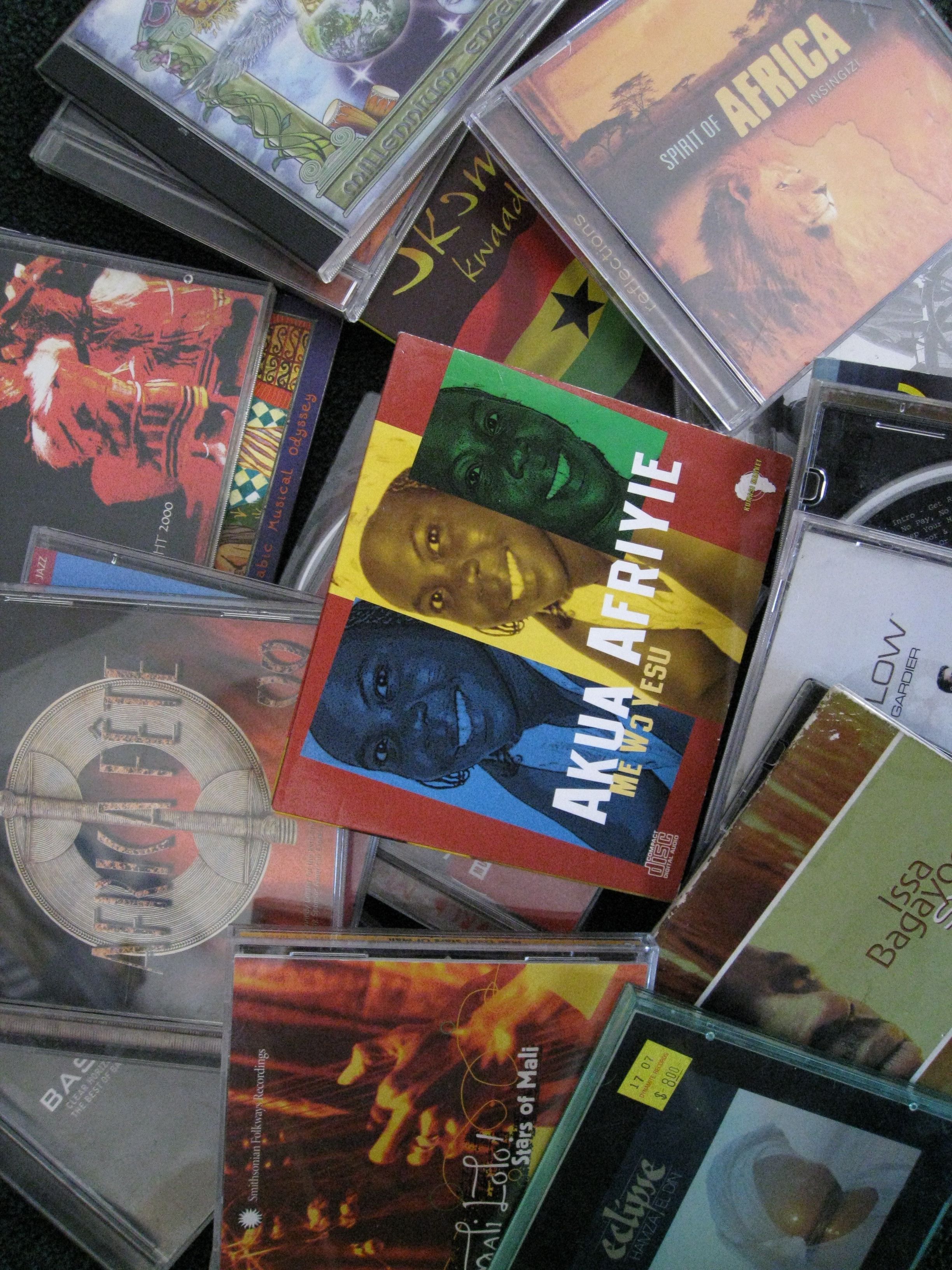
 I was going to ask everyone I knew to play the music game again. This time with a twist: give me African music for my next 5k. Darfur. The rules would be simple: stay away from South Africa, get as close to Sudan as possible, and mention nothing that would put me to sleep. No zzzzs please. I thought it would be a fun challenge & had bets going that not many people would suggest anything.
But, before I could post anything, before I could put my musical dare in print, a guy named George blew the challenge away. I mentioned my run, mentioned my music, mentioned my need and before I knew it had more music than I knew what to do with. Well, I have a plan, now. Between now and next Saturday I’ll listen to as much as I possibly can and make a mix from what moves me. George knows music.
Tag: africa
Bill Bryson’s African Diary
Bryson, Bill. Bill Bryson’s African Diary. New York, Broadway Books, 2002.
I added this to the December list when I read a review describing it as “short.” It’s much shorter than I thought – only 49 pages of “diary” and a few more pages of statistical information. So short that I was able to read it over a lunch break. I’m glad it was a quick read because I couldn’t put it down. I’m a sucker for charitable tactics, especially unique ones, and this book definitely qualifies. CARE International (a non-profit organization dedicated to fighting global poverty) funded Bill Bryson’s trip to Nairobi, Africa with the request that he write about his eight day adventure. Bryson is known for his travel literature, his humor, and his expressive way of describing life around him. He would certainly be able to describe the poverty, the landscape, and best of all, the people of Africa. Many reviewers called this book a charity puff-piece, a lengthy advertisement for the work of CARE, and were bitter about the $12 price tag. What they missed out on was the stunning photography, the wry humor and the painless way to do good (all royalties and profit from the sale of the book went to CARE International).
Speaking of humor, here are a few of my favorite lines: “…tireless commitment to mediocrity” (p 2), “you had to be really unlucky to be shot and stabbed” (p 4), “Kenyan Railways has something of a tradition of killing its passengers” (p 21) and, “Watamu was tranquil to the point of being comatose” (25). There are other funny moments: “flying toilets,” and flying for real, to name two.
For more information on CARE, International go here.
BookLust Twist: From More Book Lust and the chapter “Bill Bryson: Too Good to Miss” (p 36). This being my first introduction to Bryson I am looking forward to more.
Abyssinian Chronicles
Isegawa, Moses. Abyssinian Chronicles. New York: Alfred A Knopf, 2000.
This took me absolutely forever to read. In the beginning Athenian Murders seemed more interesting. No, I take that back. It seemed a faster read. Honesty is the best policy. Then, I started Autumn Across America. Juggling two “landscapes” as sweeping as Abyssinian and Autumn wasn’t easy. Both are elaborate, even panoramic, if you will. Very descriptive. But, enough excuses – back to Abyssinian Chronicles.
This is story of Mugezi. It is more than a coming-of-age chronicle. It is Mugezi’s life story from childhood to harsh adulthood in the span of twenty years and the necessary means it took to survive each and every day. In addition, it weaves in the landscape of Uganda, the politics of the 1970s, society, religion, violence, and the family traditions of African clan. It is panoramic and profound. Isegawa’s language is harsh, his subjects, brutal. For example, the children Mugezi looks after are caller “shitters.” A line that made me laugh outloud was Muzegi’s aunt’s warning to a woman who was letting herself go, “If she did not take care, Nakibuka thought, soon birds would be nesting in her hair, baby hippos snorting in her belly and hyenas rubbing their rumps in her armpits” (p 162). If you are anything like me, you read that sentence and said “whaaaat?” I read it twice, said “whaa?” and then laughed out loud. I have no idea what it means (especially the hyena part) but it was funny. Female cattiness. I can relate to that. But, probably the section I can relate to the most is a tie between politics and family. First, politics: “Local politics were also at work: you never bit the hand that fed you… Consequently, there was much turning of the other cheek and much patience in the hope that everything would turn out right in the end” (p 218). Words I should take to heart in my present situation. Now, family: “Grandpa’s old lawyerly dreams boiled inside me. I felt I had stepped onto holy ground” (p 341). I felt that way when I was training for the Leukemia Society…something about fighting the ghosts of cancer, cradled in my grandmother’s name…
BookLust Twist: From More Book Lust and the chapter “Africa: A Reader’s Itinerary” (p 3). While I called Isegawa’s novel panoramic and sweeping Pearl describes it as sprawling and ambitious. Either way it’s 462 pages long. I think you get the point.
Africa News Cookbook
Africa News Service, Inc. The African News Cookbook: African Cooking for Western Kitchens. New York: Penguin, 1986.
Another BookLust pick. There is something magical about this book. Maybe it’s from the introduction, “Cooking by the book is not the African way” (p.xiii). It’s romantic to learn the ingredients, forget the recipe and go with the heart; that’s what this book seems to be telling me.
On a serious side it’s crammed with interesting facts usually not associated with a cookbook. For starters there is a list of African nations and their capitals. Because this cookbook focuses on a geographical location there are maps. Because it focuses on a culture there are stories about African Women and food, and even how to eat with joy.
Probably my favorite aspect of this cookbook is the recognition of the origin of each recipe. From Malawi comes Masamba; from Algeria comes Dess b’l-besla. I think of Aubrey from Malawi who would write letters on onion paper and dream of traveling to Algeria.
BookLust Twist: From More Book Lust under the category of, “Africa: A Reader’s Itinerary” (p.2)
Things Fall Apart
Achebe, Chinua. Things Fall Apart. Portsmouth: Reed Publishing, Inc. 1992.
 I started The Plague (you all have read Albert Camus) before I got sick. Not a good thing while you’re puking as you can surely imagine. So, I’ve started Things Fall Apart, instead. It’s another Booklust choice (of course). My library has a pretty cool edition complete with a list of principal characters, a glossary of terms, a background history of culture, and suggestions for further reading – all before you even get into the story by Achebe. I’m only at the part where it’s announced that Ezeugo, the wife of Ogbuefi, is murdered. Page eight. More later.
12/7/06: Puzzlement: Okonkwo learns that when is father is called, “agbala” it’s not only another name for a woman, but it’s also a term for a man without a title, a purpose. A seemingly derogatory term for sure. But, wait! The Oracle was also called Agbala and people came from all over to consult it. Maybe being called, “agbala” isn’t so bad after all.
Booklust Twist: this is categorized as “African Literature in English” and as a companion read with Heart of Darkness by Joseph Conrad, The Poisonwood Bible by Barbara Kingsolver, and King Leopold’s Ghost by Adam Hoschild (Book Lust, p.15 & 63).

