Tiepolo’s Hound

Walcott, Derek. Tiepolo’s Hound. New York: Farrar, Straus and Giroux, 2000.

At first glance Tiepolo’s Hound is pretty deceiving. It looks like a simple poem with gorgeous pictures. Upon closer inspection Tiepolo’s Hound becomes more complicated. One narrative becomes two. Aside from Camille Pissaro’s desire to leave St. Thomas to follow his artistic dreams, the author describes his own journey to rediscover the details of a venetian painting. The dual narration tangles the storyline and leads to an anti-climatic ending to an otherwise fascinating journey. The vivid imagery of the sights, sounds and smells of St. Thomas make the poem beautiful. The colorful descriptions of the surrounding landscapes are what successfully capture the reader’s attention and hold it until the end.

Favorite descriptor: “thunderhead cumuli grumbling with rain” (p 10)
Favorite line: “I felt my heart halt” (p 7).

Favorite aspect of the book: so many references to the sea. For example ~ blue gusting harbor, wide water, cobalt bay, quiet seas, wooden waves, furrowing whitecaps, soundless spray, sea-gnarled islets, etc, etc. Simply beautiful.

BookLust Twist: From More Book Lust in the chapter called, The Contradictory Caribbean: Paradise and Pain” (p 55).

Choice Cuts

Kurlansky, Mark. Choice Cuts: a Savory Selection of Food Writing from Around the World and Throughout History. New York: Ballantine, 2002.

I like nothing better than a good cookbook. A close second to a good cookbook is reading books written by cooks. Mark Kurlansky does one better and combined the best of food writing from soup to nuts; covering techniques, ingredients and even ethnic origins of food. Then, there’s the introduction. How can you compete when the introduction is titled, “Better than Sex” (p 1)? I mean, come on! Out of the thirty chapters  five six really grabbed my attention. More than the introduction, you ask? Mais oui! How could I not be seduced with chapter titles such as these: “Rants” (p 115), Poultry, Fowl, and Other Ill-Fated Birds (p 210), “Loving Fat” (p 303), “The Dark Side of Chocolate” (p 330), “A Good Drink” (p 361) and, “Bugs” (p 380). See, aren’t you the least bit curious about that last one?

Everything about this book is based on one simple subject – food. Kurlansky takes that subject and explores everything having to do with it. From growing, hunting, buying, and preparing to smelling, eating, and savoring it. The art of cooking, the downfall of rotting, from killing to cultivating. From Cato to Chekhov, Kurlansky finds quotes, essays and passages from a multitude of well known individuals, some with lives centered around food like M.F.K. Fisher and Elizabeth David and some not like Virginia Woolf, Ernest Hemingway and E.M Forster. Whether focused on an ingredient like garlic or chocolate, or a technique like faking venison or baking bread, or a location like favorite restaurants or markets, Kurlansky covers it all. It’s historical and cutting edge. Technical and funny. Poetry and dissertation. Well worth the read.

Favorite passages: “A blonde seems humbly to beseech your heart while a brunette tends to ravish it” (p 39), “So don’t worry about me down here eating nothing and [makeing] an ass of myself. I have had strange eating habits since I was a boy (Ernest Hemingway)” (p 61) and, “cook-books have always intrigued and seduced me (Alice B. Toklas)” (p 182).

BookLust Twist: From Book Lust in the chapter, “Mark Kurlansky: Too Good To Miss” (p 146).

A side note: Before I knew what Choice Cuts was really about I assumed it had something to do with meat. After all, Kurlansky has written about solitary food items such as cod and salt, too. So, thinking this was a book about edible meats nothing disturbed me more than seeing an illustration for what I thought was a squirrel. I was close – it was a dormouse.

‘Sippi (with a spoiler of sorts)

Killens, John Oliver. ‘Sippi. New York: Trident Press, 1967.

In honor of Mississippi becoming a state in the month of December I put ‘Sippi on my list. What an incredibly expansive, volatile story! It follows the lives of two very different people growing up Wakefield County, Mississippi in the 1960s. Carrie Louise Wakefield was born into white money privilege about the same time as Charles Othello Chaney was born into black poverty servitude. “Chuck” and his family worked as servants for Carrie Louise’s extremely wealthy family and would forever be intertwined in each others lives. Over the ever growing turbulent years, events like the Vietnam war, the Civil Rights Movement and the death of Malcolm X stoked the fires of racial unrest. Despite Carrie and Chuck’s vastly different upbringings they both manage to go to college, see a world larger than little Wakefield County. Black and white becomes more and more complicated.        

Favorite lines:
“…seriously wondering how a little bouncing hunk of human essence could possibly emerge from this organized confusion” (p 4). If you couldn’t guess Killens is describing childbirth.
“She was time enough and overtime” (p 69). Here, he’s describing a beautiful woman.
“He had been daydreaming in the nighttime”  (p 129).
“Actually he had drunk the kind of whiskey that would not let you walk. It made you run. He was running drunk” (p 218).

A few complaints. It took a long time to get to the only place the story could end up. Some places were a little drawn out and repetitive. And, yes – I’m gonna blow it – the sex scenes between Carrie and Chuck are a little drawn out and more than a little ridiculous.

BookLust Twist: From More Book Lust in the chapter, “Southern Fried Fiction” (p 208).

Lincoln’s Dreams

Willis, Connie. Lincoln’s Dreams. Toronto: Bantam Books, 1987.

Connie Willis typically writes science fiction or fantasy and while Lincoln’s Dreams doesn’t take place in the year 2197 or on the planet Baktakazini, it is equally mind bending and thought provoking. Jeff Johnston is a historical researcher working for a Civil War novelist, Thomas Broun. Broun is obsessed with Abraham Lincoln’s dreams of foreshadowing before his death. Broun goes to great length to analyze them with Jeff’s help. Through his research, Jeff meets Annie, a beautiful Sleep Institute patient who has troubling dreams of her own. Annie has been having dreams not about Robert E. Lee, but AS Robert E. Lee. It’s as if her dreams really are those of Lee’s. Jeff takes it upon himself to not only satisfy the growing obsession Broun has with supporting facts about Lincoln’s dreams but, he also tries to cure Annie of her own Civil War nightmares while falling in love in the process.

Since the bulk of Willis’s storyline centers on Annie having dreams there are a lot of sleep scenes and subsequently the analysis of those dreams. It’s the analysis that I enjoyed the most. The details of the dreams gave life to the Civil War and its participants.

BookLust Twist: From Book Lust in the chapter “Connie Willis: Too Good to Miss” (p 246).

Note:  It is painfully obvious this is a half-assed “review” of sorts. This just goes to show me & myself how out of it we really have been these past few weeks. I have been finished with this book for awhile and never finished this properly. *sigh*

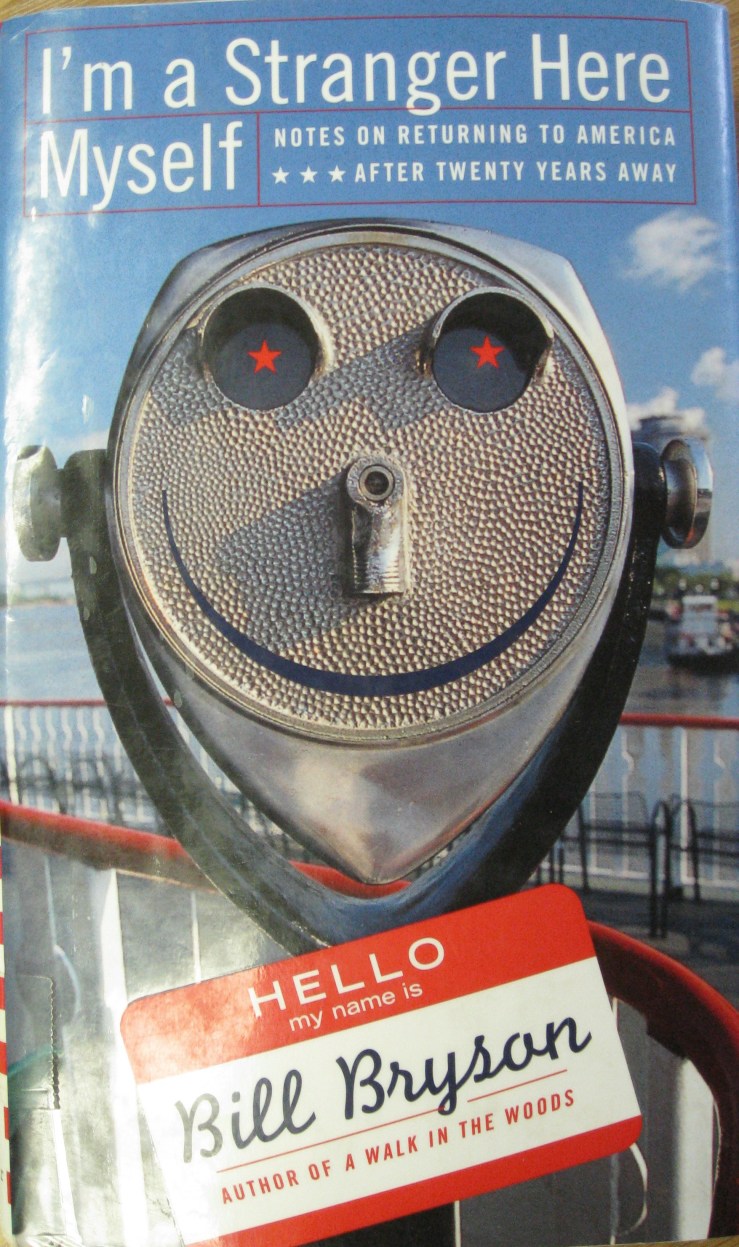
I’m a Stranger Here Myself

BrysonBryson, Bill. I’m a Stranger Here Myself: Notes on Returning to America After Twenty Years Away. New York: Broadway Books, 1999.

I was skeptical of this book. The premise is Bryson has been away from American soil for twenty years (living in England) and the book is supposedly his running commentary on how different everything has become. Right off the bat I wanted to ask, “What? They didn’t have ATM machines or public pay phones in England? Not even by the time Mr. Bryson left?” I have to admit, it never crossed my mind that England could be twenty years behind the U.S. in such things as technology and invention.
In actuality, Bryson’s book was, in a word, delightful. I thoroughly enjoyed his opening essay about the differences between English and American postal services. However, for the most part the comparisons ended there. It was more about how nonsensical America could be with it’s rules and regulations. It reminded me of Robert Fulghum with his humorous observations.

Favorite funnies:
“Going to a restaurant is generally a discouraging experience for me because I always manage somehow to antagonize the waitress” (p 13).
“It is all immensely complicated, but essentially it means that practically every team in baseball except the Chicago Cubs gets a chance to go to the World Series” (p 25).
“He converses as if he has heard that someday he will be billed  for it” (p 93). Sounds like my father!

BookLust Twist: From More Book Lustin the chapter, “Bill Bryson: Too Good to Miss” (p 36).

Anatomy of a Murder

img_43561Traver, Robert. Anatomy of a Murder. New York: St. Martin’s Press, 1958.

If you want to get technical about it this was my first book of December – considering the first two were read while it was still November. A technicality, I guess.

Anatomy of a Murder was written in the 1950s by Robert Traver. From the moment I started reading it I couldn’t put it down. 439 pages went by in a blur. I read before bed, when I first woke, on the drive into work, on my lunch break, waiting in line at the grocery store…It had me hooked from the very first sentence. It’s no wonder this novel became a movie. For starters, take the author – Robert Traver was the pen name for John D. Voelker who happened to be a lawyer and a judge in addition to being a fantastic writer. Secondly, Voelker used a real life murder than took place in the Upper Peninsula of Michigan. True stories are always fascinating.

So, here’s the story (now that I’ve set the stage, so to speak): Paul (Polly to his friends) Biegler is an ex-D.A. turned public defender set out to prove his client, Frederic Manion, murdered a bartender in a moment of insanity. Proving the insanity isn’t the only challenge of the case. Biegler must also prove Manion’s wife was raped by the bartender (and thus creating the moment of insanity) when all evidence surrounding Mrs. Manion’s attack is not admissible in her husband’s trial. The entire story is so well written you never want it to end.

Some of the many, many lines and phrases I found great:
“gently drunk” (p 13).
“Juries, in common with women drivers, are apt to do the damndest things” (p 39).
“I consider jealousy the most corrosive and destructive of all emotions and I long time ago made up my mind that I refused to be jealous of anyone or anything. Life is simply too goddam short” (p 73).

One last comment. I always thought that lawyers (of any kind) needed to show judges the utmost respect both in the courtroom and in chambers. Right? Well, someone needs to explain the scene on page 244 where Polly is in Judge Weaver’s chambers. Picture this, the Judge has just lit a pipe and Polly sits, “one leg over the arm of [his] chair.” I don’t even sit that way in my mother-in-law’s house!

BookLust Twist: From Book Lust in the chapter, “What a Trial That Was!” (p 243).

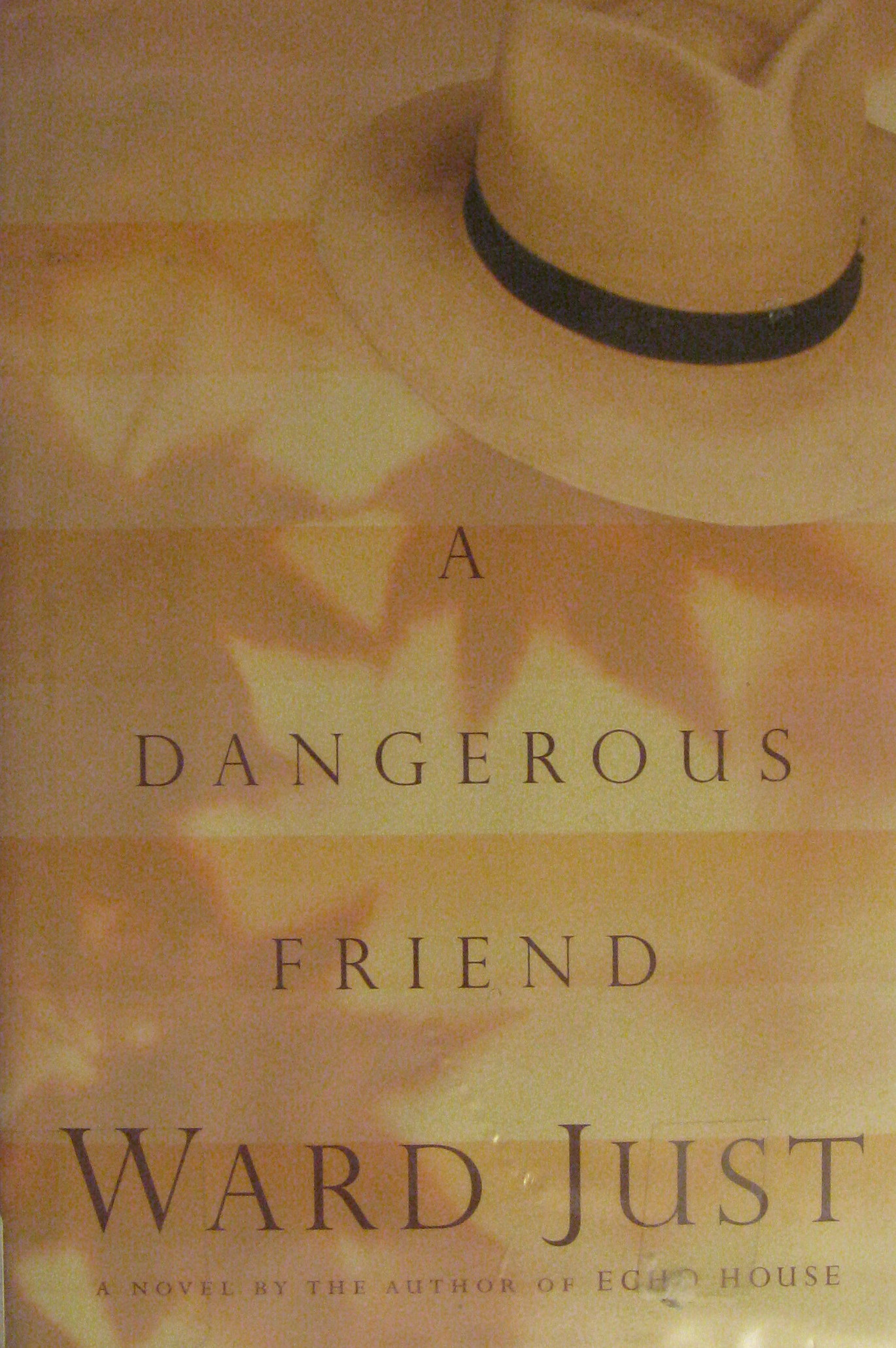
Dangerous Friend

Dangerous FriendJust, Ward. A Dangerous Friend. Boston: Houghton Mifflin, 1999.

This is the companion read to The Quiet American by Graham Greene. I have to say it was interesting to read one man’s book in honor of someone else. But, back to Ward Just. Just was born in December, hence the addition of A Dangerous Friend. If it isn’t clear, I read The Quiet American because it was so similar to A Dangerous Friend. It just made sense to read them together.

A Dangerous Friend takes the reader to Vietnam, 1965. Sydney Parade is a man bored with his Connecticut life. In search of something bigger than himself he leaves his wife and daughter for the jungles of Saigon. While his intention is to be part of a foreign-aid operation building bridges, administering agriculture education, and facilitating supply delivery, Sydney soon discovers war is war no matter which side you are on. The depths of conflict strike his moral heart and leave him struggling to survive any way that he can.

A couple lines that I liked:
“…we were imprisoned in our own language, tone deaf to possibility” (p 4)
“The answer to chaos is repetition” (p 73).

BookLust Twist: From Book Lust in two different chapters: “Companion Reads” (p 64), and “Ward Just: Too Good to Miss” (p 135). Also, mentioned in the introduction (p xi).

Quiet American

Greene, Graham. The Quiet American. New York: Viking Press, 1956.

This has come up twice for my December readings – once because of Ward Just’s birthday (don’t ask), and once because it is a companion read to Ward Just, again don’t ask. I’ll explain all that when I get to Ward Just’s book later this month week.

Like my friend who started decorating for Christmas, I started reading my December picks on 11/23/08. I couldn’t help myself. I had wanted to fit in Just So Stories by Rudyard Kipling but my library’s version was not the complete works. In addition it was missing the two crucial stories Nancy Pearl specifically pointed out. Rather than disrupt the flow of order I moved onto December…a week early!

This was a story of two battles. An English reporter is sent to cover a war-torn Saigon. While there he falls in love with Vietnamese woman. His love is challenged when an American from Boston falls in love with the same woman. There is a real war raging on the periphery, complete with bombings and mass murders, while at the center is a battle over a woman. The interesting twist to this story is how the story makes the reader feel towards the two men and how that changes over time.

Best lines: “I shut my eyes and she was again the same as she used to be: she was the hiss of steam, the clink of a cup; the was a certain hour of the night and the promise of rest” (p 5). That is such an achingly beautiful line!
“You cannot love without intuition” (p 13).
“The possession of a body tonight seemed a very small thing – perhaps that day I had seen too many bodies which belonged to no one, not even to themselves” (p 65-66).
“For a moment I had felt elation as on the instant of waking before one remembers” (p 205).

BookLust Twist: From Book Lust in two different places: in the chapter “Companion Reads” (p 64), and “Ward Just: Too Good To Miss” (p 135).

December is…

img_00281December is one of the longest months in my opinion. But, it is also one of the most festive, thanks in part to the 25th & 31st. December is also the return of the Hot Chocolate Run, the return of the awesomely awesome Rebecca Correia (to the Iron Horse) and for reading books it is:

  • Anatomy of Murder  by Robert Traver in honor of John Jay becoming the first Chief Justice in this month (I’ll explain at review time).
  • Quiet American by Graham Greene in honor of Ward Just’s birthday (I’ll explain that in a second).
  • Dangerous Friend by Ward Just in honor of Ward Just’s birthday. I had always been told to read Quiet American with Dangerous Friend so that’s what I’m doing.
  • Family Affair  by Rex Stout in honor of his birthday.

And if there is time…

  • I’m a Stranger Here Myself  by Bill Bryson in honor of his birthday.

So, I’m celebrating author birthdays more than real life birthdays. What’s up with that? Not really sure I know myself….

The Book Lover’s Cookbook


Wenger, Shaundra Kennedy and Janet Kay Jensen. The Book Lover’s Cookbook: Recipes Inspired by Celebrated Works of Literature, and the Passages That Feature Them. New York: Ballantine Books, 2003.

I grazed on this book a while ago. The hardcover (borrowed) version sat on my desk for a few days and every so often I would pick it up, skim the pages, eye the recipes, until it was time to send it back. I couldn’t get into it because I was truly afraid I would mark up a book that wasn’t mine. I have that habit with cookbooks – writing in them. So, I sent it back, barely digested.
Fast forward to last year. Book Lover’s Cookbook was on The List. I was thinking I could call it accomplished until I remembered how I didn’t devour it.
Skip to this Christmas. My sister and brother-in-law gave me the softcover version and suddenly, I’m not only devouring the book I’m dedicated to cooking every recipe, reading every book mentioned. This version is mine, mine, mine and I can write in it all I want.

What is so special about this book is that it includes a variety of books and are not all standard Oprah favorites. There are classics, stories for children, chick lit, murder mysteries, nonfiction, and even poetry. Same goes for the dishes – they aren’t all typical recipes. There is something for everyone.

BookLust Twist: From More Book Lust in the chapter “Dewey Deconstructed” (in the 600s, p72).

Fer-De-Lance


Stout, Rex. Fer-De-Lance. Pennsylvania: Franklin Library, 1934.When I saw this book arrive in the library van box for me I got very excited about the cover alone. It’s beautiful! I didn’t even know it was my requested book, just that it had a gorgeous cover. How’s that for judging a book by its cover? I have heard so much about Rex Stout and his Nero Wolfe mysteries but had never read one before now. I have to admit, I didn’t really care for the character of Mr. Wolfe. He seems to spend a lot of time bossing other people around while being very, very particular about his own activities. The story is actually told from the point of view of his assistant, Archie Goodwin, who seems to do all the legwork work solving mysteries since Wolfe never leaves home.

So, the plot to Fer-De-Lance is this: a man is found murdered. Clues in his room lead to the death of someone else. Ultimately, it’s the solving of the second death that leads to the truth of the first death. It’s a fun story. Here are some of my favorite quotes:
“I made some sort of conversation so O’Grady’s ears wouldn’t be disappointed” (p 39).
“Maybe your salary is the only rope that holds Saturday and Sunday together for you” (p 48).
“It is always wiser, where there is a choice, to trust inertia. It is the greatest force in the world” (p 190).
“A genius may discover the hidden secrets and display them, only a god could create new ones” (p 246).

BookLust Twist: From Book Lust and the chapter “Rex Stout: Too Good To Miss”

24 hours

Iles, Greg. 24 Hours. New York: G.P. Putnam’s Sons, 2000.

A kidnapping mystery set in Mississippi…sort of an odd read for the holiday season, but December is the month Mississippi became a state.
Here’s the storyline: Basically, this guy, Joe, has set up the perfect kidnapping scheme. He targets a doctor who has a spouse and child, learns all he can about the doctor’s family and then while the doc is at an annual convention he kidnaps his/her child. His cousin (a hulking man with the IQ of a chipmunk) holds the child in a remote location while his “wife” entertains the male parent and Joe entertains the female parent for 24 hours. They call each other every 30 minutes and if a call is missed Cousin Chipmunk kills the kid. In the AM one parent wires the ransom to the other parent so the kidnapper doesn’t have any connection to the withdrawal. The money is always an amount the doctor can afford and the kidnapping always works because the child is worth more than getting the money back or calling the police. The detail that makes the whole thing work are the every 30 minutes phone calls. Everything hinges on those calls and the convention – because the convention is the guarantee the doctor will be separated from the rest of the family for at least 24 hours.
Despite the brilliant plot I have two problems with detail. In the beginning both parents are told their family has been scrutinized and studied in great detail. The kidnappers claim to know everything about the family. If that is true then why did they not know their latest kidnapping victim was diabetic? If they knew everything how did they miss such a large piece of a child’s life? The second problem with detail is on page 164 – one of the kidnappers says “You have to chill, Will!” and is delighted by the rhyme of the doctor’s name, yet two pages later Iles writes, “Why don’t you at least face the truth about something, Will.” It was the first time she [the kidnapper] had used his Christian name” (p 166). No, actually it wasn’t. She told Will to chill two pages earlier. Ugh.
All in all, this moved fast and was a constant page turner. Every time I had to put it down I was at “the good part” and hated to stop reading. The end is a little over-the-top dramatic and there are loose ends, but well worth the read.

BookLust Twist: In More Book Lust in the “Southern Fried Fiction (Mississippi)” chapter (p 208).

Age of Grief

Smiley, Jane. The Age of Grief. New York: Fawcett Columbine, 1987.

A collection of short stories. Instead of summarizing them I have decided to quote my favorite lines instead because there was one from every story.

  • Pleasure of her company~ “I felt like your child or your sister or something”    (p 25).
  • Lily~ “Love was like an activity, you had to put in the hours” (p 33).
  • Jeffrey, Believe Me~ “Who can tell the lifelong effect of a cacophonous conception” (p 60), and “you would indeed be spending the night but in a near coma” (p 64).
  • Long Distance~ “Can a melancholy sound have a quality of desperation?” (p 71)
  • Dynamite~ “When they would ask me, I was fine, too, but I had the excuse of making bombs, something, I told myself, they didn’t want to know (p 96).
  • And finally, the novella, The Age of Grief~ I couldn’t find one or two quotesI liked best -too many to mention so I won’t mention at all; and I can’t tell you what I think of this final story. A dentist and his wife (also a dentist) go through the ups and downs of marriage & parenting. It’s haunting because I can’t imagine this kind of grief.

BookLust Twist: From More Book Lust in the chapter “Big Ten Country: The Literary Midwest (Iowa)” (p 26).

The Body is Water

Schumacher, Julie. The Body is Water. New York: SoHo, 1995.

I love it when reading fits the day. I don’t know how to describe it other than the perfect marriage between a book and time. It was snowing, sleeting, windy and freezing cold. Every so often a gust of wind would send pellets of freezing rain drumming against the windows, yet the Christmas tree glowed softly, the cat purred at my feet, a balsam candle burned bright, a fleece blanket was thrown over my lap, a cup of tea at my elbow and I was content. If I could ignore the wind, all was quiet, all was still; the perfect time to lose myself in The Body is Water.
I’m still reading December picks and The Body is Water celebrates the month New Jersey became a state, oddly enough. It’s also the story of single and pregnant Jane, and her return to her New Jersey shore childhood home. In one sitting I read 184 of the 262 pages.

“All my life I’ve never been certain of where I should be” (p 20).
“In a crisis, other families probably rush to hold the ailing person’s hand; our family rushes to the general vicinity of the crisis and putters around, hoping the patient will spontaneously recover on her own” (p 61).
“No matter where I lived, I never knew my way around; there was no ocean, no rushing noise of a heartbeat from the east” (p 230).
“I start to cry, remembering the days before my mother died, before Bee slept in another room. That was when we loved each other best and didn’t know it” (p 262).

I ended this book sobbing. I connected with Jane even though she was the younger sister (Bee was four years older); even though Jane lost a mother and I lost a father; even though she became a mother and I remain sans motherhood. I connected through the simple loss of a parent, the soothing sound of the ocean, and the complex closeness of sisters.

BookLust Twist: From More Book Lustin the chapter called “Jersey Guys and Gals” (p 129). This also could have been mentioned in chapter called “Maiden Voyages” (p 158) because this was Schmacher’s first novel.

Little Porcupine’s Christmas

Slate, Joseph. Little Porcupine’s Christmas. New York: Harper, 1982.

Cute. Cute. Cute! Felicia Bond illustrates this story and, for those of you who don’t know, Felicia Bond is the illustrator for another favorite of mine, If You Give a Mouse a Cookie. This isn’t about a mouse. This time it’s a porcupine who can’t be in the school play because of his sharp and pointy quills. It’s a typical story about how cruel “kids” can be towards an outsider, But, but, but, in the end Little Pocupine prevails and proves his worth. The adult in me hates stories like this because the other animals are never corrected when they say “you’re too — to participate. You don’t belong,” all because he is different. I worry (too much) that kids reading the story will learn that it’s okay to push someone outside the popular circle because that someone is different. I’ve been there and it isn’t fun. But, that’s the stoic, always serious adult talking. Take the book at face value and it’s a cute story about someone who is unique finding his niche and belonging after all.
Note: This story is also called How Little Porcupine Played Christmas.

BookLust Twist: From Book Lust in the chapter “Christmas Books for the Whole Family to Read” (p 56). Pearl calls Little Porcupine “heartwarming.”