Time Traveler’s Wife

Niffenegger, Audrey. The Time Traveler’s Wife. Orlando: Harcourt: 2003.

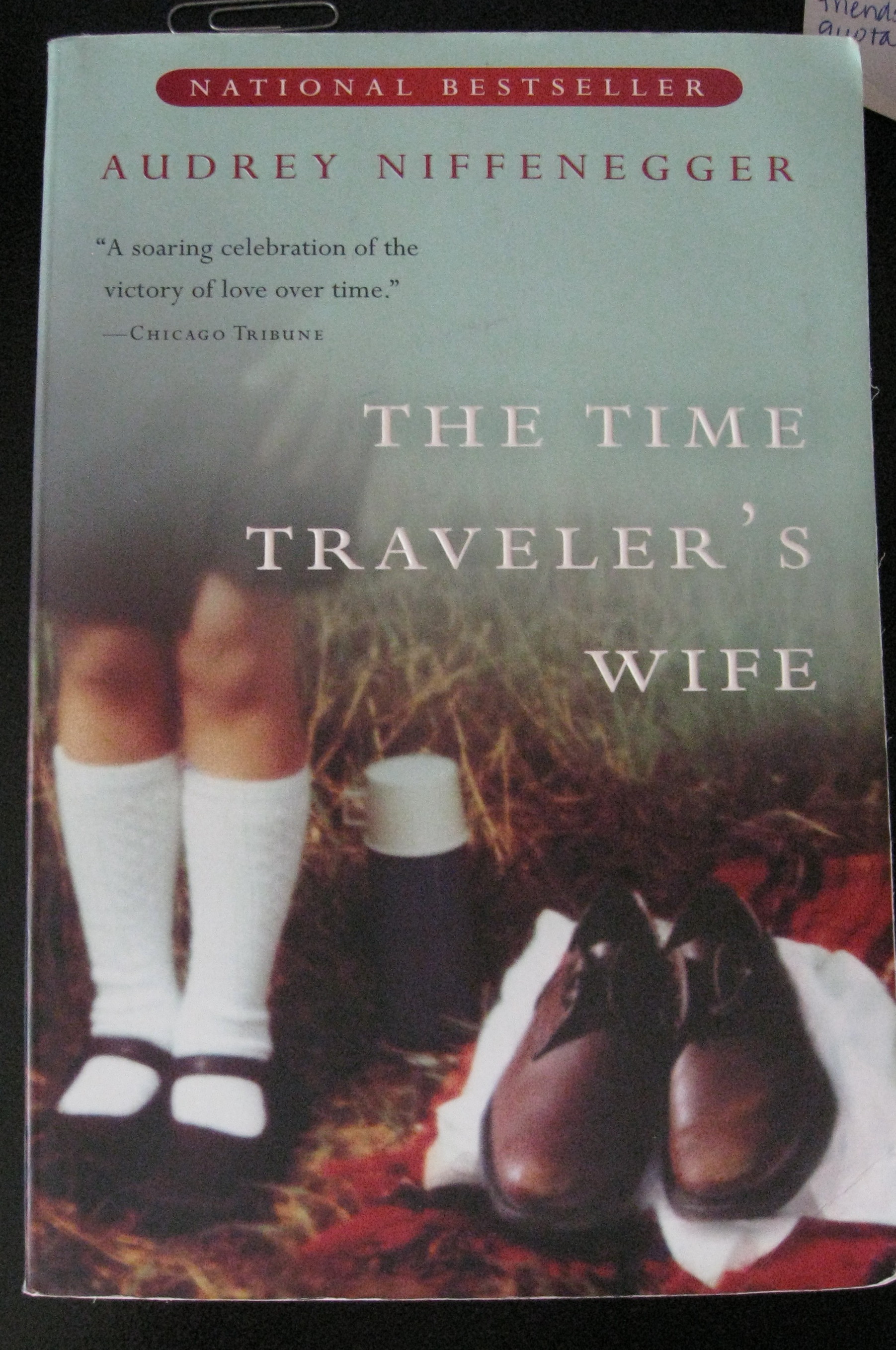
This was a reread for me. I first read it on a cruise and it seemed only fitting to reread it on my vacation in California. The first time I read The Time Traveler’s Wife I ached to map out a time line for the story. I wanted to chart Henry’s comings and goings. Reading it a second time was no different.
The Time Traveler’s Wife is the intricate love story of Henry DeTamble and Clare Abshire. Henry is a Chicago librarian who visits the opera, beats people up, and just happens to have a genetic disorder that not only causes him to involuntarily time travel, but gives him the ability to duplicate and visit himself at various stages of his life.
Clare Abshire is an artist and the object of Henry’s affection. Henry’s ability to time travel brings the couple together when young Clare is as young as six years old. As a result, Clare must endure waiting for Henry to time travel back to her. Her wait is made easier by a list of dates of when Henry will return.
While the main story focusses on Henry and Clare’s unusual romance life and world events go on around them. Sex, drugs and rock and roll give way to the aids epidemic and advances in science. Soon doctors are looking for a cure for Henry’s genetic disorder. Because Henry cannot control his time travel he seems to disappear during times of stress or some other great emotion. For example, haunted by the memory of his mother’s tragic death, Henry visits the scene of the accident again and again. Throughout it all, Clare stays by his side as best as she can given the unusual circumstances.

BookLust Twist: In More Book Lust twice. First, in the chapter called “Maiden Voyages” (p 158), and again in the chapter called “Time Travel” (p 221). How appropriate!

June Was…

June was a night of Sean Rowe music with some great women. June was one hell of a trip. June was the kick in the pants I needed. June was the “get off the pot” month. For BookLust Challenge it was:

  • Ninety-Two in the Shade by Thomas McGuane (fishing month)
  • An Academic Question by Barbara Pym (Ms. Pym’s birthday)
  • Act of the Damned by Antonio Lobo Antunes (family month)
  • The Amateur Marriage by Anne Tyler (best month to get married)
  • The Time Traveler’s Wife by Audrey Niffennegger (Ms. Niffennegger’s birth month)
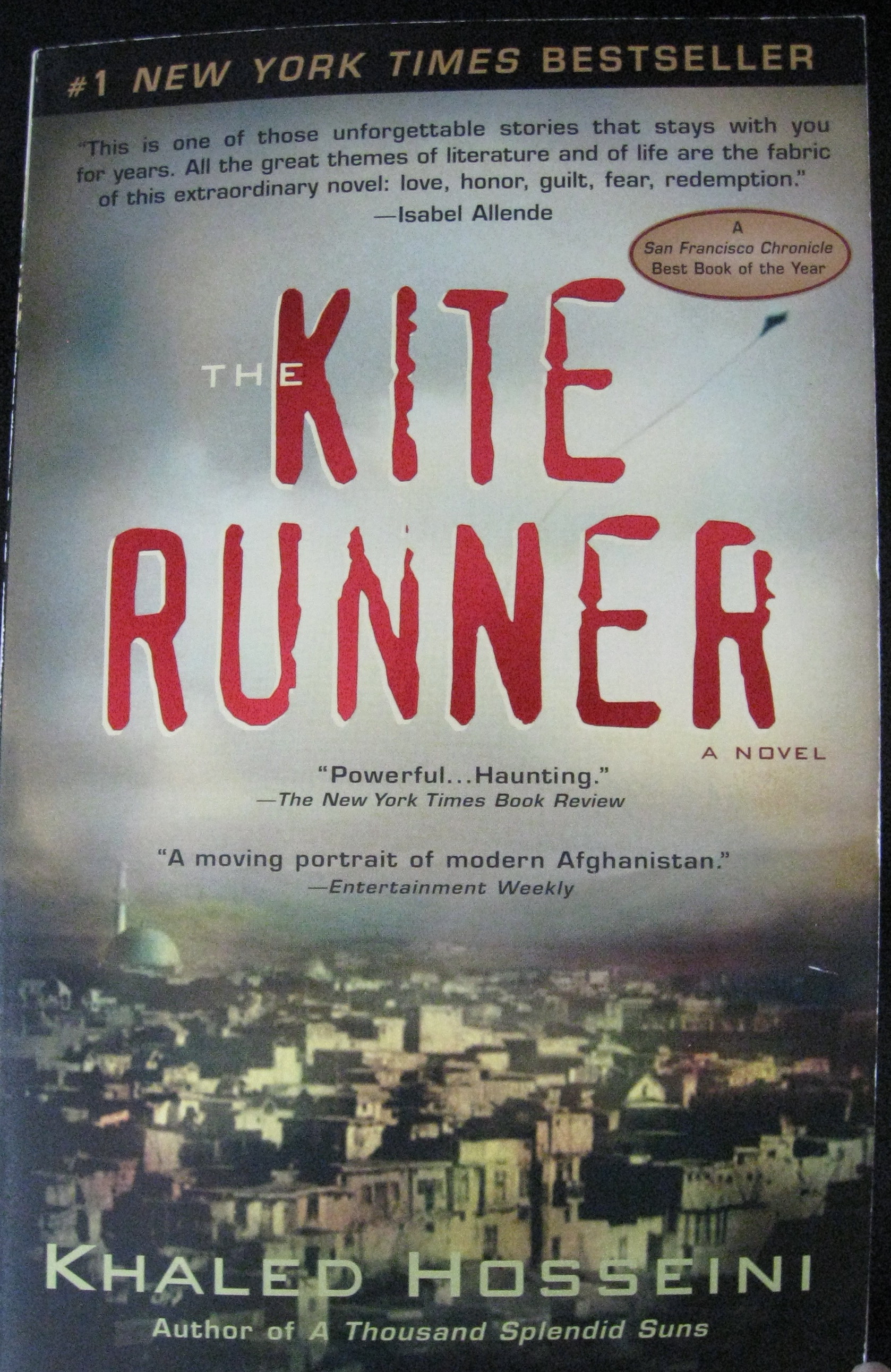
  • The Kite Runner by Khaled Hosseini (Father’s Day)
  • The American Ambassador by Ward Just (Anti-Father’s Day)

One review for LibraryThing:

  • Tomato Girl by Jayne Pupek (one word: tragic, tragic, tragic!)

Both Ninety-two in the Shade and Tomato Girl  were described as “gritty” and yes, were both gritty, but in two very different ways. I have to say The Kite Runner was my favorite June book.

Amateur Marriage

Tyler, Anne. The Amateur Marriage: a Novel. New York: Ballantine, 2004.

It’s weird to say I finished this book poolside in Las Vegas, Nevada. Who would have predicted that? Certainly not me.

This is a book I will definitely read again someday. When thinking about this review I wanted to box this story into a corner and call it a sad book, but I couldn’t. It’s such an accurate portrait of how a marriage (and ultimately, a life) can end up that I can’t just call it “sad.” How can I when it’s beautiful, funny, tragic, infuriating, intelligent, frightening and honest all at the same time?
Michael and Pauline are two teenagers whose lives collide at the start of World War II. Their romance is the result of a marriage between a fear of the future and the desire to be someone else at that very instant. Michael wants a girlfriend, any girlfriend. Sensing Pauline’s fascination with the war effort he spontaneously enlists. Pauline wants a soldier for a boyfriend. Any soldier. The culture and uncertainly of the times have thrown these two people together in such a way that neither of them can back out, despite the growing realization they were never meant to be together.
One things leads to another and soon thirty years have gone by. Pauline and Michael divorce and life goes on. And on. While the marriage didn’t survive more than halfway through the novel, Michael and Pauline go on. Their relationship from beginning to end and beyond is captured beautifully.

Favorite quotes: “You know how men are about wearing ties on a Saturday” (p 31).
“I’ve reached the stage where I got so hungry that I’ve gone beyond  hunger” (p 71) …and Kisa didn’t think that was possible!
“Sometimes, Pauline got a feeling like a terrible itch, like a kind of all-over vibration, and she thought that any moment she might jump clear out of her skin” (p 71).

BookLust Twist: From More Book Lust in the chapter “Marriage Blues” (p 161). 

Act of the Damned

Antunes, Antonio Lobo. Act of the Damned. New York: Grove Press, 1995.

I have to admit this was not one of my favorite books this month. Maybe something was lost in the translation (literally from Portuguese to English), but there were too many layers of storytelling going on. Dr. Nuno Souza, a dentist, tells his story in first person, but his imagination works overtime to include an Edward G. Robinson, a cigar smoking, gun toting tough guy. Nuno is married to Ana, but has a drug addicted girlfriend on the side.
Even though Nuno is telling the story in the first part, it’s Ana’s family that is the center of the story. Her family is beyond corrupt. Incest and greed come second nature to these people. Ana’s mother is the voice in part two. I think what makes the story so confusing is that no one really uses names. When Ana’s mother tells the story she uses family connections, “my brother-in-law, sister-in-law, my husband, his father, her brother…” Later, Ana herself tells the story…then someone else who uses the same technique…

These are the quotes that caught my attention:
“I opened the drawer to take out a shirt and tie, and was met by enough sicks for an army of ankles” (p 5).
“I laid down the receiver while the two voices tussled, scratched and bit each other in an electric desert of screws and wires” (p 17).
“‘I want her out by the thirtieth at the latest. She can go to tell and listen to conversations down there'” (p 42).
“I wiped the smile off my mouth with a napkin” (p 71).

BookLust Twist: From Book Lust from the chapter “Families in Trouble” (p 83).

Tomato Girl

Pupek, Jayne. Tomato Girl. Chapel Hill: Algonquin Books, 2008.

What a beautifully written, tragic first book! The characters are so true to life and so compelling I was picturing them in a movie. It’s told in first person from the point of view of 11 year old Ellie. With the help of a series of seamless recollections Ellie recounts her life with a mentally ill mother and a cheating father. Ellie’s father is taken with, and soon overcome by, a teenage girl who delivers tomatoes to the store he manages. From the moment the “tomato girl” comes into Ellie’s life every day is stacked with another unbelievable tragedy, a level of sadness leading to horror much deeper than the one before. It is hard to imagine the amount of pain this child has to endure at such a tender age. Pupek writes with sentences full of foreshadowing. They hang heavy like dark clouds, bloated with the storm that will erupt any minute.
My only complaint is absence of addressing molestation. Ellie is “grabbed” by boy hard enough to leave a bruise. At the same time her period has started (her first). When Sherrif Rhodes discovers the blood, and Ellie tells him of the rough boy, the Sheriff doesn’t take Ellie to a hospital to be examined by a real doctor. She is brought to a black woman who practices witchcraft. Because the story is set in the late 60’s and racism is hinted at I was surprised Sherriff Rhodes would bring a child to her rather than the local hospital. This is the only part I wish was explained better.

ps~ there are a ton of those “gotcha” sentences that I love so much. Too many to mention.


An Academic Question

Pym, Barbara. An Academic Question. New York: E.P. Dutton, 1986.

When this book landed on my desk I nearly laughed. It’s only 182 pages long with a decidedly easy-to-read large font. Needless to say I read it in a day!
Here are some things that intrigued me about the book before I read it: Barbara Pym died of breast cancer when she was only 66 years old. Her last book, An Academic Question was published six years after her passing and is actually a blend of two different manuscripts.
Here’s what I put on LibraryThing: An Academic Question at first read appears to be about a lonely, bored, mother of one, who is feels neglected her professor husband. Her friends are bland, her hobbies even moreso. It’s only after she agrees to help her husband find information to support an article he is drafting do things really start to get interesting. As with any academic, there is competition to get published and for Caro’s husband the pressure is on. Human emotion is played out in subtle detail as Caro deals with jealousy, betrayal, and the need for approval from everyone around her.

One of my favorite scenes is when Caro is in the audience, listening to a young professor give a lecture. Bored with the beautiful lecturer’s topic, Caro starts to focus in on how the striking woman is dressed. Upon noticing a pale pink rose pinned between her breasts Caro decides the color matches the roses she has in her own garden. Soon she is imagining her own husband placing the rose…and speculation and imagination create jealousy which becomes an accusation later on…It truly is a classic way jealousy manifests itself.

BookLust Twist: From Book Lust in the chapter, “Barbara Pym: Too Good To Miss” (p 196).


92 in the Shade


McGuane, Thomas. Ninety-Two in the Shade. New York: Farrar, Straus & Giroux, 1972.

June is fishing month. Go figure. Ninety-Two in the Shade is about a man (Thomas Skelton) who has always wanted to run a guided fishing tour off the Florida Keys. Not the fishing I had pictured for the month of June, but a form of it, I guess. Thomas is new to the business and even newer to competition. He is not without his share of problems. The opening “scene” is Thomas waking up in a hotel and finding four people standing naked in a tub. Right away you know this isn’t your typical River Runs Through It fishing story! Other quirks: violence that does (or doesn’t) happen, relationships that are (or aren’t) good, and the entire book is absent of chapters. I may have come across other books like this but never noticed this chapterlessness before. The only reason why this seems odd is because not having chapters makes it difficult to know where to stop!

I did a little extra research and found out that Ninety-Two in the Shade was made into a movie not long after it was written and while it’s Thomas McGuane’s third work of fiction many critics consider it his best.

I never did get used to McGuane’s “gritty” style of writing, but here are some quotes (and scenes) that caught me: “He walked to Homestead, then right on through town, tripping his brains out in the emptiness of 5 a.m.” (p 4).
A conversation between Skelton and “his girl.” May it confuse you as much as it did me:
Miranda~ “Tom, I had this incredible orgasm.”
Tom~ “Do I have to hear about your organism too?”
M ~ “Just this one. It was like a whole dream of sweet things to eat…Spun sugar, meringue, whipped egg whites…”
T ~ “How about when your chum shot off? Was it a blintz or an omelet?”
M~ “Ask him.”

To say that Ninety-Two in the Shade isn’t without humor would be a lie: “You should never kill somebody if it isn’t funny” ( 34).

BookLust Twist: In both Book Lust and More Book Lust. Book Lust: in the chapter “Montana: In Big Sky Country” (p 156) because Thomas McGuane is from Montana. This, by the way, takes care of a November read because that’s when Montana became a state and Ninety-Two in the Shade was on the November list. More Book Lust: in the chapter “Gone Fishin'” (p 101).

June is…

June is:

  • Fishing Month (92 in the Shade by Thomas Mcguane)
  • Barbara Pym’s birth month (An Academic Question)
  • National Family Month (Act of the Damned by Antonio Lobo Antunes)
  • The most common month to get married in (Amateur Marriage by Anne Tyler)

If there is time I’ll also reread Time Traveler’s Wife by Audrey Niffenegger

June is also another LibraryThing Early Review:

  • Tomato Girl by Jayne Pupek

Personally, I ended May on a crappy note so June is ME month. It’s also vacation month! Hello Vegas! Hello San Diego! I’m hoping to see some very special people. June is also house-hunting month (like we haven’t been doing that already!). The farm starts up this month and I started a new blog about the fantastic four which I am really, really excited about, too! Like I said, ME month! 8)

Second Sex – Failed

Second sexde Beauvoir, Simone. The Second Sex. New York: Alfred A. Knopf, 1971.

Okay, I admit it. I got two paragraphs into the translator’s preface then skipped to the author’s introduction. There, I got as far as page v . Mind you, the introduction starts on page v. Then, I skipped to chapter one, got as far as paragraph three where I promptly fell asleep. I couldn’t get a single page entirely read. Not a one. Here and now I’m evoking the BookLust 50 page rule and admiting defeat with The Second Sex (see Book Lust Rules). Women everywhere hate me now for what I’m about to say.

I am not a diehard feminist. I have strong beliefs in what a woman can and can’t do. I’ve said before that women are more cerebral than men. They frequently change their minds, then change them back again. This makes them flighty, indecisive. Not exactly the type of person I would want in combat. The ability to drive a car? Please, don’t even get me started! I could go on, but I don’t think I can take the hate mail.
My second reason for not wanting to finish (or even properly start) Second Sex is the fact that it was written in 1952 (from a treatise written three years earlier, in 1949). Much has changed for women since that time. We’re more accepted in the corporate world, the political realm & even the far reaches of outer space. It’s becoming more acceptable for women to be the bread winners while their husbands stay at home with the kids. One might argue that reading Second Sex would be good from a historical standpoint. True, but I’m just not that interested in standing in that light.
My third reason for not reading Second Sex is purely a selfish one. The book is long – over 750 pages! I just don’t see myself devoting my entire summer vacation to something that reads like a textbook.

BookLust Twist: From More Book Lust in the chapter, “I Am Woman – Hear Me Roar” (p 120). Pearl calls de Beauvoir a pioneer  of the women’s movement. I’ll take her word for it.

Note: This makes the seventh book I have given up on since starting the Book Lust Challenge.

Anne Frank

Anne FrankFrank, Anne. Anne Frank: Diary of a Young Girl. New York: Doubleday, 1995.

I was prompted to reread Anne Frank: Diary of a Young Girl after reading the New York Times article about her cousin, Bernhard “Buddy” Elias, donating 25,000 letters, photos and other documents to the Anne Frank House. What an amazing thing to do. I’m sure Hans Westra, director of the Anne Frank House, is…well…psyched. Imagine the historical value of such a gift! It’s a gift for all humanity and truthfully, it’s worth is immeasurable. Anne Frank died when she was 16 years old. Her “dates” are 1929 – 1945 and that alone devastates me. My heart was caught in my throat when I opened my copy of Diary of a Young Girl and saw her handwriting staring back at me. Everyone knows Anne’s story so I won’t bother with a “review” per se, except to say I simply cannot believe there are people out there who feel her diary is a fraud!

Probably the hardest thing about reading Diary of a Young Girl was the fact I was painfully aware of dates. I knew she was arrested and taken from the Annex on August 4th, 1944. As soon as her diary entries had the “1944” date I started to despair. It was like counting down to death row. It was different when I read this as a child. Anne Frank was a character to me. I couldn’t put reality to her words, flesh and blood to her black and white photo. This time it was different, tragically so. I found myself wiping away tears whenever she mentioned “the end being near.”

What fascinates me about Anne Frank first and foremost is her dedication to telling her truth. She started her diary for herself but, after hearing first hand accounts of life under German occupation were needed, she decided to edit her diary for publication. After her death her father combined both versions and created what we all have read, The Diary of a Young Girl. I never knew there were versions A, B & C.

Two of my favorite quotes, about writing, appear on the same page, “I have an even greater need to get all kinds of things off my chest” and “paper has more patience than people” (p. 6). I couldn’t agree more. 
“Memories mean more to me than dresses” (p 20) and “Will the reader please take into consideration that this story was written before the writer’s fury had cooled?” (p 120) indicate I would have gotten along with Miss Frank “swimmingly”. Seriously.

BookLust Twist: I would have thought Pearl would have a chapter on the Holocaust and this would be included in it. However, I’m relieved it’s in the chapter “100 Reads, Decade by Decade” (p. 177) from Book Lust.

Beloved

BelovedMorrison, Toni. Beloved. New York: Penguin, 1987.

It’s been 21 years since I first read Beloved. The one and only thing I remember is my reaction to it. I remember crying and crying, not understanding why the words moved me so. Every sentence was so beautiful in its heartbreak.
After rereading Beloved I realize why I had such a hard time remembering people and plot. Beloved is the story of running. At the center is Sethe, a former slave who cannot escape her past. Everyday she lives in fear of being brought back to someone’s possession. Her history chases her everywhere. Denver is her surviving daughter who runs from loneliness, constantly trying to catch up to her mother’s attention. Paul D is another former slave who shares Sethe’s past. He, too, is in a devastating cycle of running away from his past, never believing he is capable of staying in one place freely. Beloved is Sethe’s murdered daughter, back from the dead to reclaim her life with Sethe.
After rereading Beloved I remembered English class and how we went round and round about the symbolism. What did the number 124 on the house meant? Why was color such a prominant description for things? What about Baby Suggs? In the end we decided one of the most powerful images of Beloved is Denver’s birth. Denver wouldn’t have made it into the world had it not been for the help of a white woman when Sethe was in labor. It’s almost a commentary on how society should be thinking today – we can’t make it in this world if we do not work together.

“The sky above them was another country. Winter stars, close enough to lick, had come out before sunset” (p 175) is my favorite line.

BookLust Twist: From Book Lust and the chapter called, “African American Fiction: She Say” (p. 12).

Abbreviating Ernie

Abbreviating ErnieLefcourt, Peter. Abbreviating Ernie. New York: Villard, 1997.

At first glance this humorous book is just plain cut and dried funny. Okay, bad pun. Read on and you’ll see why. Here’s the surface premise, the tip of the iceburg, of Abbreviating Ernie. Ernie and his wife are having sex. He drops dead of a heart attack. She’s blamed for his death. Here’s the just under the surface details: Ernie likes to dress in his wife clothes while having sex. He also likes to handcuff his wife and he can’t seem to “do the deed” anywhere normal. Long story cut short (there’s that pun again): Wife is found holding an electric carving knife, chained in the kitchen while hubby lies dead on the floor missing his “tommyhawk” as one character put it. All of this happens within the first twenty pages of the book so I found myself wondering what in the world Lefcourt would have say in the remaining 271.
Here’s the rest of the iceburg. Abbreviating Ernie is a commentary on the legal system, mental illness, women’s rights, the sensationalism the media can create, the Hollywoodization of a tragedy (what famous actor will portray the prosecutor?), and the exposure to human nature, often seen as failings. It’s about how warped our society can be when confronted with the dark secrets of suburbia. Yet, it keeps you laughing.

BookLust Twist: Abbreviating Ernie shows up in Pearl’s More Book Lust in the chapter on “Alabama” (p 207). While Abbreviating Ernie doesn’t take place in Alabama Pearl makes mention of Lefcourt’s book because Crazy in Alabama has an electric carving knife in its plot.

Aspects of the Novel

Aspects of the novelForster, E. M. Aspects of the Novel. New York: Harcourt, Brace & Co., 1940.

I loved holding this book in my hands. Old and musty, it just felt right to read. There is an inscription on the inside cover, “Presented by Miss H. Miller’s Freshman English Classes, February 1941.” My father was four. My mother still had another seven years before even being born. But, anyway.
Aspects of the Novel came out of lectures Forster gave at Cambridge University in 1927. In these lectures Forester divides a novel into six crucial parts: story, people, plot, fantasy, prophesy and pattern and rhythym (counting as one element). Story asks the question what next. The trick is to keep the reader asking that very question. As soon as they can predict the next “they either fell asleep or killed him [the author].”  (p 46). There is a grave price for being predictable in literature.
In the element of character (or people as Forster refers to them) love is an emotion highly questioned. Love can be more complicated than food or sleep and Forster begs the question “How much time does love take?” (p 79). 
In the element of plot readers are not supposed to be asking what next, but rather, why? Why does this happen? They keep reading to find out more.
Fantasy and prophecy are the mythologies, the magic of writing. This is where the reader *thinks* the next twist in the plot should be obvious, but acutally isn’t. It’s the unbelievable made believable. 
My favorite elements are the combined Pattern and Rhythym. I like that Forster draws from art for the description of pattern and music for rhythym and continues with one of my favorite words, symmetry. “History develops, art stands still.” (p 244)

BookLust Twist: From More Book Lust, mentioned twice- Once in the chapter “Commonplace Books” (p 53) and again in the chapter called “The Writers Craft” (p 236).

Above The Thunder

Above the ThunderManfredi, Renee. Above the Thunder. San Francisco: MacAdam & Cage, 2004.

Once I started reading Above the Thunder it was like a giant boulder building momentum down a hill. I couldn’t stop turning the pages. I like that it’s all about journeys, big and small. Personal and global. On the surface its four people, on the whole it’s humanity. The plot is simple – it’s about the life of Anna. She starts out being a cynical, bitter widow who “doesn’t want to get involved.”‘ She doesn’t want to get involved in living, period. She has all but disowned her daughter whom she hasn’t seen in 12 years. She has one friend. When her son-in-law and granddaughter return to live with her and she reluctantly agrees to help moderate an aids support group she ends up being the center of a collection of people so diverse and wonderful she can’t help but change and, in the process, grow. Sounds predictable and nice, but it isn’t. There is a harsh reality to this coming-into-the-light story: aids, suicide, divorce, miscarriage and sadness all play an important part in the plot.

The thing I liked best about Above the Thunder are the characters. They are believable. Anna is introduced to us as closed off and inflexible. In time she changes, but when faced with a new tragedy she reverts back her old self and craves solitude where she can grieve in private. In shrugging off the comfort of others she is still the same person we meet in chapter one. Even Jack, a homosexual with problems with fidelity, doesn’t change his desire for sexual freedom once he discovers he is hiv positive. All the characters go through a period of growth and acceptance, but at the core are all still the same unique individuals.
Some favorite lines:

  • “She doubted it was possible to understand someone else’s suffering. Even her beloved husband whose pain had become a private geography on which she couldn’t trespass.” (p 21)
  • “Holy God, man, how long does it take to cook a hot dog? I’ve been in line long enough to break a habit, backslide, and recommit.” (p 183)

And a favorite scene: two homosexual men trying to teach a pubescent girl how to use a tampon for the first time. It’s hysterical and poignant all at once.

BookLust Twist: From More Book Lust in the chapter called, “Maiden Voyages” (p 159). I have always loved discovering someone’s very first novel. Katherine Weber’s maiden voyage is one of my favorite, but Above the Thunder rates right up there, too.

Sounder

SounderArmstrong, William, H. Sounder. New York: Harper & Row, 1969.

Haunting. I find this story haunting on so many different levels. Haunting and tragic. Where do I begin? Where can I begin? The copy of Sounder I picked up had the words “now a motion picture!” emblazoned across the cover with photographs of scenes from the movie inside. Of course, I studied the photos before I read a single word and saw pictures of an obviously poor black family. One picture showed the mother with three kids as a father, handcuffed, is being led away by white, mean looking “authorities.” Another picture depicts the “criminal” as he is about to be struck by a prison guard…

But, the tragic pictures couldn’t prepare me for the quiet yet strong story. The raw undercurrent of something more ominous buzzed constantly. No one in the story has a name except the family hunting dog, Sounder. The father is accused of stealing a ham and is sent to jail, the mother cracks walnuts and sells the meat in town. There are three children and the story is told from the oldest’s perspective.
During the father’s arrest, Sounder is shot. Everyone in the family thinks Sounder is dead. What amazes me is the oldest son is more worried about the dog than his own father. His father’s guilt is plain, simple and true when his mother returns what was stolen, yet because Sounder’s body cannot be found, it’s all the boy can think about. “If the deputy sherrif had turned around on the seat of the wagon and shot his father, the visiting preacher and somebody would bring him back and bury him behind the meetin’ house, the boy thought. And if Sounder dies, I won’t drag him over the hard earth. I’ll carry him. I know I can carry him if I try hard enough, and I will bury him across the field, near the fencerow, under the big jack oak tree.” (p34)

I can’t do the storyline justice, but the writing is beautiful. Here are a few of my favorite lines:

  • “And Sounder, too, settin’ on his haunches, would speak to the moon in ghost-stirrin’ tones of lonesome dog-talk” (p 38).
  • “Now the cabin was even quieter than it had been before loneliness put its stamp on everything” (p 76).

BookLust Twist: From Book Lust and the chapter called “Three-Hanky Reads.” Sounder is paired with other dog books for children like Beautiful Joe and Goodbye, My Lady (p 237).