Things They Carried

O’Brien, Tim. The Things They Carried. New York: Broadway Books, 1998.

I admit it. I have picked this book up three different times now. Technically, I should have read it in March to celebrate the day U.S. troops pulled out of Vietnam (March 1975), but as you can tell, there were plenty of other things to reach for in March…
Nope, I cracked this book open for no other reason than sheer boredom. I finished Peter Pan and The Ground Beneath Her Feet and decided I wasn’t up for The Joy Luck Club…at least not right now. The Things They Carried has been hanging around my office for months now. It just seemed to say “read me” and the time was right. I am so very glad.

This was an amazingly moving book. I had a hard time getting into it the first two times I picked it up, but the third time was a charm because after that I couldn’t put it down. Tim O’Brien writes with such ferocious honesty. He calls it a fiction but it easily could have been the truth. The shocking violence, the depths of sadness, the urgency to survive, the humble efforts to maintain sanity and the humor that survives it all…each chapter is a short story of all of these things. Each story stands alone, complete as it is, yet connects beautifully to the story before it as well as the one after it. Peter S. Prescott from Newsweek said the stories “bounce off each other…” and I would agree.
I could quote nearly each story, but here are my favorites:
“They carried all they could bear, and then some, including a silent awe for the terible power of the things they carried” (p 7). The reason why this quote stuck with me is because O’Brien spends the opening chapter listing everything a soldier carried in the Vietnam war. Both the physical and mental, the essential and the sentimental. This quote sums up how they never forgot why they were carrying everything else.
“The problem, though, was that a draft board did not let you choose your war” (p 44). I found this to be one of the most humanitarian statements of the book. O’Brien had just finished explaining that some wars were justified, like stopping Hitler, but in this case he was drafted to fight a war he didn’t understand.

BookLust Twist: From Book Lust in the chapter “Vietnam” (p 239).
ps~ one of the reasons for starting the Book Lust challenge was to find writers I could fall in love with. I wanted one book that would spark an obsession. Much like Margaret Atwood’s The Handmaid’s Tale or Barbara Kingsolver’s Animal Dreams or Katherine Weber’s Objects in the Mirror are Closer than They Appear. All of these books created a rabid need to read anything else written by the authors. I found such an obsession with The Things they Carried. I will go on to get my hands on any and everything Tim O’Brien has written before and since.

May Was…

A month of allergies. Lilacs. The end of the school year (yay). Dreams coming true. The final Chuck Lelas walk. A new haircut. The serious house hunt. Family time. Natalie Merchant performing with the Boston Pops and ten good books (Nine and a half…).

  • Educating Esme: Diary of a Teacher’s First Year by Esme Raji Codell (National Education Month)
  • Plain Speaking by Merle Miller (Harry Truman’s birthday, Merle Miller’s birthday, on the heels of a book about Roosevelt…it just made sense).
  • True Confessions: a Novel by Mary Bringle (Mothers & Daughters)
  • Dreamland by Kevin Baker (History. I have to admit, tail between my legs, that I didn’t finish this one. Once I found out what the reader doesn’t find out I didn’t want to continue. BooHiss).
  • Ground Beneath Her Feet by Salman Rushdie (Music month)
  • Murder on the Leviathan by Boris Akunin.

Books added to the list because I gave up on Dreamland:

  • Peter Pan by J.M. Barrie (celebrating Barrie’s birthday)
  • The Things They Carried by Tim O’Brien for no ther reason than it was a great book!

For LibraryThing & the Early Review Program~two books!:

  • Best Girlfriends Getaways Worldwide by Marybeth Bond (really, really fun travel guide)
  • Home Girl: Building a Dream House on a Lawless Block by Judith Matloff. Interesting, considering I’m dreaming of houses these days…


Peter Pan

Barrie, J.M. Peter Pan. Toronto: Bantam books, 1980.

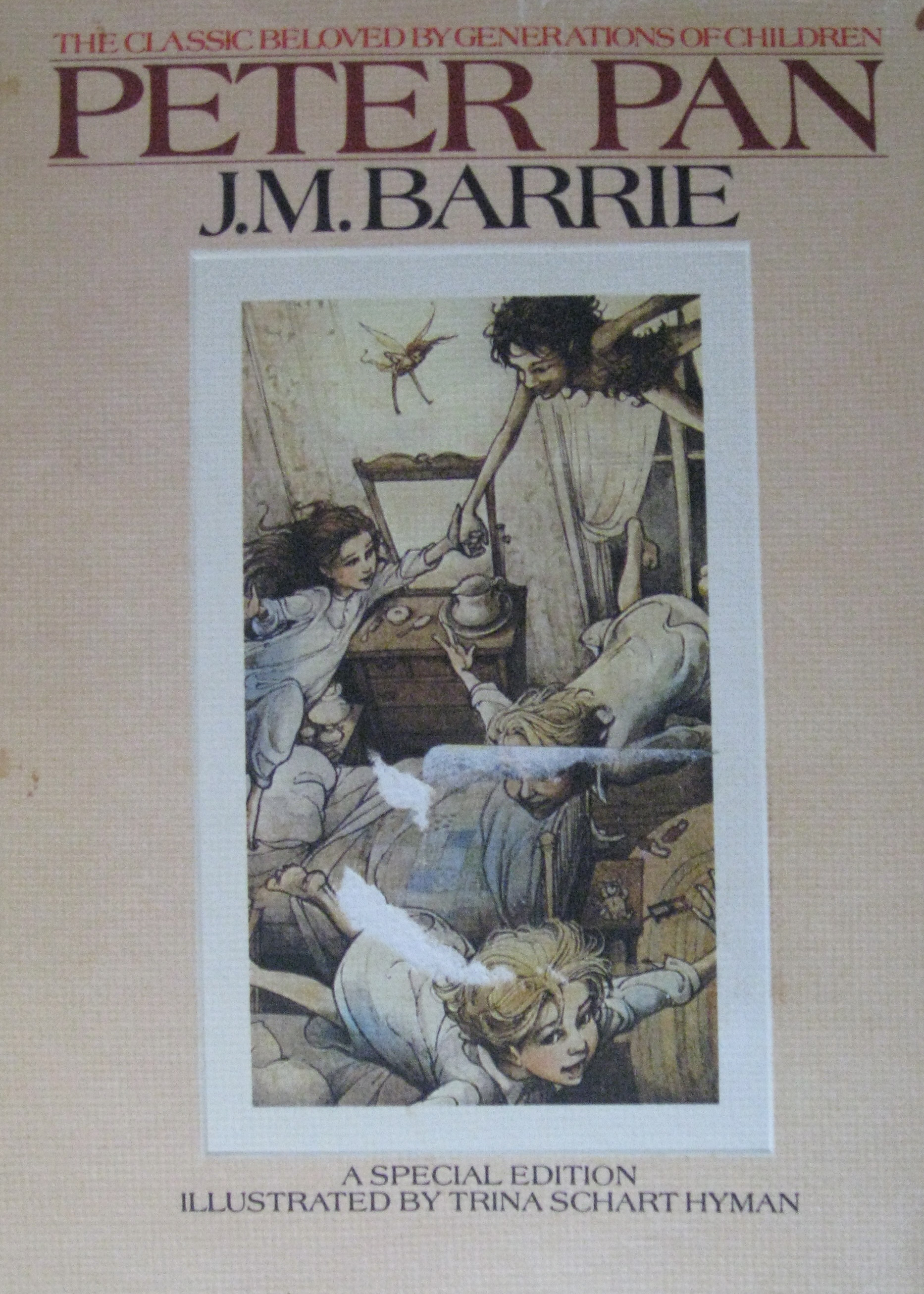
Barrie was born in May. I needed a quickie read for the end of the month. Choosing Peter Pan was a no-brainer. The version I chose to read was an illustrated deluxe addition. Full of both color and black and white illustrations: “Special edition illustrated by Trina Schart Hyman.” Really.

Because Peter Pan is such a well loved, well (over?) produced story, everyone knows the basic plot: three kids unhappy with the way their father has treated the family dog run away with an orphan boy to his Neverland (not to be confused with Michael’s Never Land Ranch). Peter and his Lost Boys are looking for a mother and they think they have such a figure in Wendy, one of the Darling children. It’s a magical adventure full of danger in the form of pirates, “redskins” and a ticking crocodile. Even the fairies and mermaids are not to be trusted.

Upon rereading Peter Pan I was surprised by how slow the story moved in certain sections. Because of the glossed-over, dumbed-down, glitzed-up theater/movie/storybook versions that have popped up over the years I had forgotten Barrie’s original 1911 language and long since deleted details. It was hard to picture reading this aloud to a young child. Peter Pan seemed slightly evil (being described as cunning and sly), Tink seemed downright dirty as she responded to her own jealousy over Wendy (gleefully leading Wendy to her death). True to fairy tale form, it does have a happy ending. Sort of.

One of my favorite images from the book that I’ve never forgotten is how Peter describes fairies as being the shattered pieces of a baby’s first laugh, “You see, Wendy, when the first baby laughed for the first time, its laugh broke into a thousand pieces. and they all went skipping about, and that was the beginning of the fairies” (p 29).

BookLust Twist: From More Book Lust in the chapter “Fantasy for Young and Old (p 83). 

Ground Beneath Her Feet

IMG_1374
Rushdie, Salman. The Ground Beneath Her Feet. New York: Henry Holt & Co., 1999.

May was deemed National Music Month by someone out there so, in honor of that tidbit I chose The Ground Beneath Her Feet as my “music book.” This was my first time reading Salman Rushdie & I have to confess, if all his other books are so lengthy and detail driven, I am going to have a hard time getting through them. This one was a whopping 575 pages long and and and! I knew the ending in the first chapter!

The Ground Beneath Her Feet is an epic rock and roll love story. Spanning several lifetimes Rushdie tells the love story of Ormus and Vina, two musicians from Bombay. Their story is like a gigantic flood, catching up and describing in detail: cultures, mythologies, histories, industries (agriculture (goats!), music and beyond), the landscapes of India, England and America, their societies, religions, ancestries of families, personalities, births, deaths, emotions, tragedies, triumphs, anything and everything from  the mid 1950s until the early 1990s.  This is a sweeping story that cannot be pigeon-holed into a romance, mystery, or comedy. It is all these things and thensome. Suicides and secrets, miscarriages and murders, wealth and poverty, sane and strange, greedy and generous, brothers and sisters, twins and torture, and of course, sex, drugs and rock and roll.

My favorite quotes circled and scrutinized love:
“In love one advances by retreating” (p 15).
“when it comes to love there’s no telling what people will convince themselves of” (p 30).
“But as the years passed we became each other’s bad habit” (215).

And one quote about my fave, the drums: “It is as if the drums have been yearning to speak to him, and he to them. Finally, he thinks: at long last, here are friends” (p 287).

BookLust Twist: From Book Lust in the chapter “Music and Musicians” (p 164).


Home Girl

Matloff, Judith. Home Girl: Building a Dream House on a Lawless Block. New York: Random House, 2008.

I could not put this book down. From start to finish it had me looking to answer that What Happened Next? question.
Matloff trades in one adventurous life (as a foreign correspondent) for another (home owner and wife in New York City). The exchange seems benign until the reader (and Matloff herself) realizes the Victorian she is buying is decrepit; in need of repair in every possible way, the new neighborhood is a one of the biggest drug zones in the country, and on a daily basis she must protect her property from the addicts who have called it home. If that wasn’t enough, Matloffmust walk a fine line of graceful respect and distance with the dealers on the street while becoming a mother, a crime fighter and witness to the tragedies of September 11th. Throughout it all, Matloff remains humbled and humorous.

Other observations: The picture on the inside cover indicates the title would have been Home Girl: Building a Dream Home in a Drug Zone. Not sure what I think about that.
I hope they keep the author’s note. Matloff’s sentiment about wishing the events weren’t true really intrigued me…really made me want to read the book.
Of course, there were quotes I absolutely loved, but I’ll keep them to myself until the book is published.

Murder on the Leviathan

Murder on the LeviathanAkunin, Boris. Murder on the Leviathan. New York: Random House, 2004.

Oddly enough, I chose this book because it was written by an author who spent a great deal of time in Moscow and a guide book advised me that now was the best time to visit Russia. There was no other reason to read this at this particular time. But, having said that, I’m glad that I did. It was fun.
Murder on the Leviathan starts out violently, a record of an examination of a crime scene set in 1878. I think the murders of ten people ranging from ages 6 to 54 in one Parisian house would cause a stir even in the 21st century. Oddly enough, this is not the murder the title of the book refers to. Commissioner Gauche discovers a clue that leads him to the Leviathan, a giant steamship headed for Calcutta. As he sets sail with a host of interesting passengers (in first class) he soons discovers each and every one of them is a potential suspect. It gets interesting when people start dying on the ship. A Russian detective soon joins Gauche on the hunt for the killer.

I didn’t find any quotes to include, but I did have to look up “gutta-percha” shoes. Depending on who you ask, gutta percha is described as tree gum, rubber, or plastic.

BookLust Twist: In More Book Lust in the chapter “Crime is a Globetrotter”, subsection, “Russia” (p 59).

Dreamland

DreamlandBaker, Kevin. Dreamland. New York: Harper Collins, 1999.

It makes sense that a historian like Kevin Baker would write something as epic and sweeping as Dreamland. It is a beautifully blended tale of fiction and reality. Events like the Triangle Shirtwaist fire and people like Sigmund Freud and politics like Tammany Hall exist in harmony with fictional Coney Island gangsters and seedy carnival performers. It’s a world of underground rat fights, prostitution, gambling, and the sheer violent will to survive. It’s dirty and tragic. A love story hidden behind the grime, the colorful lights, the tricks, and the chaotic noise of New York.
Favorite lines that moved me: “That is always the thing with depravity: just when you think you’ve plumbed the very depths, there is always someplece lower to fall” (p 26).
“I sat behind the left ear of Satan, and watched the sun come up over Sheepshead Bay, and dreamed of an empire of little men and little women, ruled by a mad queen” (p 34).

BookLust Twist: From Book Lust in the chapter “American History: Fiction” (p 21). I think Pearl’s description says it all, ” Dreamlandvividly describes the lives of poor immigrants families on the Lower East Side of New York City, circa 1910, who find their lives somewhat more bearable by the promise of excitement of Coney Island” (p 21).

True Confessions

True Confessions
Bringle, Mary. True Confessions. New York: Donald I. Fine, 1996.

This sounds like it would be the title of a very juicy blog. Something I haven’t already spilled in some sordid way or another. Unfortunately, it’s only the latest challenge book for Book Lust. I read this in honor of Mother’s Day and I have to admit it was a strange choice. The inside book cover describes True Confessions (in part) as “…a mother who loves her to death and an ex-mother in-law who doesn’t approve…” So, yes, mothers are part of the story, but you never really meet either mother. As a result I didn’t get that loved to death feeling from mom, nor the disapprovefrom the ex-mother in-law.
But here’s the story in a nutshell: Grace teaches writing in New York, lies to her mother about her location (mom thinks she’s in England), struggles with relationships and fantasizes about being a story in a magazine she is obsessed with called – you guessed it – True Confessions. Grace doesn’t have direction. In the beginning she seems shallow and self-absorbed. Of course there is a period of growth through odd incidents such as her friend’s affair revealed on television, a kidnapping, and even a death. When it is all said and done, Grace emerges a stronger, wiser person.
Critics describe the book as funny, but I have to admit the first laugh-out-loud moment I had was when Grace is in Central Park with her friend Naomi. Naomi has two children, but acts like she wasn’t meant for motherhood: “Grace always felt grateful to Naomi for refusing to submit to the role which it would have been so natural for her to assume” (p 68). On describing her daughter Alice, Naomi says, “Sometimes I think we have her on loan, like a library book…sometimes…it’s not even a book I want to finish” (p 68). There is more. Naomi rants about trying to keep kids away from television. “…unless you want them to be social pariahs they’ll be contaminated sooner or later” (p 69.
Another favorite line: “lunacy is quite impartial. Warps in the genes, screwy endocrines – they don’t count” (p72).

BookLust Twist: From Book Lust in the chapter “Mothers and Daughters” (p 160).

Plain Speaking

harry s trumanMiller, Merle. Plain Speaking: An Oral Biography of Harry S. Truman. New York: P.G. Putnam, 1973.

I think I mentioned before that reading this was good timing. For starters, both Truman and Miller share May as their birth month. Secondly, I just finished reading about Roosevelt for the Early Review program. This just seemed appropriate for the next book to read. There was “flow” to the subject material, if you will.

Comprised of interviews in chronological order, Miller talks to Truman (as former President) as well as Mary Jane Truman (Truman’s sister), fellow Battery D veteran Albert Ridge, even a childhood neighbor of Truman’s, Henry Chiles. The interviews (as opposed to Miller’s interpretation) allow for personalities to emerge. Miller spends more time delving into Truman’s political and military careers instead of the more personal subjects such as Truman’s childhood and relationships. There is a definite rapport between Miller and Truman and Miller is careful to avoid disrespect on several occasions.
While the interviews are very candid (I thoroughly enjoyed “hearing” Truman swear) I thought some sections were drawn out and much longer than they needed to be. I also found myself skipping some of the footnotes because they didn’t always relate to the subject. Another small criticism I had is while reading it was sometimes difficult to know the difference between Truman answering a question and Miller telling his reader something. While he used a different font for the questions posed to the respondent he didn’t for generalized comments to the reader.

BookLust Twist: From Book Lust in the chapter “Merle Miller: Too Good To Miss” (p 155).

Educating Esme

Educating EsmeCodell, Esme Raji. Educating Esme:  Diary oi a Teacher’s First Year. Chapel Hill: Algonquin Books, 1999.

Word to the wise: if you want to celebrate education month and you need something really quick to read, grab Educating Esme. Barely 200 pages it’s an entertaining, fast and funny book. This one interested me on so many different levels. For starters, at one time I thought I might be a teacher – even declared Education as my major for a while (until I found out that you never have time to read anything, you just pretend you do). It also interested me because I know two different people who have gone through that “first year” of teaching. They had completely different experiences and I wanted to compare notes.

What went on LibraryThing:
Educating Esme: Diary of a Teacher’s First Year  is smart and funny. It’s a journey inside the mind of a young, fresh-minded educator hell bent on doing things her way. Her lessons and style of teaching are engaging. They allow students to be themselves and in the process learn something.  The students are not bribed or cajoled into lesson plans. Codell disguises education in a safe, fun environment. This is not to say she doesn’t have her share of problems. Chicago has it’s gang culture, it’s broken homes, it’s drug addled families; not to mention a difficult hierarchy within the school system. Codell encounters it all with grace and strength.

Funny quotes: “The way they sassed patrons they didn’t like. The way they seemed to know too much. A little like librarians” (p 62). You would think this quote would somehow offend me on some level…especially considering the fact Esme is describing prostitutes! LOL
“What sort of Jedi would I be if I don’t really face the Dark Side? Mr. Turner may be Vader, but is there an enemy that remains to be revealed , like that bossy old wrinkled guy who told Vader what to do?” (p 112).

BookLust Twist: From Book Lust in the chapter “Teachers and Teaching Tales” (p 230). I love how Pearl calls Codell “relatively” hip (p 231).

May is…

May is one of my favorite months. I love the one month of lilacs. I love the urgency of spring in the air. Days are warm but nights stay cool. Plus, there is Mother’s Day for all those mums out there.
Here is how I am going to celebrate May (besides trying to quell the homesickness):

  • Mother’s Day: Reading: True Confessions by Mary Bringle. Personally: Taking my two favorite mothers to see Natalie Merchant at the end of the month.
  • Merle Miller’s birthday: Plain Speaking by Merle Miller – which is really funny because this is about Truman and his birthday is in May, too…a-n-d…I just finished reading about Roosevelt.
  • National Education Month: Reading: Educating Esme by Esme Raji Codell (nonfiction). Personally: taking my staff out for a Middle Eastern lunch.
  • National Music Month:Reading: Ground Beneath Her Feet by Salman Rushdie (The big question is will I be able to get it out of my head that he did a little acting in that “Bridget Jones” movie?). Personally: I’d like to see Sean Rowe this month. Sirsy would be on the list but their closest show is on a Monday night. Boston Symphony Orchestra is probably the classiest way to celebrate National Music Month, don’t you think?
  • IMG_0163

And if there is time:

  • Best time to visit Russia: Murder on the Leviathan by Boris Akunin
  • National History month: Dreamland by Kevin Baker

I have one Librarything early review book: TBA (which means they told me I’m getting one but I haven’t got it yet…if that makes sense.)


Allegra Maud Goldman

AllegraKonecky, Edith. Allegra Maud Goldman. New York: The Feminist Press, 1990.

This was another one of those “kid books” – about a kid coming of age, I should say. I enjoyed this much better than the Angus book. Both have witty, sarcastic, growing up girl narratives only Allegra is Jewish instead of Catholic and lives in Brooklyn, New York instead of England. She isn’t afraid to use her mind, or speak it. A few of my favorite quotes:

“Just thinking about that whole library filled with ideas, things to mull over , all sorts of new people to get to know, boggled my mind.” (p88)

“”You’ll never be really happy as a woman,” Sonia said “until you have your own sweet baby at your breast.” I recognized this as something her mother was always saying to her, but I refrained from throwing up.” (p145)

I enjoyed this book a great deal. Allegra Maud Goldman is my kind of kid. Her sense of humor stands up and takes a bow in the face if that audience called insecurity that only growing up can produce.

BookLust Twist: From Book Lust in the chapter appropriately called, “Girls Growing up” (p 101). Pearl liked Allegra as much as I did saying, “…Konecky manages to write from a child’s point of view  without ending up sounding silly, condescending or false.” (p 102)

About a Boy

About a boyHornby, Nick. About a Boy.New York: Riverhead Books, 1998.

I have heard so much about this book. Maybe it’s because I’ve liked other Hornby books that have been made into movies~ Fever Pitch & High Fidelity. Will is a pretty interesting character. He’s a single guy, bound and determined to never work a day in his life. He spends his time watching movies, listening to music and trolling for women. His newest tactic is to join SPAT (Single Parents Alone – Together). Needless to say, he’s not a single parent. In reality he hates kids. He’s callous and shallow but you can’t help but like him, especially when he gets involved with Fiona and her 12 year old son Marcus.

“There were about seventy-nine squillion people in the world, and if you were very lucky, you would end up being loved by 15-20 of them” (p147).

One of the things that struck me about this story is the philosophical ending. Marcus is a boy who acts too old for his age, too serious for his youth while Will acts too young for his years, too immature for the adulthood he is in. In the end they learn to swap maturities – growing down and up. Now I want to see the movie.

BookLust Twist: From both Book Lust and More Book Lust. In More Book Lust About a Boy is in the Chapter, “Dick Lit” (p.79). If you are scratching your head, think chick lit. Get it?

Above Suspicion

Above SuspicionMacInnes, Helen. Above Suspicion. New York: Harcourt Brace Jovanovitch, Inc., 1969.

This book smells of stale cigarette smoke when it got to me, like it had been hanging out in a 1980’s bar until closing time. The library issued plastic cover is falling off, the tape is yellowing, too. This is not a book that feels good to hold and that really matters to me. I don’t know how many other readers feel this way, but a book has to look a certain way, feel a certain way… in addition to read a certain way.
Nevertheless, the story was intriguing. It’s the story of a young couple recruited to check out a chain of spies (suspected nazi sympathizers) during World War II. The plan is elaborate and dashing. As the story picked up pace I could barely turn the pages fast enough to keep up with my growing interest. Here are some of my favorite quotes (as usual):

“The party in Frame’s rooms had just reached the right temperature when Frances and Richard Myles arrived” (p 17).

“It was strange how her mind, as well as her stomach, rebelled when the choice was sausage or sausage or sausage” (p. 86).

“At first, Richard would only take her on a short ten-mile walk” (p.111). Yikes! I’m lucky if I get in five miles a day!

One of the things I loved about this novel was the interaction between Frances and Richard as man and wife (only married four years). They took cues from each other, nonverbal signs, and acted accordingly. Their intimate knowledge of one another bordered on parapsychology.

BookLust Twist: Nancy Pearl has some great things to say about Above Suspicion in her second Book Lust book, More Book Lust. She calls it “pure fun” something she “rereads regularly” (p 162). For a person who reads a lot that’s a pretty big compliment.

The Paperboy (with Spoiler)

PaperboyDexter, Pete. The Paperboy. New York: Random House, 1995.

For the longest time I have been concentrating on books that begin with the letter ‘A’ such as About Time, Animal Dreams, and Awakening. As if getting through the A titles would be the most reasonable thing to do first. When The Paperboy by Pete Dexter showed up at my library I felt it was a sign to read it. Especially since it’s on The List and academics don’t keep books like The Paperboy around. I listen to signs.

The Paperboy is an intriguing first-person tale about two brothers working to prove the innocence of a man convicted of murdering Moat County Sheriff Thurmond Call. As Hillary Van Wetter sits on death row, looking as guilty as a child with his hand caught in the cookie jar, Jack James and his journalist brother Ward investigate the events leading up to the murder. They get help along the way from Van Wetter’s girlfriend – an apparent death row groupie – as well as other interesting characters.
All the evidence leads towards Van Wetter’s innocence until one day it doesn’t. Instead of all hell breaking loose purgatory unfolds, unwinds for the brothers, slow and sinister like a boa constrictor unfurling itself from a tree limb. Things go from bad to worse until dark becomes death. I couldn’t put it down for three days straight. Even though I saw Ward’s suicide coming the instant he wanted to know more about swimming it still took me by surprise when it finally happened. 

BookLust Twists: From Nancy Pearl’s Book Lust and More Book Lust. In Book Lust in the chapter “First Lines to Remember” Pearl draws attention to Dexter’s first line, “My brother Ward was once a famous man”‘ (p.86) and in More Book Lust in the chapter called “O Brother!” (p180).