Saint Mike

saint mikeOster, Jerry. Saint Mike. New York: Harper & Row, 1987.

I love it when a book has me scratching my head and asking why in the first chapter. In Saint Mike it actually took the last paragraph at the end of the first chapter before the “huh?” kicked in, but just imagine this: two knights jousting in a field. At the end of the battle one of the knights unscrews his sword to reveal a vial of cocaine. After a good snort he gives it to his jousting mate and tells him they’ll get breakfast afterwards. The kicker is, the scene is neither here nor there in the overall description of the book as described by Nancy Peal in Book Lust, “When Susan Van Meter’s federal narcotics investigator husband is found murdered…she leaves her research position and takes on the task of tracking down and bringing to justice the murderer” (p 6).
I enjoyed every page of Saint Mike. With such a heavy plot (drugs, murder, avenging wife, federal agents) I didn’t expect such playful, witty, sexy language. Granted, there are some really weird scenes (yes, the armor comes back and someone dies by the sword in the most unusual way, but that’s all I’ll say about that). Overall it was an entertaining, fast read.

Favorite scene: I urge every parent of a child on the verge of becoming a teenager to read pages 12-14. Susan is trying to get her daughter up for breakfast, “The sound of drugs and drug paraphernalia and semiautomatic weapons being thrown out the window” (p 13). It’s hysterical.
Favorite line: “Rita tossed her head like a fandango dancer. “It is not just the penis that is flawed; it is the whole organism.”” (p 15).

BookLust Twist: From Book Lust in the chapter called, “Action Heroines” (p 5).

Bethlehem Road Murder

Gur, Batya. Bethlehem Road Murder. New York: Harper Collins, 2004.

I have a confession to make. Bethlehem Road Murder is the last book in a series recommended by Pearl. I should have read this one last. Dead last. Instead I read it first. Oh well.

I read Bethlehem Road Murder at the same time as The Concubine’s Tattoo and immediately I was struck by a huge similarity between the two stories (besides the fact they are from the same chapter in More Book Lust). Both books are centered around the murder of a woman. Both women were strikingly young and beautiful. Both women had experience as fighters (one in the army, one as a samurai). Both women had secret lovers and complicated histories. Both women were in the early stages of pregnancy at the time of death (which always throws a wrench into the question of motive).

Bethlehem Road Murder takes place in Jerusalem in a community locked in the ancient culture of Israeli society. They have their own way of governing; their own way of thinking. In the middle of this community lies a mystery. A beautiful woman is brutally murdered. Chief Superintendent Michael Ohayon must investigate the crime and solve the mystery while keeping within in line with the constraints of the rules of a close-knit community. Political and religion tensions between Jews and Arabs only serve to complicate the case. Of course, no murder mystery would not be complete without a little romantic intrigue and psychological guess work. Gur does not disappoint.

Favorite lines: “Each time he stood over a corpse…he imagined he felt every bone of his body and his skull laughing derisively beneath his flesh” (p 7). “Don’t you know that all real estate agents are crooks?” (p 9). I had to laugh at that one because just having gone through the process of buying a house for the first time my realtor is a saint!

Note: I think this was the first book I have ever read that included a no-nonsense account of most every detail of an autopsy.

BookLust Twist: In More Book Lust in the chapter called, “Crime is a Globetrotter: Israel” (p 58).

A Reconstructed Corpse

Brett, Simon. A Reconstructed Corpse. Toronto: World Wide Books, 1996.

Just to hold this book in my hands was fun. It’s one of those pocket-sized paperbacks with a loaded cover. Depicted is a foggy night. A not so put-together man walks by an overturned metal garbage can. A large brown paper package tied with white cords and blood dripping from it has presumably spilled from the canister. Among the debris is broken egg shells, a worn shoe that has seen better days and an empty bottle. As if the title can’t tell you, you know by the illustration it’s a murder mystery.

Simon Brett’s A Reconstructed Corpse is a fun mystery. Charles Paris, a down and out actor, has been hired to play the role of a missing man on a true crime series called “Public Enemies.” Think re-enactment shows like “Unsolved Mysteries” or more recently, “America’s Most Wanted.” Charles’s role goes from that of a missing man to a presumed murdered man when body parts start showing up each week…right before airing. It’s a little too mysterious for Charles and soon he finds himself not only playing the dead man, but amateur detective on the side.

Phrases that caught my attention: “…fastidiously groomed and languid to the point of torpor” (p 9). “he put everything grittily – he was constitutionally incapable of speaking without grit” (p 29). He shoehorned a smile on to his face” (p 31).

I think my only complaint would be the silliness over identifying the body parts. The missing man’s wife was asked to look at the arms through plastic and she made an affirmative identification based on a fake Rolex watch. Whatever happened to DNA evidence?


BookLust Twist: From More Book Lust in the chapter, “All the World’s a Stage” (p 8).

January Was…

January started off and ended with a head cold (damn you, kisa), a really nice dinner party, a re-commitment to the houses HOUSE (glutton for punishment that I am), a re-commitment to charities with a big one – training for a 20 mile walk for Project Bread, a huge re-commitment to friendships and huge changes at the library. For books it was:

  • Death Comes to the Archbishop by Willa Cather in honor of New Mexico becoming a state in January.
  • Red Death by Walter Mosely in honor of Walter’s birthday being in January
  • Biggest Elvis by P.F. Kluge in honor of both Elvis and P.F. celebrating their birthdays in January.
  • Devices and Desires by P.D. James ~ in honor of mystery month.
  • The Eleven Million Mile High Dancer by Carol Hill
  • Edith Wharton: a Biography by R.W.B. Lewis ~ in honor of Edith’s birthday on January 24th.
  • The Guns of August by Barbara Tuchman ~ in honor of Barbara’s birthday.

For fun:

  • The Letters by Luanne Rice and Joseph Monninger ~ a story that partially takes place on Monhegan. How could I resist? This is the blog that was plagarized by some dumb-azz.
  • 30 pages of Nutritional Wisdom ~ a Christmas gift from my sister.

So I didn’t get a LibraryThing Early Review book in January. That’s not a big deal. I have certainly gotten my fair share over the course of the program so I’m not complaining. I do have to admit, I feel a little guilty. For the first time ever, I am really late publishing the review for the last ER book. Maybe that had something to do with it…who knows?

ps~ I did get one for February, or so I am told! 🙂

Devices and Desires

James, P.D. Devices and Desires. New York: Warner Books, 1989.

When I first saw this book I practically groaned aloud. For starters, it’s paperback. As my husband can I tell you I hardly settle down with anything but hardcover. Next, it’s over 460 pages long. Guns of August, The Eleven Million Mile High Dancer and Edith Wharton are all over 400 pages long, too. Quite a lot of reading for the month of January. But, luckily (for me) Devices and Desires was thrilling to read.

It begins with a serial killer stalking lone women up and down the coast of Norfolk. Commander Adam Dalgliesh (of Scotland Yard) is trying to take a holiday in nearby sleepy Larksoken where his aunt has willed him a quaint windmill/cottage. His vacation is cut short when the killer takes one of Larsoken’s own. Adding to the drama is a highly controversial atomic power station, a lover’s tryst and blackmail. There’s always blackmail, right? Dalgliesh does his best to assist the local authorities but there is controversy even there as he has a not so pleasant history with Rickards, the lead on the case.
As with all small towns the entire community is well embroiled in each other’s lives. They seem to know everything about one another yet no one suspects the real killer.

Best line: “But he had no understanding of the extraordinary compexities and irrationalities of human motives, human behaviour” (p 108). 

BookLust Twist: From Book Lust in the chapter, “I Love a Mystery” (117).

Red Death

Mosley, Walter. A Red Death. New York: Norton, 1991.

This was a quick read for me. I was first introduced to Walter Mosley’s work this past summer while renting a cottage on the island. It was a paperback in the cottage’s collection and I “borrowed” it for awhile. I like the orginality of Mosely’s voice. It is complicated and cunning, sarcastic and sexy, tough and tender all at once.

Red Death is Walter Mosley’s continuation of his debut novel, Devil in a Blue Dress. In Devil in a Blue Dress we meet Ezekiel “Easy” Porterhouse Rawlins, a hard drinkin’, hard lovin’ unofficial Los Angeles detective who has an eye for the ladies and is a magnet for trouble. In Red Death Easy gets himself tangled in yet another scandal, this one political. Taking place in the 1950s, Easy faces the paranoia brought on by Communism and the ever present racial tensions as he deals with not only the IRS, but the FBI. Both want him, but for very different reasons. As always, Easy doesn’t shy away from trouble. Once again, Easy is sexy and dangerous all at once.

Favorite lines: “I like to use my legs , especially when I had thinking to do” (p 24).
“He loved us in the strange way that he felt everything” (p 74).
“Dreams are wonderful things, because they’re a different way of thinking” (p 235).
“I made like I was friends with people and then I planned to do them dirt” (p 276).

BookLust Twist: From More Book Lust in the chapter, “Walter Mosley: Too Good To Miss”

Family Affair

img_4357Stout, Rex. A family Affair. New York: Viking Press, 1975.
When this little book came across my desk I could hardly contain my surprise. First, it’s only 152 pages long. Second, this was the very first time I was seeing Rex Stout’s picture on the dust jacket. I have to admit Jill Krementz took one funky picture of Stout! Incidentally, A Family Affair was Rex Stout’s last book published while he was still alive (he died one month later in October of 1975).

Despite this being a short mystery it certainly had more twists than the usual Rex Stout creation. Told from the point of view of his assistant, Artie, the mystery begins in Wolfe’s own home when his favorite waiter is murdered in his spare room. It’s unheard of for a crime to happen right under his nose. Another strange development is Wolfe’s uncharacteristic emotional outbursts. This is a case he takes very personally – enough to call it “a family affair” and enough for him to spend a night in jail (this coming from a man who never even likes to leave his home)! Because the murder happens in his own home he is more than determined to find the killer before the authorities do, despite not having a client. Typical of other Stout mysteries Wolfe has his beloved orchids and by-the-minute routines and mannerisms. What is different about this particular story is the inclusion of political commentary concerning Nixon and Watergate. Stout displays his displeasure with the political happenings in Washington through Wolfe.

While I didn’t I really didn’t get into the story enough to care how it ended I will say it was nice to read a compact mystery that wasn’t overburdened with subplots and heavy details.

My favorite quotes: “…on the way back there was an open door and I entered. A good detective doesn’t have to be invited” (p 25).
“I am in a rage right now and out of control” (p 30).
“…but I have rules too. No hat before Thanksgiving. Rain or snow is good for hair” (p 49). How odd.

BookLust Twist: From Book Lust in the chapter, “Rex Stout’s Nero Wolfe: Too Good To Miss” (p 228).

Devil in a Blue Dress

Mosley, Walter. Devil in a Blue Dress. New York: Pocket Books, 1990.

I have to admit I picked this book up by accident. I was vacationing and needed a quick book. Something to pick up while I waited for the pasta water came to a boil, or while the boys were still sleeping. I remembered this being part of the Challenge and decided to see if I could read it in less than 36 hours.

Devil in a Blue Dress is Walter Mosley’s first book and kicks off the Easy Rawlins series. Ezekiel “Easy” Rawlins is a black war WWII vet prone to violent flashbacks. In the beginning Devil in a Blue Dress he is fired from his defense plant job and doesn’t know how he’s going to pay the mortgage next month. By the second chapter Easy has been hired to locate a missing girlfriend, a devil in a blue dress, as they say. Throughout the next 200 pages Easy faces his share of violence, sex, racism and mystery but in the end, discovers a new found career – private investigations.

My favorite line: “He put up his hand as if he wanted me to bend down so he could whisper something but I didn’t think that anything he had to offer could improve my life” (p25). It’s that kind of sense of humor and sarcasm that carries Devil in a Blue Dress. You don’t realize that Mosley is telling you more than a story. He’s giving you a social commentary on what it meant to be a black man, riding the line of poverty in the 1940’s.

BookLust Twist: From More Book Lust in the chapter “Walter Mosley: Too Good To Miss” (p 169).

Blackbird, Farewell

Greer, Robert. Blackbird, Farewell. Berkley: Frog Books, 2008.

I took a chance requesting Blackbird, Farewell for the Early Review program. For one thing, I don’t know that much about basketball (the little I do know I learned this season from watching the Celtics win the championship this year). For another, I have never read a CJ Floyd novel. I didn’t want to make comparisons or see how it stacked up against to other CJ Floyd books. None of that really mattered when I got down to the serious reading.

Blackbird, Farewell starts out a little rough. It begins with Shandell “Blackbird” Bird going to make a deposit at a bank. Within 27 pages he is dead. Leading up to his murder Bird is described as “having a problem”, jittery, frustrated, sad, mechanical, dismissive and blank. It seems excessive considering the reader already knows he is to die. The cliches did little to pique my interest as to what was really wrong with Bird or care when he was killed.

When Bird’s best friend and college teammate, Damion “Blood” Madrid decides he needs to solve the murder the plot of Blackbird, Farewell  picks up. Madrid is the godson of famed CJ Floyd, a Denver, Colorado bail bondsman. While rough around the edges Madrid does a good job tracking down key players in the mystery. Of course he has his beautiful girlfriend, Niki, for a sidekick as well as the mafia, a hitman, and a Persian Gulf war vet (flora Jean Benson, CJ’s partner). Blackbird has enough drama (violence & sex) to make it interesting but not overly stereotypical of murder mysteries. The streets of Denver, as well as surrounding towns of Fort Collins and Boulder serve as an accurate and appealing backdrop for Greer’s mystery to play itself out.

Final thought: If Greer is trying to sell Blackbird, Farewell on the popularity of other CJ Floyd mysteries he shouldn’t. CJ Floyd doesn’t even enter the picture until the final 20 pages of the book. It is misleading to lure readers in by saying CJ Floyd is there to watch Madrid’s back (back cover) when he isn’t even in the book until the very end. Floyd fans are sure to be disappointed. Blackbird, Farewell stands alone a fun read apart from the CJ Floyd series.

Edited to add: If I were Greer’s editor I would have asked him to change Flora Jean’s “gasket popping” comment to something else, especially since not even five pages later a completely differently character is using a very similar gasket phrase.

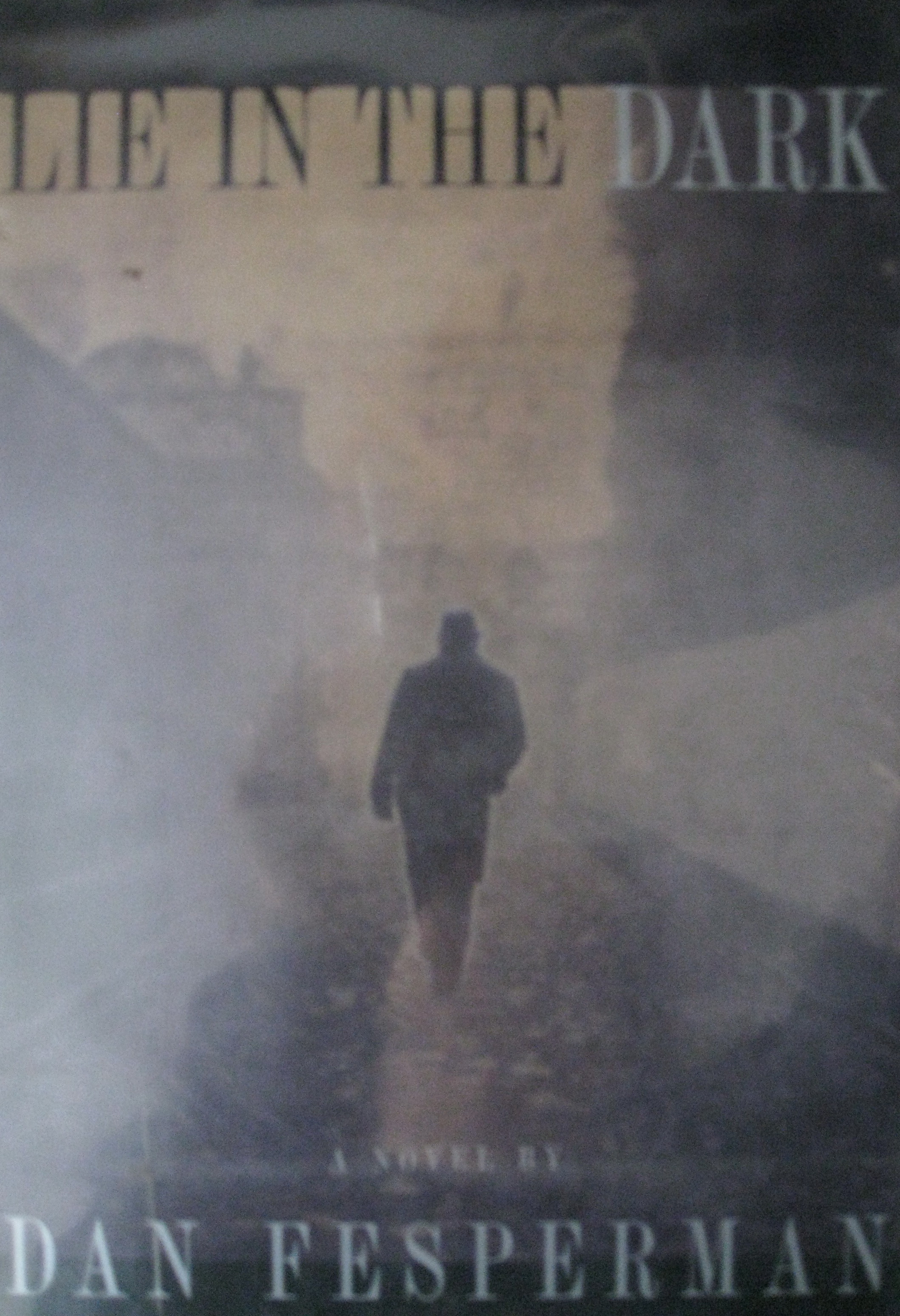
Lie in the Dark


Fesperman, Dan. Lie in the Dark. New York: Soho Press, 1999.

 I can remember this intense sadness when the civil war in Sarajevo broke out…the second time. It seemed like yesterday the Olympics were held there & it was a city of promise, of dreams come true.

Lie in the Dark is an interesting tale about life in war-torn Sarajevo and one police inspector’s fight to win his own private war. In the beginning of the conflict Vlado Petrics’s wife and infant daughter were allowed to escape to Germany. Vlado, as with all men of military serving age, stayed behind. He escaped being drafted into the military because of his employment as a policeman.
While investigating a murder Vlado is confronted with a much bigger scandal than he bargained for. Not knowing who to trust he works alone, unraveling the mystery while the civil war continues all around him. Woven into the plot are the harsh realities of what war can do to economics, politics, families, the landscape and the human spirit.

Right away I knew I would like this book. Fesperman does a great job describing the absurdity of investigating a murder in the middle of a war. As Fesperman says (p 2) “Vlado’s task was that of a plumber fixing leaky toilets in the middle of a flood.” It makes you realize that people will grasp and struggle for normalcy even if it doesn’t make sense.

Favorite lines: ” They never stopped retreating, ending up at the bottom of either a bottle or a grave” (p 5).
I found this next line profoundly sad: “It had taken the first few weeks of separation to rediscover her as lover, as something more than the wife and mother she’d become” (p 83).
“He felt himself beginning to deaden, to go numb and cold and dreary as he left the truth behind” (p 86).

BookLust Twist: From More Book Lust in the chapter “Crime is a Globetrotter” (p 59).

Jackson’s Dilemma

Murdoch, Iris. Jackson’s Dilemma. New York: Viking, 1995.

I hate it when I read a review that influences my way of thinking, my way of reading a book. This happened innocently enough. I was looking for more information about Jackson’s Dilemma. Was it ever made into a movie? Adapted for the stage? A musical? As a result of my searching I discovered Jackson’s Dilemma was Murdock’s last book. Not only that, but she was diagnosed with Alzheimer’s right around the time of publication. Inadvertently, I read two reviews that seemed to blame the disease for the demise of Murdoch’s craft. In other words, Jackson’s Dilemma bombed. Because of the reviews I found myself wondering about the words. I will admit, the beginning was slow and the characters, curious, but in the end I didn’t think it was all that bad.

It starts off on the eve of Edward and Marian’s wedding. Edward is enjoying dinner with friends when he discovers a note under the door: an “I can’t marry you” letter from Marian. There is no explanation but the following day there is much hoopla about making sure people are “barred” from the church and from attending a wedding that won’t happen. All of Edward’s friends are absurdly devastated by this turn of events, so much so that I started to really question their sanity. Meanwhile, both Edward and Marian disappear (separately, of course). Enter Jackson (Just Jackson, no last name). Even his arrival is peculiar.

In the end the plot becomes a garbled mess. Everyone is trying to be in love with someone else, exclaiming undying devotion left and right. Even Owen (male) and Tuan (also male) have some kind of odd, unexplained relationship going on. Despite all this, I did have two favorite lines: “The moon was not present, being elsewhere” (p 22). Who actually knows where the moon was, but I thought that was funny. The other line: “After all, as Randall said, it’s the sea that matters” (p 100). Too bad Randall would lose his life to the very thing that mattered.

BookLust Twist: Book Lust in the chapter “Iris Murdoch: Too Good To Miss”. Leave it to me to read her last book (sorta) first.

Chasing Vermeer

Balliett, Blue. Chasing Vermeer. New York: Scholastic Press, 2004.

I love it when a book takes me somewhere new. It’s even better when it opens doors to other interests that stick. It’s best when it’s completely unexpected. Such is the case with Chasing Vermeer. When I first realized it was a young adult book I thought I would get through it in a day, get through it and move onto something more my speed. Who knew this book would be just my speed? For starters there is a play-along game involving pentominoes. If you can’t get the hidden message there is an interacted website (still active) to help you out, complete with other games to get you sidetracked. Then, there is the discovery of something completely unexpected I mentioned before. Chasing Vermeer mentions a lot of Vermeer’s work in detail so I started doing a little more research and found a fantastic website dedicated to Vermeer. It’s really great. I lost my lunch break playing with it! I love learning something new everyday in the most unexpected ways. But back to Chasing Vermeer, the book.

It’s a great mystery for kids and adults alike. Petra Andalee and her new found friend Calder Pillay find themselves in the middle of a mystery complete with codes and the crime of stolen art. It starts off with Petra and Calder as classmates with a weird assignment: find letters in art. Both Petra and Calder call the other “weird” and can’t imagine ever being friends, but soon weird coincidences bring them together to solve a mystery involving an old woman, the FBI and an international art scandal.

Here are some quotes that nabbed me: “Good letters were no longer written. He was sure of it” (p 23). Glad I’m not the only one who feels this way!
“What was art, anyway? The more she thought about it, the stranger it seemed” (p 40). My thoughts exactly!

BookLust Twist: From More Book Lust in the chapter “Best For Boys and Girls” (p 21).

Murder on the Leviathan

Murder on the LeviathanAkunin, Boris. Murder on the Leviathan. New York: Random House, 2004.

Oddly enough, I chose this book because it was written by an author who spent a great deal of time in Moscow and a guide book advised me that now was the best time to visit Russia. There was no other reason to read this at this particular time. But, having said that, I’m glad that I did. It was fun.
Murder on the Leviathan starts out violently, a record of an examination of a crime scene set in 1878. I think the murders of ten people ranging from ages 6 to 54 in one Parisian house would cause a stir even in the 21st century. Oddly enough, this is not the murder the title of the book refers to. Commissioner Gauche discovers a clue that leads him to the Leviathan, a giant steamship headed for Calcutta. As he sets sail with a host of interesting passengers (in first class) he soons discovers each and every one of them is a potential suspect. It gets interesting when people start dying on the ship. A Russian detective soon joins Gauche on the hunt for the killer.

I didn’t find any quotes to include, but I did have to look up “gutta-percha” shoes. Depending on who you ask, gutta percha is described as tree gum, rubber, or plastic.

BookLust Twist: In More Book Lust in the chapter “Crime is a Globetrotter”, subsection, “Russia” (p 59).

Case for Three Detectives

Case for Three Detectives
Bruce, Leo. Case For Three Detectives. Chicago: Academy Chicago, 1936.

First things first: Leo Bruce is actually a pseudonym for Rupert Croft-Cooke. Just had to get that out there. Second, I have to say how disappointed I am to not be up on my mysteries – or at least the detectives of pop culture! Nancy Pearl compares the three detectives in Case for Three Detectives with Peter Wimsley, Father Brown, and Hercule Peirot. I have only vaguely heard of Peirot so I had no idea what she was talking about! My loss, I guess.
Maybe it’s a generational thing (because this book was written over 70 years ago). Maybe it’s a cultural thing (because this book is decidedly British). Either way, I wasn’t able to get over the fact that, despite a murder (a woman’s throat was slashed), not only were people capable of carrying on as if nothing happened (washing cars and entertaining), but the guests were included to help solve the mystery. Now, I have to keep in mind in those days guests stayed overnight and became “house guests” and dinner parties consisted of four or five house guests, each with his or her own room. 
Pearl included this in her “humor” section but warned I probably wouldn’t laugh outloud, and she’s right. I didn’t. It’s the mystery of three off the wall detectives trying to solve a murder. Each comes up with a completely different yet plausible scenerio for what could have happened. You find yourself saying, “but, of course!” until you hear the final Who Really Did It story. 
A line that made me smile: “‘If you mean spiders,’ he said, ‘I know only two things about them. And those are the things which everyone knows. They kill flies. And they hang on threads.'” (p53).

BookLust Twist: From More Book Lust in the chapter “Tickle Your Funny Bone” (p 218).

Fer-De-Lance


Stout, Rex. Fer-De-Lance. Pennsylvania: Franklin Library, 1934.When I saw this book arrive in the library van box for me I got very excited about the cover alone. It’s beautiful! I didn’t even know it was my requested book, just that it had a gorgeous cover. How’s that for judging a book by its cover? I have heard so much about Rex Stout and his Nero Wolfe mysteries but had never read one before now. I have to admit, I didn’t really care for the character of Mr. Wolfe. He seems to spend a lot of time bossing other people around while being very, very particular about his own activities. The story is actually told from the point of view of his assistant, Archie Goodwin, who seems to do all the legwork work solving mysteries since Wolfe never leaves home.

So, the plot to Fer-De-Lance is this: a man is found murdered. Clues in his room lead to the death of someone else. Ultimately, it’s the solving of the second death that leads to the truth of the first death. It’s a fun story. Here are some of my favorite quotes:
“I made some sort of conversation so O’Grady’s ears wouldn’t be disappointed” (p 39).
“Maybe your salary is the only rope that holds Saturday and Sunday together for you” (p 48).
“It is always wiser, where there is a choice, to trust inertia. It is the greatest force in the world” (p 190).
“A genius may discover the hidden secrets and display them, only a god could create new ones” (p 246).

BookLust Twist: From Book Lust and the chapter “Rex Stout: Too Good To Miss”