March 2009 was…

March was all about the new house. Moving, moving, moving. Living in limbo. For books it managed to be:

  • The Concubine’s Tattoo by Laura Joh Rowland ~ fascinating tale that takes place in 17th century Japan (great sex scenes to get your libido revving). So good I recommended it to a friend.
  • The Bethlehem Road Murder by Batya Gur ~ Israeli psychological thriller.
  • The Drowning Season by Alice Hoffman ~ a grandmother and granddaughter struggle to understand one another.
  • Daniel Plainway or The Holiday Haunting of the Moosepath League by Van Reid ~ this was a really fun book with lots of subplots and meandering stories.
  • The Famished Road by Ben Okri ~ I will admit I failed on this one. Magical realism at this time is not a good idea.I need to keep my head grounded, so to speak.
  • The Old Gringo by Carlos Fuentes ~ This was a powerful little book, one that I definitely want to reread when I get the chance.
  • Lone Star by T.R. Fehrenbach ~ The history Texas. More than I needed to know. More than I wanted to know.
  • Saint Mike by Jerry Oster~ an extra book in honor of hero month. I was able to read this in a night.
  • Industrial Valley by Ruth McKenney ~ in honor of Ohio becoming a state in the month of March.
  • The Fan Man by William Kotzwinkle ~ in honor of the Book Lust of others. Luckily, it was only 182 pages.

For the Early Review program:

  • When the Time Comes: Families with Aging Parents Share Their Struggles and Solutions by Paula Span ~ this was gracefully written. Definitely worth the read if you have elderly people in your care.

For fun:

  • Dewey: The Small-Town Library Cat Who Touched the World by Vicki Myron ~ really, really cute story. Of course I cried.

I think it is fair to say work had me beyond busy. But, I will add it was a learning experience and for that, I am glad. Reading these books during the crazy times kept me grounded and for that, I am doubly glad and grateful.

When the Time Comes

Span, Paula. When the Time Comes: Families with Aging Parents Share Their Struggles and Solutions. Springboard Press, 2009.

When this book first came in the mail my mother was visiting. She has just celebrated her 60th birthday. Savvy, independent, strong in body and mind I didn’t really think this book applied to her. Needless to say I was surprised when she thought I requested this particular book to review on purpose, because of her. It became an awkward moment because when I scanned the selections for the month I can’t say I specifically chose the book because of her. It is more accurate to say I didn’t pass over the choice because of her. Does that make sense?

At any rate, I found Span’s book When the Time Comes incredibly useful in some respects and (predictably) not so helpful in others. I enjoyed all of the stories about the trials, tribulations and triumphs of caring for elderly parents. It put aging into perspective. Not all parents will age the same way, physically or mentally. Not all parents will welcome the solutions their children have to offer. Not all solutions will work for all types of aging. The variables are endless but Span does a wonderful job trying to tell a different story for each scenario. It was wonderful to have examples to remind the reader, “you are not alone.” I found myself comparing the stories on the page with situations I know in real life and nodding in agreement all the while. On the negative side, the title of this book is misleading. It implies this is a book about aging, and this is not a book for someone who has parents years, possibly decades, away from needing elderly care. By the time my mother deems it necessary to have outside help some of the resources Span lists in her book might not be available to me. Websites disappear, organizations change. While this is definitely a book to prepare children for the aging of their parents, it is not recommended for planning too far in advance. However, should my mother have a stroke or serious accident I could pick up When the Time Comes and start using it immediately.

Powers That Be

Halberstam, David. The Powers That Be. New York: Alfred A Knopf, 1979.

When I told a friend I was reading this as my last February book his eyes lit up – said that Halberstam was one of his favorites, “for the sheer irony of him.” Whatever that means.

Despite its heft (being 771 pages long), The Powers That Be was an extremely entertaining read. But, I have to confess I ran out of February and didn’t finish it in time. Back to the book: Halberstam’s style of writing is intimate. It is as if he is taking his reader into his confidences – leaning in to tell the reader secrets in a hushed, yet knowledgeable voice. His prose is not gossipy, but rather matter of fact. Yet, there is a hint of society tell-all about it. In one particular section Halberstam states Edward Murrow was “ungodly handsome” (p 40), but then does not offer proof by way of pictures or real description. The reader simply has to take his word for it (luckily I’m old enough to remember what Murrow looked like). Halberstam deftly wraps the political and economic climates around the historical who, what, where, when and why of all media giants. Events like the Great Depression, World War II, the Cold War, Communism, and Vietnam all played a crucial part in influencing print, radio and television communications. How the world received information changed all landscapes – political, economic, social, forever.

BookLust Twist: Mentioned twice in More Book Lust. First in the chapter called, “The Fourth Estate” (p 92) and in the chapter, “David Halberstam: Too Good To Miss” (p 112).

Cult of Personality

Paul, Annie Murphy. The Cult of Personality: How Personality Tests are Leading Us to Miseducate Our Children, Mismanage Our Companies, and Misunderstand Ourselves. New York: Free Press, 2004.

Okay. How many of us think of a well toned guy with long hair jumping around in bright colored spandex when we hear the words “cult of personality”? Am I the only one who thinks fondly back to Living Colour days? Probably. I’m showing my age.

At any rate, the book The Cult of Personalityby Annie Murphy Paul is compelling. Fearing it to be a dry, psychology “talk-shop” laden lecture on personality tests I read it along side a fictional psycho-babble book. Oddly enough, I found the nonfiction just as interesting as the fiction. Paul’s book didn’t need the fictional bells and whistles to be a page-turner. Paul has a style of writing that is reminiscent of Halberstam such that you feel as if you are getting good society gossip (like the details of a juicy affair) along with the cut and dried information on how a test was conceived.

BookLust Twist: In More Book Lust in the chapter called, “Dewey Deconstructed” (p 62).

March 2009 is…

March is going to be the month of new leaves. Hopefully, some on the trees but more for me. I am hoping to change some things along the way. Here’s hoping at least. March is also a number of great birthdays (Atty, rock on with your bad five year old self!). I was thinking March was music, but I’m rethinking that (although, Rebecca has come home). Needless to say, March is also a new address that’s keeping me really, really, really busy! *Quick house update: we got the washer/dryer hooked up, hung temp curtains, got the phones rewired, got another phone for man town, picked up a dehumidifier, unpacked all the house boxes, organized the kitchen, and got the cat to hang out in more than one room!*

Here’s what is on the list for March:

  • Concubine’s Tattoo by Laura Joh Rowland ~ in honor of March being the best month to visit Japan.
  • Daniel Plainway by Van Reid ~ in honor of Maine becoming a state in March
  • Drowning Season by Alice Hoffman~ in honor of Alice’s birth month
  • Famished Road by Ben Okri ~ in honor of March being African Writers Month
  • Bethlehem Road Murder by Batya Gur ~ in honor March being the best month to visit Israel

If there is time:

  • Industrial Valley by Ruth McKenney
  • Lone Star by T.R. Fehrenbach

And for fun it is:

  • Dewey the Library Cat by Vicki Myron (a Christmas gift I have been dying to read)

For the Early Review Program it is:

  • When the Time Comes by Paula Span (a nonfiction about preparing for the aging of your parents).

February (2009) Was…

February started the month with a big ole bang. First, there was the Gee-I-Couldn’t-Have-Predicted-the-Winner-of-This-Matchup Superbowl. Then, there was me. Turning 40. Then, add in Smiley’s birthday, a rockandroll party and approval for financing, a memorial and a visit from mom… all in the first week! Like I said, February started with a bang! Then it turned into the wait and see month…which ended in a house!

For books it it was:

  • Cult of Personality by Annie Murphy Paul. A fun, informative read!
  • The Extraordinary Voyage of Pytheas the Greek by Barry Cunliffe. Not so fun.
  • The Good Patient by Kristin Waterfield Duisberg ~probably one of my favorites of the list.
  • The Color Purple by Alice Walker ~ really, really hard to read. So sad!
  • Fool by Frederick Dillen ~ very psychological.
  • The Inn at Lake Devine by Elinor Lipman ~ very cute.
  • Bedtime for Frances by Russell Hoban ~ speaking of cute!
  • Not a Day Goes By by E. Lynn Harris ~ a very, very quick read in honor of Black History Month
  • A Reconstructed Corpse by Simon Brett in honor of National Theater Month even though the acting in this mystery doesn’t take place on a stage…
  • Tracks Across America by Leonard Everett Fisher ~ in honor on National Railroad Month
  • The Powers That Be by David Halberstam ~ in honor of Scholastic Journalism month

As you can see, I did a lot of reading during that “wait and see” time! In the end, February was full of emotions as well as books and finally, finally a house!

I didn’t get to A Tale of Two Cities by Charles Dickens and I started When the Time Comes by Paula Span – an Early Review book (review coming in March).

Tracks Across America

dscn0495Fisher, Leonard Everett. Tracks Across America: The Story of the American Railroad 1825-1900 with photographs, maps, and drawings. New York: Holiday House, 1992.


My father-in-law has a love affair with trains. He can’t wait for me to move out of his house so he can set up his ultimate railroad village complete with snow covered trees and a ski loving community. I can’t say I blame him. There is a romance associated with the railroad whether it’s the real deal or in miniature.

I think Fisher’s title would have been only slightly more accurate if he had added the word quotations to “with photographs, maps, and drawings” because that’s all that was missing. In addition to an informative narrative and the before mentioned photos, maps, and drawings Fisher includes fitting quotes from Charles Dickens, Ralph Waldo Emerson, and Woodrow Wilson as well as song lyrics and poetry fitting of the railroad era. While Tracks Across America is a condensed version of the story of the American railroad Fisher makes an effort to include all aspects of the history including life before the railroads, the building period, the Civil War, Native American “resistance” (really hard to read), famous robberies and disasters, and progress with bigger and faster engines.

One of the best discoveries was learning the origin of the phrase “wrong side of the tracks.” You were on the wrong side if the wind blew the soot and dirt from the trains in your direction. It was considered in poor taste to have a church or home “on the wrong side” but my question is this, what happened when the wind changed direction?

Favorite quote: “…that rails were to a train what water was to a boat; and that if a bridge was necessary to take a train over a river, then that bridge had a perfect right to be there” (p 47). This was Abraham Lincoln’s argument during his 1856 trial defending the railroad against a steamboat’s claim of damage.

BookLust Twist: From Book Lust in the chapter called, “Riding the Rails: Railroad History” (p 200).

Guns of August

Tuchman, Barbara. The Guns of August. New York: Dell, 1971.

My copy of The Guns of August is a squat, 576 page, dirty, and torn paperback. It has been taped several times over and written in much, much more. Nothing drives me more nuts than a library book with someone’s scrawl all over it. Donated or not, it never should have gotten into the collection that way. But, back to the actual book.

The Guns of August is nothing short of impressive. It should have won a Pulitzer for history but because Pulitzers for history can only be handed out for U.S. history, it got one for nonfiction. Same diff in my book. It was a national best seller, John F. Kennedy referred to it on more than one occasion as the end all-be all for political strategy and it was made into a movie. In other words, the critics have weighed in – it’s a good book.

Lines that (oddly) made me laugh: “Systematic attention to detail was not a notable characteristic of the Russian Army” (p 78).
“Messimy telephoned to Premier Viviani who, though exhausted by the night’s events, had not yer gone to bed. “Good God!” he exploded, “these Russians are worse insomniacs than they are drinkers”…” (p 109).

BookLust Twist: In More Book Lust in the chapter, “Barbara Tuchman: Too Good To Miss” (p 225). Indeed.
Confession: because of the length of The Guns of August I read it for the entire month of January.

Extraordinary Voyage of Pytheas the Greek

Cunliffe, Barry. The Extraordinary Voyage of Pytheas the Greek. New York: Walker & Co,. 2001.

I have to admit that this little 178  page book took me by surprise. If the photographs and maps were removed it would be shortened to 166 pages. Take out the “further reading” section and all the quoted text and you would be left with only 156 pages (approximately) which meander just as much as Pytheas’s exploration. A good chunk of those remaining pages have large segments on periphery details like tin smelting and the electrostatic qualities of amber. Unfortunately for ancient history enthusiasts there isn’t much to refer to for first hand accounts of the travels of Pytheas. Unlike Cook or Columbus, the writings of Pytheas did not survive to present day. All that is left are the numerous documents either quoting Pytheas or written about Pytheas. Such as this book.

Favorite lines: None.

BookLust Twist:  From Book Lust in the chapter called, “Here Be Dragons: The Great Explorers and Expeditions” (p 111). Note: On The Ocean by Pytheas is also mentioned in this chapter. For obvious reasons I won’t be reading it.

January Was…

January started off and ended with a head cold (damn you, kisa), a really nice dinner party, a re-commitment to the houses HOUSE (glutton for punishment that I am), a re-commitment to charities with a big one – training for a 20 mile walk for Project Bread, a huge re-commitment to friendships and huge changes at the library. For books it was:

  • Death Comes to the Archbishop by Willa Cather in honor of New Mexico becoming a state in January.
  • Red Death by Walter Mosely in honor of Walter’s birthday being in January
  • Biggest Elvis by P.F. Kluge in honor of both Elvis and P.F. celebrating their birthdays in January.
  • Devices and Desires by P.D. James ~ in honor of mystery month.
  • The Eleven Million Mile High Dancer by Carol Hill
  • Edith Wharton: a Biography by R.W.B. Lewis ~ in honor of Edith’s birthday on January 24th.
  • The Guns of August by Barbara Tuchman ~ in honor of Barbara’s birthday.

For fun:

  • The Letters by Luanne Rice and Joseph Monninger ~ a story that partially takes place on Monhegan. How could I resist? This is the blog that was plagarized by some dumb-azz.
  • 30 pages of Nutritional Wisdom ~ a Christmas gift from my sister.

So I didn’t get a LibraryThing Early Review book in January. That’s not a big deal. I have certainly gotten my fair share over the course of the program so I’m not complaining. I do have to admit, I feel a little guilty. For the first time ever, I am really late publishing the review for the last ER book. Maybe that had something to do with it…who knows?

ps~ I did get one for February, or so I am told! 🙂

Edith Wharton: a Biography

Lewis, R.W.B. Edith Wharton: a Biography. New York: Harper & Row, 1975.

I had always know Edith Wharton was gifted even as a child. I think I was 16 the first time someone told me she was of my age when she first published. What they failed to tell me was that her literary voice fell silent for over a decade after that. I thought she had published all along and as a result I have always been impressed by her lifelong success.

Beginning with Wharton’s genealogical background and ending with her funeral R.W.B. Lewis’s  Edith Wharton: a Biography is at once both extensive and entertaining. Wharton begins her life as Edith “Pussy” Jones, the daughter of a socially well-to-do family. Her life is surrounded by all the things the culture of 1870s cherished – multiple family estates, social gatherings with citizens of good standing and trips abroad to places like Italy and France. With access to letters, diaries and manuscripts Lewis is able to give animated details to Wharton’s upbringing and subsequent literary career. It is no wonder he won a Pulitzer for his work. It also is easy to see how Wharton was drawn to a writing career when you consider the wealth of influences in that era: Henry James, Theodore Roosevelt, William Vaughn Moody, Charles Dickens, Gustave Flaubert, and George Eliot to name a few. What is amazing is her inability to stay the course of confidence. The slightest criticism could send her career out of commission for months at a time.

On a personal note – because Edith’s marriage failed and she never had kids there was on and off speculation about her sexuality. Rumors ranged from lesbian to frigid and everything in between. Edith did her best to remain privately passionate despite the talk, but I think, in the end, there was some overwhelming desire to prove something to her critics. At least, that is the explanation I am taking away with me when it comes to the incestuous, slightly pornographic appendix C.

Favorite Edith Wharton realization: During World War I, otherwise known as The Great War, Edith started up charities to help displaced refugees and war victims. Some if her tireless crusades were taken up by the Red Cross when they became too much for her.

Favorite passages: “She had learned from Bernhard Berenson…to take a professional librarian’s attitude towards her own private library, and the disposition of books..” (p 4).
“…but at this stage it was almost as important for her that the young Bar Harborites excelled at the art of flirtation” (p 39).

BookLust Twist: From More Book Lust in the chapter, “Literary Lives: The Americans” (p 144).

Choice Cuts

Kurlansky, Mark. Choice Cuts: a Savory Selection of Food Writing from Around the World and Throughout History. New York: Ballantine, 2002.

I like nothing better than a good cookbook. A close second to a good cookbook is reading books written by cooks. Mark Kurlansky does one better and combined the best of food writing from soup to nuts; covering techniques, ingredients and even ethnic origins of food. Then, there’s the introduction. How can you compete when the introduction is titled, “Better than Sex” (p 1)? I mean, come on! Out of the thirty chapters  five six really grabbed my attention. More than the introduction, you ask? Mais oui! How could I not be seduced with chapter titles such as these: “Rants” (p 115), Poultry, Fowl, and Other Ill-Fated Birds (p 210), “Loving Fat” (p 303), “The Dark Side of Chocolate” (p 330), “A Good Drink” (p 361) and, “Bugs” (p 380). See, aren’t you the least bit curious about that last one?

Everything about this book is based on one simple subject – food. Kurlansky takes that subject and explores everything having to do with it. From growing, hunting, buying, and preparing to smelling, eating, and savoring it. The art of cooking, the downfall of rotting, from killing to cultivating. From Cato to Chekhov, Kurlansky finds quotes, essays and passages from a multitude of well known individuals, some with lives centered around food like M.F.K. Fisher and Elizabeth David and some not like Virginia Woolf, Ernest Hemingway and E.M Forster. Whether focused on an ingredient like garlic or chocolate, or a technique like faking venison or baking bread, or a location like favorite restaurants or markets, Kurlansky covers it all. It’s historical and cutting edge. Technical and funny. Poetry and dissertation. Well worth the read.

Favorite passages: “A blonde seems humbly to beseech your heart while a brunette tends to ravish it” (p 39), “So don’t worry about me down here eating nothing and [makeing] an ass of myself. I have had strange eating habits since I was a boy (Ernest Hemingway)” (p 61) and, “cook-books have always intrigued and seduced me (Alice B. Toklas)” (p 182).

BookLust Twist: From Book Lust in the chapter, “Mark Kurlansky: Too Good To Miss” (p 146).

A side note: Before I knew what Choice Cuts was really about I assumed it had something to do with meat. After all, Kurlansky has written about solitary food items such as cod and salt, too. So, thinking this was a book about edible meats nothing disturbed me more than seeing an illustration for what I thought was a squirrel. I was close – it was a dormouse.

January is…

January is..a little sass

What is it about a new year that inspires so much ambition? Where does that fresh start attitude really come from? January is so many things to so many different people. For me it is simply all about the books:

  • Death Comes to An Archbishop by Willa Cather in honor of New Mexico becoming a state in January
  • Biggest Elvis by P.F. Kluge in honor of the King’s birthday and P.F. Kluge having a January birthday as well.
  • Book of Puka-puka by Robert Dean Frisbie in honor of National Geographic month
  • Devices and Desires by P.D. James in honor of January being mystery month
  • Red Death by Walter Mosely in honor of Walter’s birthday being in January
  • Guns of August by Barbara Tuchman in honor of Barbara’s birthday being in January

I haven’t decided on any “if there is time” books because I don’t think I’ll get through what I have chosen (Guns of August is over 500 pages long). Also, I don’t know if I was chosen for a LibraryThing Early Review book for January. I guess we’ll find out by the time I write “January Was…”

For Christmas I received only one book, Nourishing Wisdom by Marc David. A gift from my sister, I plan to read it over the next two to three months. It’s not all that long (185 pages) but I want to take my time with it.

For other resolutions it is running just a little more, maybe drinking coffee a little less. It’s eating a little more healthy, maybe seducing the vending machine a little less. It is writing there more often, maybe blogging here a little less. It is giving up crutches and leaning more on the ones who matter most. Like I said, it is so many different things. I want to thank Sarah and Gnash for their inspiration. Both have amazing ambitions and they have no idea how much I will be cheering them on throughout 2009.

December Was…

img_0030December started off being my fresh start. New houses, new atttitude. It would have been a return to charity walks (or runs?) had a little thing called house hunting not gotten in the way! December ended up being a really, really difficult month. Lost another house, craziness at work, mental health taking a trip south, a passing of a friend and coworker… Here are the books I read escaped with. It may seem like a lot but, keep in mind, I cheated. I was able to read the first two in November.
  • The Quiet American by Graham Green ~ I read this in three days time…in November. Was really that good!
  • A Dangerous Friend by Ward Just ~ Another book I read in just a few days time, again…in November.
  • Anatomy of a Murder by Robert Traver ~ probably one of the best court-room dramas I have ever read.
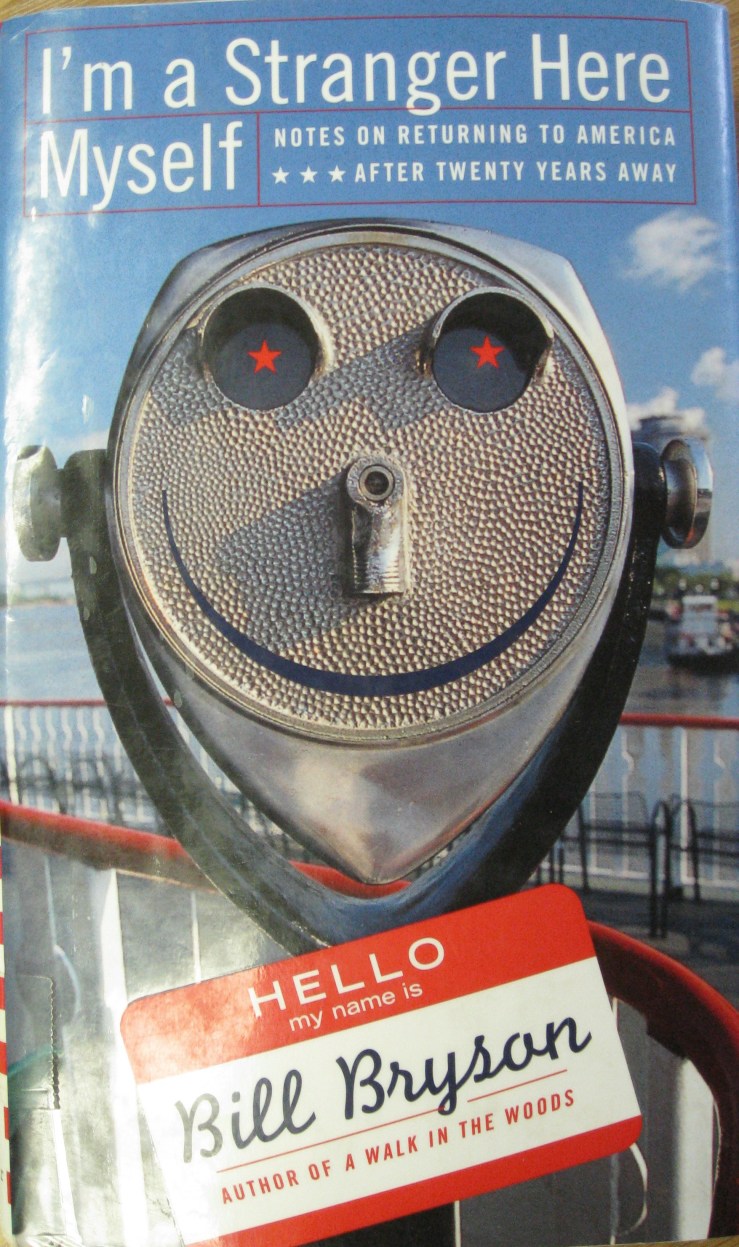
  • I’m a Stranger Here Myself: Notes on Returning to America After Twenty Years Away by Bill Bryson ~ funny, but repetitive!
  • A Family Affair by Rex Stout ~ very strange yet entertaining.
  • Lincoln’s Dreams by Connie Willis ~again, strange but entertaining!
  • Shoeless Joe by W.P. Kinsella ~ okay. I’ll admit it. This one made me cry.
  • ‘Sippi by John Oliver Killens ~ powerful – really, really powerful. That’s all I can really say.
  • Snobs by Julian Fellowes ~ silly story about what happens with you combine boredom with good old fashioned English snobbery.
  • Choice Cuts by Mark Kurlansky ~ really interesting, but a bit dry at times (no pun intended).

For LibraryThing it was the fascinating Honeymoon in Tehran by Azadeh Moaveni (really, really good).

Confession: I started Le Mort d’Arthur and couldn’t deal with neither volume one or two. Just not in the mood for the King, no matter how authoritative the version.

So. 11 books. Two being in the month of November and nine as the cure for what ailed me.

Edited to add: someone asked me to post “the count” at the end of each “— Was” blog. What a great idea. I will be starting that next month – something new to start 2009 with. Thanks, A!

I’m a Stranger Here Myself

BrysonBryson, Bill. I’m a Stranger Here Myself: Notes on Returning to America After Twenty Years Away. New York: Broadway Books, 1999.

I was skeptical of this book. The premise is Bryson has been away from American soil for twenty years (living in England) and the book is supposedly his running commentary on how different everything has become. Right off the bat I wanted to ask, “What? They didn’t have ATM machines or public pay phones in England? Not even by the time Mr. Bryson left?” I have to admit, it never crossed my mind that England could be twenty years behind the U.S. in such things as technology and invention.
In actuality, Bryson’s book was, in a word, delightful. I thoroughly enjoyed his opening essay about the differences between English and American postal services. However, for the most part the comparisons ended there. It was more about how nonsensical America could be with it’s rules and regulations. It reminded me of Robert Fulghum with his humorous observations.

Favorite funnies:
“Going to a restaurant is generally a discouraging experience for me because I always manage somehow to antagonize the waitress” (p 13).
“It is all immensely complicated, but essentially it means that practically every team in baseball except the Chicago Cubs gets a chance to go to the World Series” (p 25).
“He converses as if he has heard that someday he will be billed  for it” (p 93). Sounds like my father!

BookLust Twist: From More Book Lustin the chapter, “Bill Bryson: Too Good to Miss” (p 36).