Guns of August

Tuchman, Barbara. The Guns of August. New York: Dell, 1971.

My copy of The Guns of August is a squat, 576 page, dirty, and torn paperback. It has been taped several times over and written in much, much more. Nothing drives me more nuts than a library book with someone’s scrawl all over it. Donated or not, it never should have gotten into the collection that way. But, back to the actual book.

The Guns of August is nothing short of impressive. It should have won a Pulitzer for history but because Pulitzers for history can only be handed out for U.S. history, it got one for nonfiction. Same diff in my book. It was a national best seller, John F. Kennedy referred to it on more than one occasion as the end all-be all for political strategy and it was made into a movie. In other words, the critics have weighed in – it’s a good book.

Lines that (oddly) made me laugh: “Systematic attention to detail was not a notable characteristic of the Russian Army” (p 78).
“Messimy telephoned to Premier Viviani who, though exhausted by the night’s events, had not yer gone to bed. “Good God!” he exploded, “these Russians are worse insomniacs than they are drinkers”…” (p 109).

BookLust Twist: In More Book Lust in the chapter, “Barbara Tuchman: Too Good To Miss” (p 225). Indeed.
Confession: because of the length of The Guns of August I read it for the entire month of January.

January Was…

January started off and ended with a head cold (damn you, kisa), a really nice dinner party, a re-commitment to the houses HOUSE (glutton for punishment that I am), a re-commitment to charities with a big one – training for a 20 mile walk for Project Bread, a huge re-commitment to friendships and huge changes at the library. For books it was:

  • Death Comes to the Archbishop by Willa Cather in honor of New Mexico becoming a state in January.
  • Red Death by Walter Mosely in honor of Walter’s birthday being in January
  • Biggest Elvis by P.F. Kluge in honor of both Elvis and P.F. celebrating their birthdays in January.
  • Devices and Desires by P.D. James ~ in honor of mystery month.
  • The Eleven Million Mile High Dancer by Carol Hill
  • Edith Wharton: a Biography by R.W.B. Lewis ~ in honor of Edith’s birthday on January 24th.
  • The Guns of August by Barbara Tuchman ~ in honor of Barbara’s birthday.

For fun:

  • The Letters by Luanne Rice and Joseph Monninger ~ a story that partially takes place on Monhegan. How could I resist? This is the blog that was plagarized by some dumb-azz.
  • 30 pages of Nutritional Wisdom ~ a Christmas gift from my sister.

So I didn’t get a LibraryThing Early Review book in January. That’s not a big deal. I have certainly gotten my fair share over the course of the program so I’m not complaining. I do have to admit, I feel a little guilty. For the first time ever, I am really late publishing the review for the last ER book. Maybe that had something to do with it…who knows?

ps~ I did get one for February, or so I am told! 🙂

December Was…

img_0030December started off being my fresh start. New houses, new atttitude. It would have been a return to charity walks (or runs?) had a little thing called house hunting not gotten in the way! December ended up being a really, really difficult month. Lost another house, craziness at work, mental health taking a trip south, a passing of a friend and coworker… Here are the books I read escaped with. It may seem like a lot but, keep in mind, I cheated. I was able to read the first two in November.

  • The Quiet American by Graham Green ~ I read this in three days time…in November. Was really that good!
  • A Dangerous Friend by Ward Just ~ Another book I read in just a few days time, again…in November.
  • Anatomy of a Murder by Robert Traver ~ probably one of the best court-room dramas I have ever read.
  • I’m a Stranger Here Myself: Notes on Returning to America After Twenty Years Away by Bill Bryson ~ funny, but repetitive!
  • A Family Affair by Rex Stout ~ very strange yet entertaining.
  • Lincoln’s Dreams by Connie Willis ~again, strange but entertaining!
  • Shoeless Joe by W.P. Kinsella ~ okay. I’ll admit it. This one made me cry.
  • ‘Sippi by John Oliver Killens ~ powerful – really, really powerful. That’s all I can really say.
  • Snobs by Julian Fellowes ~ silly story about what happens with you combine boredom with good old fashioned English snobbery.
  • Choice Cuts by Mark Kurlansky ~ really interesting, but a bit dry at times (no pun intended).

For LibraryThing it was the fascinating Honeymoon in Tehran by Azadeh Moaveni (really, really good).

Confession: I started Le Mort d’Arthur and couldn’t deal with neither volume one or two. Just not in the mood for the King, no matter how authoritative the version.

So. 11 books. Two being in the month of November and nine as the cure for what ailed me.

Edited to add: someone asked me to post “the count” at the end of each “— Was” blog. What a great idea. I will be starting that next month – something new to start 2009 with. Thanks, A!

Snagged

Southern end

I hate this murky underwater apathy. This floating through things on tired waves of discontent. Lately, all I want to do is give it up. Why am I exhausted and who should I blame? Maybe it’s the dreams. At night I have nightscares that frighten me so badly I wake disorientated and confused. I struggle to ask myself why do I repeatedly have visions of bombers flying over Monhegan, dropping weapons of mass destruction? Masked fighter pilots spewing hundreds of rounds of bullets into people and places. We run, we scatter, yet there is blood. There is death I can’t explain. The sad thing is this. In my dreams I see them coming from miles and miles away. The sky is crystal clear, glaring and brilliant blue. At first they are dots on the horizon, yet I know who they are and what will happen when they arrive. I am powerless to stop it. As they get closer details emerge until I can see their faces. My dreams make them human and cruel.
Another repeat offended is the dream of drowning. Monhegan is hit with a wave as big as Texas. Again, there is that sense of foreboding. I can see it coming from miles away but I’m powerless to stop it.

Some say I want to destroy home. Some say I am started to dread the return, but what part I always ask. It’s true that Colorado started out as a joke, but has become more of a deep wishful thinking as time goes on. I fantasize about being snagged by the Rockies. I dream about being trapped miles from New England with no direction (or desire) to go home. Is that what I really want?

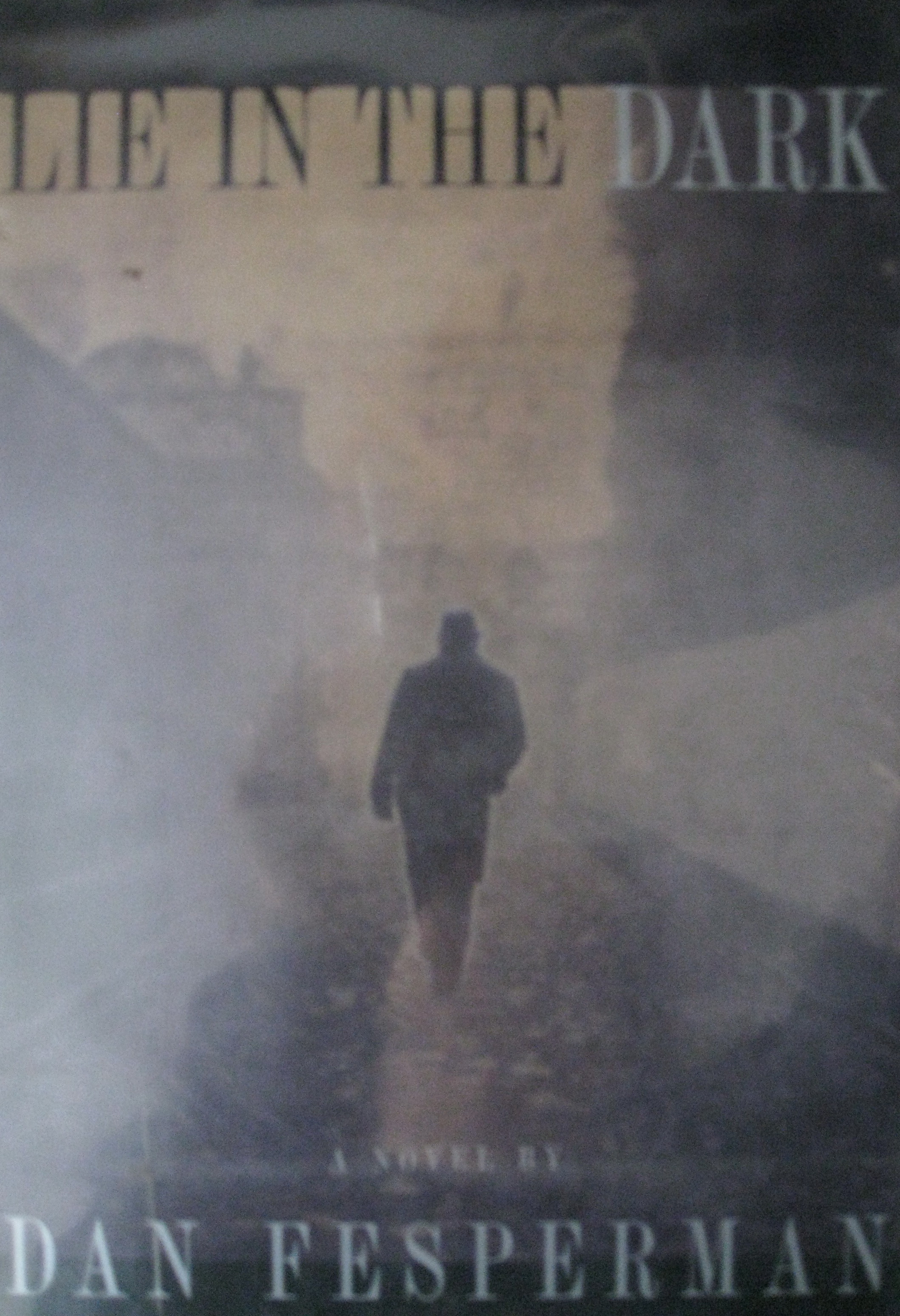
Lie in the Dark


Fesperman, Dan. Lie in the Dark. New York: Soho Press, 1999.

 I can remember this intense sadness when the civil war in Sarajevo broke out…the second time. It seemed like yesterday the Olympics were held there & it was a city of promise, of dreams come true.

Lie in the Dark is an interesting tale about life in war-torn Sarajevo and one police inspector’s fight to win his own private war. In the beginning of the conflict Vlado Petrics’s wife and infant daughter were allowed to escape to Germany. Vlado, as with all men of military serving age, stayed behind. He escaped being drafted into the military because of his employment as a policeman.
While investigating a murder Vlado is confronted with a much bigger scandal than he bargained for. Not knowing who to trust he works alone, unraveling the mystery while the civil war continues all around him. Woven into the plot are the harsh realities of what war can do to economics, politics, families, the landscape and the human spirit.

Right away I knew I would like this book. Fesperman does a great job describing the absurdity of investigating a murder in the middle of a war. As Fesperman says (p 2) “Vlado’s task was that of a plumber fixing leaky toilets in the middle of a flood.” It makes you realize that people will grasp and struggle for normalcy even if it doesn’t make sense.

Favorite lines: ” They never stopped retreating, ending up at the bottom of either a bottle or a grave” (p 5).
I found this next line profoundly sad: “It had taken the first few weeks of separation to rediscover her as lover, as something more than the wife and mother she’d become” (p 83).
“He felt himself beginning to deaden, to go numb and cold and dreary as he left the truth behind” (p 86).

BookLust Twist: From More Book Lust in the chapter “Crime is a Globetrotter” (p 59).

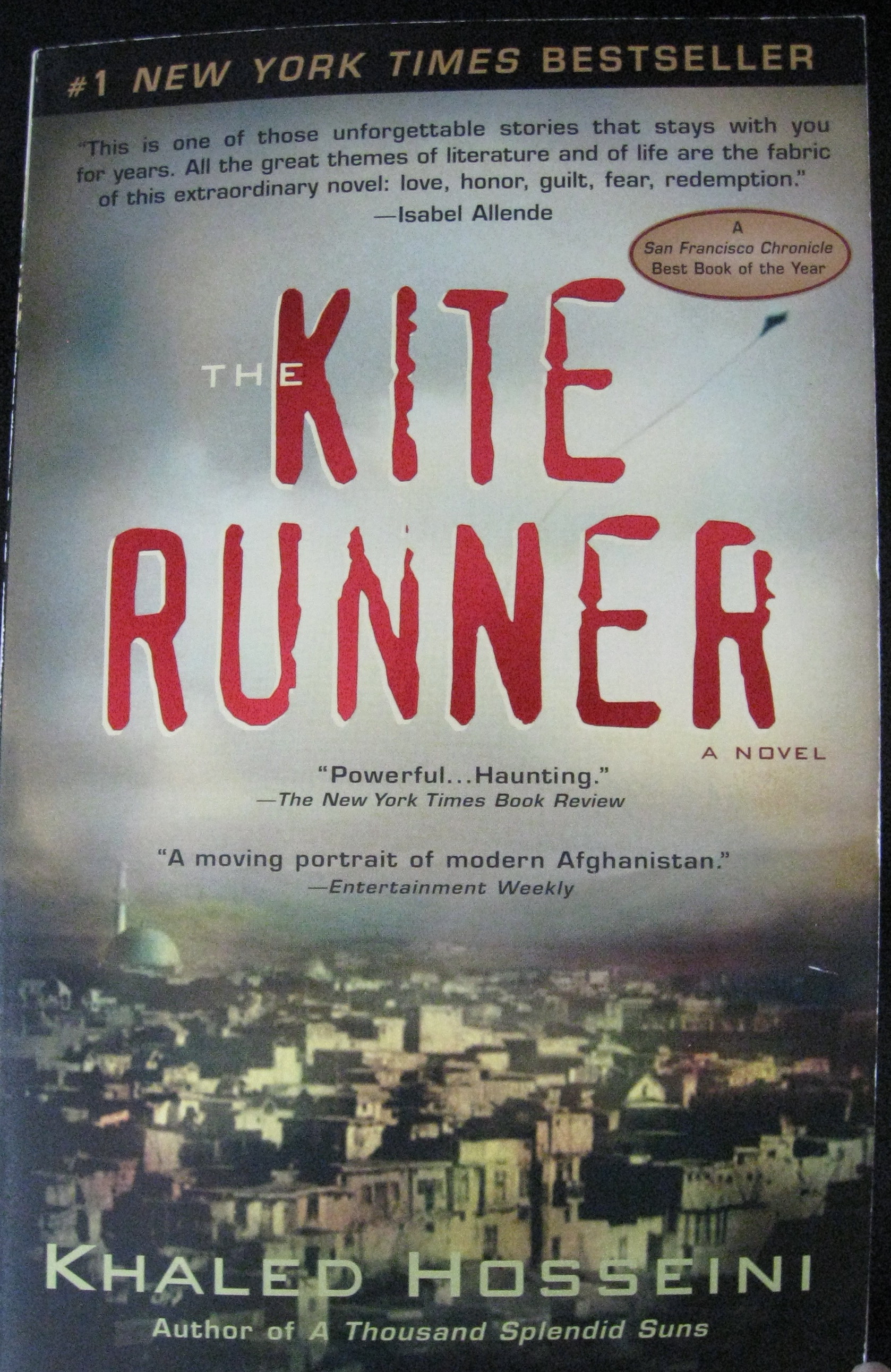
Kite Runner

Hosseini, Khaled. The Kite Runner. New York: Riverhead, 2003.

It is hard to believe The Kite Runner is Khaled Hosseini’s first novel. I am reminded of a favored race horse, one that is described as “strong out of the gate.” I couldn’t put it down (read it from start to finish on the flight back from California). The Kite Runner is a powerful story of friendship and family in a time of political and cultural upheaval. Amir tells the story of his childhood in Kabul, Afghanistan. As a privileged son, Amir grows up in the shadow of his Baba, his father’s affection, constantly looking for ways to win his father’s love and admiration. Occasionally Amir finds the sunshine and basks in the approval, but those moments are fleeting, overshadowed by Baba’s obvious and puzzling devotion to Hassan, a servant’s son. Amir spends his childhood balancing a friendship with Hassan while enduring blinding bouts of jealousy. Amir’s personal turmoil forces him to make regrettable choices and soon his life parallels his country’s dramatic revolution. For both boy and country, life as they knew it is over in a dramatic upheaval.

BookLust Twist: In More Book Lust twice:  First in the chapter called, “Central Asia: Crossroads of Empires, Cauldron of War” (p 40), and again in “Maiden Voyages” (p 159), for being Hosseini’s first book. 

Things They Carried

O’Brien, Tim. The Things They Carried. New York: Broadway Books, 1998.

I admit it. I have picked this book up three different times now. Technically, I should have read it in March to celebrate the day U.S. troops pulled out of Vietnam (March 1975), but as you can tell, there were plenty of other things to reach for in March…
Nope, I cracked this book open for no other reason than sheer boredom. I finished Peter Pan and The Ground Beneath Her Feet and decided I wasn’t up for The Joy Luck Club…at least not right now. The Things They Carried has been hanging around my office for months now. It just seemed to say “read me” and the time was right. I am so very glad.

This was an amazingly moving book. I had a hard time getting into it the first two times I picked it up, but the third time was a charm because after that I couldn’t put it down. Tim O’Brien writes with such ferocious honesty. He calls it a fiction but it easily could have been the truth. The shocking violence, the depths of sadness, the urgency to survive, the humble efforts to maintain sanity and the humor that survives it all…each chapter is a short story of all of these things. Each story stands alone, complete as it is, yet connects beautifully to the story before it as well as the one after it. Peter S. Prescott from Newsweek said the stories “bounce off each other…” and I would agree.
I could quote nearly each story, but here are my favorites:
“They carried all they could bear, and then some, including a silent awe for the terible power of the things they carried” (p 7). The reason why this quote stuck with me is because O’Brien spends the opening chapter listing everything a soldier carried in the Vietnam war. Both the physical and mental, the essential and the sentimental. This quote sums up how they never forgot why they were carrying everything else.
“The problem, though, was that a draft board did not let you choose your war” (p 44). I found this to be one of the most humanitarian statements of the book. O’Brien had just finished explaining that some wars were justified, like stopping Hitler, but in this case he was drafted to fight a war he didn’t understand.

BookLust Twist: From Book Lust in the chapter “Vietnam” (p 239).
ps~ one of the reasons for starting the Book Lust challenge was to find writers I could fall in love with. I wanted one book that would spark an obsession. Much like Margaret Atwood’s The Handmaid’s Tale or Barbara Kingsolver’s Animal Dreams or Katherine Weber’s Objects in the Mirror are Closer than They Appear. All of these books created a rabid need to read anything else written by the authors. I found such an obsession with The Things they Carried. I will go on to get my hands on any and everything Tim O’Brien has written before and since.

Red Badge of Courage

Red Badge of CourageCrane, Stephen. Red Badge of Courage. New York: Signet, 1960.
I have heard complaints about Red Badge (language is archaic, plot is meaningless, etc) and while all those points are valid, they don’t take away from the fact that for a person who never saw a day of combat in life Crane does an excellent job portraying a young soldier in battle. I would imagine that anyone facing death would wrestle with the choice to be brave (“heroic” or “patriotic”) or be a coward. To stay and fight or take flight…especially after encountering death up close.
To say that Red Badge of Courage is about a young man in combat during the Civil War sells the story short. Henry is a young man facing many things for the first time in his life and throughout battle he struggles with all of it. It’s a historical snapshot of the psychology of war. It goes beyond whether Henry can be brave or not. Whether he is a true soldier or not.

I haven’t read Red Badge of Courage since high school but the one scene that has always stuck in my mind is when Henry comes across the dead soldier in the woods. I will always picture the blue uniform faded to a shade of green and the ants. The ants crawling on the dead man’s lip. It’s a powerful scene. The other moment I always remember is when Henry longs to be one of the wounded so that he may have his “red badge of courage” too.

BookLust Twist: From Book Lust in the “Civil War Fiction” chapter (p 57).

Dulce Et Decorum Est

Owen, Wilfred. “Dulce Et Decorum Est.” The Collected Poems of Wilfred Owen. London: Chatto & Windus, 1964. 55.

I think this has to be one of the most famous poems of all times. It is certainly the most famous poem about World War I that I can think of. It’s imagery is so vivid I often recoil from the words as I try to read them. I only think I can imagine the horror of what the soldiers experienced on the battlefields. I can only pretend to feel the pain of their mental and physical traumas. Wilfred Owen has you standing in the trenches with stench of blood and mud in your nose. He has you hearing the bombs whistle and explode in your ears. He has your eyes tearing as they burn from the green gasses and the death of friends.

Lines that killed me:
“As under a green sea, I saw him drowning”
“His hanging face, like a devil’s sick of sin…”

BookLust Twist: From More Book Lust in the chapter “Poetry Pleasers” (p 188).

Edited to add: Some people prefer their poetry in a more lyrical manner. Check out “The Latin One” (10,000 Maniacs, Hope Chest – 1990) for their interpretation.

The End and the Beginning

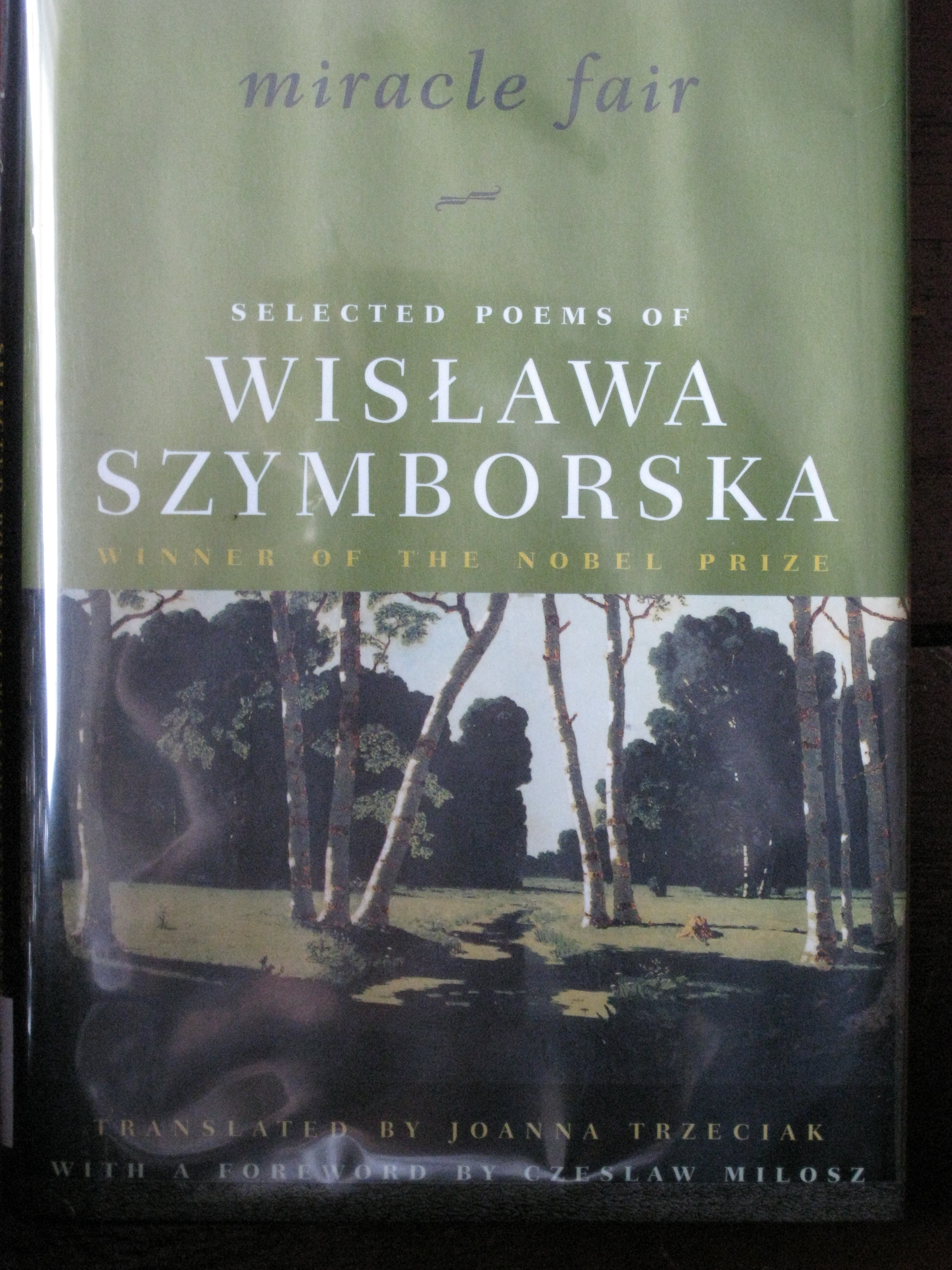
Wislawa Szymborska poetry

Szymborska, Wislawa. “The End and the Beginning.” Miracle Fair: Selected Poems of Wislawa Szymborska. New York: W.W. Norton, 2001.

This poem is so vivid that I pictured it as the scene behind the credits at the end of a war movie. Stay with me. Hear me out. In the poem, Szymborska gently, methodically runs through the list of what must be done at the end of a war: clean up debris, repair houses, rebuild bridges, carry on. Stay strong. So, imagine the credits rolling. The movie has ended, the war is over. Behind the steady stream of names, cast and crew, people survivors are shell shocked and sweeping, weeping and washing, hungry and hammering, biting their lips to continue life as best as they can; as they know how. Somehow, I see this as a stark black and white. More dramatic (or depressing) that way.
My favorite line: “From time to time someone must still dig up a rusted argument from underneath a bush and haul it to the garbage dump.” What does that mean? Maybe two someones can’t decide who really “won” the war. Maybe someone else is adament it rages still…just somewhere else. Arguments that have weathered and rusted from constant exposure.

BookLust Twist: From More Book Lust and the chapter “Poetry Pleasers” (p189).

Storm in Flanders

Storm in FlandersGroom, Winston. A Storm in Flanders: The Ypres Salient, 1914 – 1918: Tragedy and Triumph on the Western Front. New York: Atlantic Monthly Press, 2001.

I’m thinking I shouldn’t have picked this book up in the middle of my current state of mind. Don’t get me wrong, Groom’s history on World War I is impressive. Between the diary accounts, breathtaking pictures and easy language (he called someone a “military nut” and someone else “butt-headed”), this wasn’t a dry read. I know more about military warfare than ever before. For example, I learned WWI was Hitler’s introduction to war, paved the way for him, so to speak. The Germans were the first to introduce poison-gas (mustard gas) warfare; and I now know the meaning behind the poppy-like flowers veterans sell outside the grocery store. I always bought them and hung them in Gabriel without knowing why.
There is humor to Groom’s language: “While the Germans pondered their next move, there was a four-day lull in the fighting – if you can call taking thousands of casualties a day a “lull” (p 51) and “…Germans binged on a gluttony of pork until they were virtually wursted and brattened to their limits” (p 119).

Since Christmas is fast approaching I am drawn to the story Groom tells of Christmas 1914 when both sides put down their weapons and pretended to be friends for a day, exchanging gifts, singing carols, playing games and even laughing with one another. Yet, when the day was over they went back to killing one another.

BookLust Twist: From Book Lust in the chapter “World War I Nonfiction” (p 251). Pearl points out that Groom writes with compassion for the soldiers and I couldn’t agree more. I think that compassion is what makes this book so interesting.

Diary From Dixie

Diary from DixieChestnut, Mary Boykin. A Diary from Dixie. Boston: Houghton Mifflin, 1949.

From the moment I started reading Mrs. Chestnut’s diary I felt I was in for gossip, gossip, gossip. While this is a great first hand account of life during the Civil War, I couldn’t get over how much of a name-dropping, political hob-nobbing, party-going Southerner she was! Another thing I noticed  was how humorous Mrs. Chestnut was! Here are a few of her more comical entries:

“There Mrs. Hunter told us a joke that made me sorry I had come” (p 8). But, she never does explain the joke was! Too bad!
“At camp meeting he got religion, handed round the hat, took the offering to the Lord down into the swamp to pray over it, untied his horse and fled with it, hat, contribution and all” (p 13).
“I think this journal will be disadvantageous for me, for I spend my time now like a spider, spinning my own entrails, instead of reading as my habit in all my spare moments” (p 22). See, gossip, gossip!
“Every woman in the house is ready to rush into the Florence Nightingale business” (p 70). Good ole fashion jealousy, perhaps?

I think the only quote to get to me showed the attitudes of the time, “Women need maternity to bring out their best and true loveliness” (p 86). We’ve been here before.

All in all, Mary Chestnut’s diary was a delight to read. I fell in love with some of the language: flinders, rataplan, brickbat, and best of all, envenom. Love that word! Witty and humorous, it didn’t read like a history textbook. Instead, it gave texture to the sounds and sights and warmth to the personalities from the Civil War. More importantly, it gave a sense of what it was like to be a woman during that time.

BookLust Twist: From Book Lust and the chapter called “Civil War Nonfiction” (p 58).

13 Days to Glory

13 daysTinkle, Lon. 13 Days to Glory: The Siege of the Alamo. New York: Macgraw-Hill, 1958

“Remember the Alamo!” is all that I remember from my Texas history lessons. No matter. Reading 13 Days to Glory has brought me up to speed. Tinkle wrote 13 Days based on letters and newspaper reports and gives a day by day and even hour by hour account of the siege. I now can tell you where the phrase “Remember the Alamo” originated from, the time of year (February), the weather (cold), and characters (Jim Bowie, Davey Crockett, William Travis & Santa Ana to name a few), too.

Set up as a historical novel with character thoughts and feelings, 13 days also includes photography of portraits and of course, the Alamo then and now. The picture of the Alamo church next to the San Antonio medical arts center is impressive.
The siege was incredibly brutal. Santa Ana wanted every Texan dead – no surrenders, no escapes and he got what he wanted. Every Alamo defender was killed and unceremoniously burned. But, in defense of the Mexican General, Tinkle doesn’t spend much time telling his side of the story. It’s all about about keeping the legends of the Alamo alive. It makes me want to travel to Texas just to stand beside the legendary structure and lay a hand on its stone walls.

BookLust Twist: From Book Lust and the chapter called “Texas: A Lone Star State of Mind” (p233).

Climate of Treason

Climate of TreasonBoyle, Andrew. The Climate of Treason. London: Hutchinson, 1982.

Maybe it was a bad idea to read Treason at the same time as Children of the Souls: A Tragedy of the First World War. I started to get the accounts confused when Treason started mentioning Cambridge and All Souls. Of course there would be overlap. Of course there would be similarities. Both take place during World War I, after all. What I didn’t expect what the recruitment of Cambridge students. But, even that should have made sense to me. Soviets would want intellectuals for their spies. The smart boys.
Treason does have funny moments in between the seriousness of Communism and spying. One such spy was subject to a shake down and described the moment as thus, “all three men made a dive for it, spreadeagling themselves across the table. Confronted by three pairs of buttocks, I scooped the scrap of paper out of my trousers, a crunch and a swallow, and it was gone” (p 155). I could picture the moment and had a good laugh out of it.
Something I hadn’t considered before reading Treason  was the duality of a spy’s life. A “controlled schizophrenia” (p.190). To avoid detection, to be as underground as possible, the outside world must view the traitor’s political thinkings, cultural ideals and patriotic enthusiasm to be on par with their own. The traitor has to exert enough energy to convince both sides he is on their side and their side alone.

BookLust Twist: From Book Lust in the ever-funny chapter “Spies and Spymasters: The Really Real Unreal World of Intelligence” (p 223).

Children of the Souls

MacKenzie, Jeanne. The Children of the Souls; a Tragedy of the First World War. London: Chatto & Windus, 1986.WW2

When I first read about Children of the Souls; a Tragedy of the First World War in Book Lust I was excited to read it. Nancy Pearl described it as a book that “looks at the effects of World War I on a group of upper-class intellectuals” (p 251). Thanks to Tufts University I was able to borrow this book for a month and I needed a month just to even get into the story. Children of the Souls is sectioned into two parts. Part one sets up the lives of the intellectuals, The Souls. For the first 137 pages there is barely a mention of tragedy and even less of war (and the book is only 262 pages long). Like Pearl said these are the wealthy, the upper-class of England and author MacKenzie goes on and on about their schooling (all at Cambridge), their parties and socialite psychologies. I had a good laugh over the language when thinking of it in 21st century terms, “no one has molested me at all yet,” (p33) and, “I think there is something obscene about him, like the electric eel at the Zoo…” (p106).
It was hard to think of these people as tragic when one of their weddings was described as such, “With eight bridesmaids wearing dresses copied from Botticelli’s ‘Primavera’ the splendour was almost regal and overwhelming” (p112) and the description of their social lives is as follows- “parties of all kinds were now the warp and woof of their lives.” (p132)

Parts I and II are separated by photographs of the Souls. I studied their faces, thought about their lives. I couldn’t relate. They lived in a time I’ll never see, in a country to which I haven’t been. Their pictures were as foreign to me as green skinned aliens. I couldn’t even imagine a conversation between us. I’m sure it was the wealth, the high society that built the barrier and limited my imagination.

Part II introduces the politics behind World War I. Let the seriousness begin! What surprised me the most was how quickly everyone died. The first half of the book doesn’t mention the war and the second half is spent killing everyone off, one by one. I was disappointed I didn’t have more about how they experienced the war. Did their intelligence help them? Their wealth couldn’t save them.

BookLust Twist: From Book Lust and the straightforward chapter about, “World War I Nonfiction” (p 251).