July ’09 is….

I am feeling better about July. Much better. It’s like the sun has come out (literally and metaphorically). I think I am finding my way out of the darkness. July is social. Dinner with good friends. July is a Rebecca show at the Iron Horse with a whole host of people. July is more attention paid to Hilltop. Reconnecting with Germany. Maybe Norway and Lebanon. Wouldn’t that be cool?
For books, here is the endeavor:

  • Skull Mantra by Eliott Pattison ~ in honor of the best time (supposedly) to visit Tibet (in my dreams)
  • Stillmeadow Road by Gladys Taber ~ okay, this is a stretch: Nancy Pearl calls this book a “cozy.” I translated that to mean “happy” and July is National Ice Cream Month. Ice cream makes me happy and happy is cozy…told you it was a stretch!
  • Close Range by Annie Proulx~ on honor of Wyoming becoming a state in July
  • The Light That Failed by Lee Child~ here’s another stretch: Lee Child lives in New York. July is the month NY became a state. If anyone knows what month Lee Child was born in please let me know!
  • Scarlet Letter by Nathaniel Hawthorne ~ to celebrate Hawthorne’s birth month
  • Morningside Heights by Cherilyn Mendelson ~ in honor of New York becoming a state.

If there is time I would like to add The Light That Failed by Rudyard Kipling or The Making of the Atom Bomb by Richard Rhodes. Also, I’m supposed to have an Early Review book from LibraryThing – something about getting along with you mother-in-law (or something like that), but I haven’t seen it. Janice Schofield Eaton’s Beyond Road’s End: Living Free in Alaska was a bonus book.
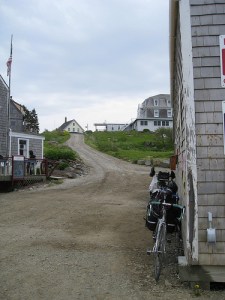
June (2009) was…

June was an amazingly quiet yet unsettling month. I think I needed it –  all of it. I know I wanted it – depression and all. Lots and lots of reading married with work on the house (we started painting!), a lot of work at work, a little music (Rebecca’s cd release party was fun, fun, fun! Can’t wait for the Iron Horse next month!), a small charity walk (Hike for Mike, which I still need to write about)…June was mostly about staying hermitage.
Here are the books:

  • Slow Dancing on Dinosaur Bones by Lana Witt ~ an interesting book about small town life.
  • And the Band Played On: Politics, People and the AIDS Epidemic by Randy Shilts ~ the most amazing journalism on the AIDS epidemic
  • Don’t Look Back by Karin Fossum ~ a murder thriller set in Norway
  • Before the Deluge by Deidre Chethem ~ a nonfiction about the Yangtze river
  • Three Farmers on Their Way to a Dance by Richard Powers ~ three stories centered around a photograph.
  • A Bigamist’s Daughter by Alice McDermott ~ In honor of Alice’s birth month…a story about how things aren’t always what they seem.
  • The Cat Who Saw Red by Lilian Jackson Braun ~ In honor of National Cat Month…okay, so the cats don’t solve the mystery, but they are funny!
  • The Daydreamer by Ian McEwan ~ in honor of McEwan’s birth month (childrens book)
  • The Comfort of Strangers by Ian McEwan~ In honor of McEwan’s birth month (adult – verrry adult book)!
  • This Boy’s Life by Tobias Wolff~ in honor of National Writing Month (families). I’ll be reading Tobias’s brother’s memoir next June.
  • The Adventures of Tom Sawyer by Mark Twain ~ I had forgotten how great this classic is!
  • Lving High: an Unconventional Autobiography by June Burn ~ Homesteading on an island off Puget Sound.

For the Early Review Program:

  • Beyond Road’s End: Living Free in Alaska by Janice Schofield Eaton ~ a memoir abotu running away to Alaska.

For the fun of it:

  • The Morning Star in Which the Extraordinary Correspondence of Griffin & Sabine is Illuminated by Nick Bantock. Everyone knows I love Nick Bantock. His books are sensual and fascinating. I am drawn to them all the time.

Beyond Road’s End

Eaton, Janice Schofield. Beyond Road’s End: Living Free in Alaska. Anchorage: Alaska Northwest Books, 2009.

Beyond Road’s End accomplished a great deal for me. For one, it was a tool of teaching: I learned a great deal about Alaska’s environment, both culturally and ecologically. Eaton’s straightforward, folksy narrative made the didactic chapters blend with the personal ones smoothly. It was interesting to see how her work with herbal remedies began as a curiosity and then grew into a viable career. Simultaneously, her personal life took the same course. Coming to Alaska from New England opened her eyes to a different way of living, a different way of being.
Another Alaskan trait I learned about from reading Eaton’s book was the native people’s generosity. Every neighbor had a story to tell, a meal to share, and a door they kept open to strangers. Many times throughout Beyond Road’s End there was someone there just in the nick of time either with shelter, food, or a helping hand. This giving attitude convinced Eaton to keep her cabin open to strangers while she and partner Ed were away for long periods of time.
The one complaint I had was the absence of dates. There was nothing to ground me chronologically until the Exxon Valdez oil spill. I found myself questioning little details like how long after leaving her husband did she take on the adventure of Alaska? Did this story start in the 1970s? Early ’80s? I found myself distracted by wondering.

Here are the quotes I hope are kept: “There are so many retirement options other than death by television” (p 81).
“Knocking meant you were strangers” (p 113).
“With each surge, king crude conquers territory” (p 350).

Another thing I hope they keep is the series of photos. They were great!

Before the Deluge

Chetham, Deirdre. Before the Deluge: The Vanishing World of the Yangtze’s Three Gorges. New York: Palgrave, 2002.

What happens to the traditions, the daily existence and essential history of a community and culture when it loses its geography, it’s place and space? What happens when entire cultures are uprooted and removed? Is it still the same as if it had never left? It is hard to imagine such a question until you consider the fate of the villages along the Upper Yangtze’s The Gorges region.
Deirdre Chetham chronicles the path of destruction China’s hydroelectric dam will create once the water levels rise. Originally set to be completed in 2009 this elevation of water will submerge entire cities, villages, towns, as well as historical and cultural areas. Chetham takes a expansive look back at the area’s remarkable history to illustrate what has been in place for centuries such as ancient temples, prayer grounds and burial sites. She also projects what the damming will mean economically for farmers and tourists alike.

Interesting quotes: “In summer hot pink is the favored color for men’s undershirts” (p 20), and “Since the beginning of time, the story of the Three Gorges region has been one of violence of nature topped off by the chaos of people” (p 49).

BookLust Twist: From Book Lust in the chapter called, “Rivers of Words” (p 201).

ps~ It is 2009 and at last word the dam project has been delayed.

This Boy’s Life

Wolff, Tobias. This Boy’s Life. New York: Perennial Library, 1989.

This Boy’s Life was spellbinding. Tobias Wolff’s personal memoir is not tremendous. It may even sound familiar to anyone who came from a broken home, had trouble with a step-parent, or had a mischievous streak growing up (who hasn’t?). What makes This Boy’s Life such a page turner is the honesty that radiates from every page, every sentence. It is not an overwhelming tragic tale, but it is painful and very real. Wolff does not paint a picture of hero, nor victim. It’s just an account of a troubled childhood. The writing is so clear, so unmuddied, that we can easily see bits of our own childhoods reflected in every chapter.

Probably one of my favorite parts was when Tobias (going by the name ‘Jack’ at this point) talks about altering his less than stellar grades in school. Report cards were written in pencil and ‘Jack’s’ admission of guilt is simply, “I owned some pencils myself” (p 184). It’s sly and smile evoking.

BookLust Twist: From More Book Lust in the chapter called, “All in the Family: Writer Dynasties” (p 5).

Living High

Burn, June. Living High: an Unconventional Autobiography. New York: Duell, Sloan and Pearce, 1941.

I like books that make me ask questions. I like books that leave me wanting more. Not more of the story. Usually, the ending is adequate enough and I don’t need to know more about that. I am left wanting to know more about the author, about the life of the author at that time. Such was the case with June Burn. When I read Living High I held in my hands a first edition copy signed by June herself. Maddeningly, there were no pictures to guide my imagination. How old was she when she finished Living High? Where were her parents? What did she looked like? I pictured a fiery redhead with an unmatchable zest for life. But, I wanted the truth of who she was.

Living High is called an “Unconventional Autobiography” and I would have to agree. Not because it doesn’t cover a life from the sunrise of birth to the sunset of death, but because it has a moral to the story. There is a lesson to be learned within Living High’s pages and that lesson is live life to the fullest. Enjoy every single moment of each and every day. June is elegant and adventurous when describing living on the gumdrop island of Sentinel off Puget Sound with her husband, Farrar; or remembering walrus hunting and dogsledding in Alaska; or later, bombing around the west coast in the Burn’s Ballad Bungalow with Farrar and two kids (named North and South, I kid you not).

Best quotes: “Be thrifty with the things that count and you won’t have time to worry about whether your wallet is fullor not” (p 7), “To go on an island and pull the ladder up after us and live, untroubled by anything – that would be heaven” (p 11), and “the wind came howling out of the north, with icicles in its whiskers” (p 150). My favorite is, “When you walk you are somewhere at every step” (p 264).

Interesting side note: June changed her name and so did her second son, South. One day he decided he was Bobby or Bob.

BookLust Twist: From More Book Lust in the chapter called, “Living High in Cascadia” (p 149). Go figure.

And the Band Played On

Shilts, Randy. And the Band Played On: Politics, People, and the AIDS Epidemic. New York: St. Martin’s Press, 1987.

This book has always intimidated me. For three decades I have heard words like “powerful,” “scary,” “depressing,” and even “a necessary evil” to describe And the Band Played On. I was afraid to really know That much about “the gay man’s disease.” I was squeamish about the how vivid I imagined the details to be. I anticipated TMI – Too Much Information – about deviant sex and the agonies of dying. In other words I was in denial and afraid.

And the Band Played Onhas got to be one of the best pieces of journalism I have read in a long, long time. Shilts’ reporting of every aspect of the AIDS epidemic is nothing short of mesmerizing. From the very beginning controlling the spread  of AIDS never stood a chance. AIDS was to be ignored by everyone. If you were heterosexual you didn’t want anything to do with the gay man’s disease. If you were homosexual you didn’t want someone telling you how to have sex, disease or no disease. Shilts does a fantastic job bringing to light the political power struggles that kept education and research about AIDS in the dark for nearly a decade.

Intriguing lines: “A group of drag queens, dressed as nuns and calling themselves the Sisters of Perpetual Indulgence, had picked the day for their debut” (p 14). “Being gay in New York was something you did on the weekends, it seemed” (p 27). “When a London gay switchboard’s lines broke down because they were so overwhelmed with AIDS calls, telephone company employees refused to fix them because they were afriad of contracting AIDS from the wiring” (p 565).

PS~ Remember my statement about being afraid of TMI, of learning something I realllly didn’t want to know? Well, Shilts did not disappoint. Not only did I get the full description of what fisting (with the whole frickin’ arm) was all about, but I learned of the practice called rimming. Politely put, it’s the human to human equivalent of licking an overflowingly full porta-potty. Good lord.

PPS~ What changed everything for me: learning that Randy Shilts took an HIV test while writing And The Band Played On; that he insisted on not knowing the results until the book was finished so as not to bias his writing; that he learned he was HIV positive on the day he sent his manuscript in…and finally, that in 1995 he died just like the AIDs patients he vividly described in his book.

Where the Pavement Ends

BikesWarmbrunn, Erika.  Where the Pavement Ends: One Woman’s Bicycle Trip Through Mongolia, China & Vietnam. Seattle: Mountaineers Books, 2001.

Reading books such as Where the Pavement Ends has a confusing effect on me. On the one hand, I start to think of my personal landscape as being too small, too confining. The need for movement and travel start to stir within me. On the other hand, I realize I am coddled, comfortable – too careful to conquer the great unknown. The idea of going where I don’t speak the language has always intimidated me. Okay. Scares the pants off me.

Where the Pavement Endsis not only a memoir about one woman’s eight month trek across Mongolia, China and Vietnam. It is also a  compassionate commentary on Erika Warmbrunn’s five (and sometimes sixth) senses. She relates everything she sees (sharing some gorgeous photographs throughout the book), everything she hears, touches, smells and tastes. From learning to enjoy Mongolian tea to ignoring sheep’s tail and demanding to eat like the natives rather than a coddled Western tourist. From the spanning the vast landscapes and bustling cities mostly by bicycle (accepting rides every so often). Every leg of Warmbrunn’s journey reflects the culture she encounters. She relies on the kindness of strangers to have decent meal, a roof over her head and to expand her social awareness. She is eager to learn the language, drink in the customs, and learn something from everyone she meets.

A small sampling of the favorite lines: “…to make things new, you have to keep going further and further away from what you know” (p 11). This is the perfect definition of bravery, “I was completely intimidated, and I was absolutely at peace” (p 13). Another one, “In the absence of language, ritual becomes a way of communication, of making yourself a little less foreign” (p 42).

BookLust Twist: From Book Lust in the chapter called simply, “Bicycling” (p 35).

June (2009) is…

June promises to be a quiet month. Another charity walk (20 times smaller than the last walk). We opened the pool so I’m hoping to take my first dip (Kisa’s already been in). For music it is an amazing, totally kickazz cd release party from Rebecca Correia at the Bennett Farm! I’d like to try to get to Peaks for a weekend, too. Here are the books:

  • Slow Dancing on Dinosaur Bones by Lana Witt ~ in honor of small town month, if there is such a thing!
  • And the Band Played On by Randy Shilts ~ in honor of gay pride month (although my former stomping grounds holds its parade in May)
  • Don’t Look Back by Karin Fossum ~ in honor of the best time to visit Norway (supposedly)
  • Before the Deluge by Deidre Chetham ~ in honor of National River Cleanup month
  • Three Farmers on Their Way to a Dance by Richard Powers ~ in honor of Richard’s birth month

If there is time I will add Living High by June Burn ~ in honor of Cascadia.

For LibraryThing and the Early Review Program it’s a nonfiction about how to get along with your son’s wife. Yeah, yeah – doesn’t fit the profile, I know. That’s what makes this reviewing stuff so interesting (and fun)!

May (2009) was…

May was a combination of heaven and hell. May was a Mother’s Day without my mother. May was walking 60 miles and having my mother at the finish line. May was a trip homehome and almost too much time with my mother. The good and the bad. As much as we love each other there is only so much mother-daughter time we can bestow on one another.
My favorite moments of the month were learning gardening tips from mom (hello! I’m brand new to everything about it), and talking to strangers about the Just ‘Cause walk.  Here’s what I managed to read:

  • Speak by Laurie Halse Anderson ~ a touching, tragic story about one teenager’s horrible secret.
  • Off Keck Road by Mona Simpson ~ not my favorite – very bland.
  • Bordeaux by Soledad Puertolas ~ a really lonesome story based in Bordeaux, France.
  • Where the Pavement Ends: One Woman’s Bicycle Trip Through Mongolia, China and Vietnam by Erika Warmbrunn~ this was probably my favorite out of everything I read this month.
  • Quartered Safe Out Here by George MacDonald Fraser ~ Fraser’s recollections of the war in Burma as a 19 year old.
  • Terms of Endearment by Larry McMurty ~ something I picked up completely by accident, a year early!

For LibraryThing and the Early Review Program:

  • Lucky Girl by Mei-Ling Hopgood ~ this was such a pleasure to read I plan to reread it once it has been published.

I didn’t get to The Victorians by A.N. Wilson. It sat on the desk in my office for the entire month. I think I looked at the pictures.

Quartered Safe Out Here

Fraser, George MacDonald. Quartered Safe Out Here: a Recollection of the War in Burma. New York: Akadine Press, 2001. 

I was hoping to take this on my 60 mile cancer walk – thinking I would have quiet nights to read and recuperate. No such thing. I never opened a page. Instead, I took it home to Monhegan and on the second to last day got it read. Confession: no small feat because I found it dull, dull, dull.

Quartered Safe Out Here is George MacDonald Fraser’s “memoir” about being in Burma as a 19 year old soldier in World War II. While it’s a vivid and honest first hand account about being in the thick of battle, I found it slow moving and tiring. Fraser takes great pains to get every accent phonetically spelled out – so much so that the written page looks like a foreign language at times. But, it wasn’t the accents that I found the most tiresome. It was the fact that nearly every every other page contained a footnote containing a special explanation or definition. Fraser could have added another 50 pages if the footnotes were included in the body of the text. Probably the scene that held my attention the best was when Fraser was looking in bunkers for ‘Japs.’ His innocence to the danger is touching.

BookLust Twist: From More Book Lust in the chapter ” Living Through War” (p 154).

May (2009) is…

May is huge. Absolutely huge and positively late. So out of control! A 60 mile walk for Just ‘Cause has had me busy. The end of the school semester has had me frustrated. May also means time with my mom – which I simply cannot wait for. A retirement party for people I barely know. The pool opening. A birthday party with sushi and laughter. My kind of gig.

For books it is:

  • Off Keck Road By Mona Simpson ~ in honor of becoming a Wisconsin becoming a state.
  • Bordeauxby Soledad Puerolas ~ in honor of Cinco de Mayo
  • Rise of David Levinsky by Abraham Cahan ~ in honor of American Jewish heritage month
  • Speak by Laurie Halse Anderson ~ in honor of teen pregnancy month. Note: this book is not actually about a teen pregnancy but the book is recommended for teens. I’m stretching this one a little, I know!
  • The Victorians by A.N. Wilson ~ in honor of Queen Victoria
  • Where the Pavement Ends: One Woman’s Bicycle Trip Through Mongolia, China and Vietnam by Erika Warmbrunn ~ in honor of National Bicycle Month
  • Quarter Safe Out Here by George MacDonald Fraser~ in honor of Memorial Day.

There is also a LibraryThing Early Review book. Forgive me if I can’t plug the name right now.

Jameses

Lewis, R.W.B. The Jameses: a Family Narrative. New York: Farrar, Straus & Giroux, 1991.

Having read Lewis’s biography of Edith Wharton I knew what to expect when reading about the Jameses. Lewis approaches his subjects with an air of authority and an eye on detail and The Jameses: a Family Narrative was no different. Lewis covers the James family from 18th century Ireland up to the death of novelist Henry James in 1916. It is an impressive cast of characters. At best I could relate to Henry James, Sr., a man who railed against any model of institutionalized or organized religion. He spent a better part of his life on a quest to understand God, spirituality, and redemption. At times I found the rest of the narrative drawn out and too expansive. I have to admit, I did not finish.

Favorite quotes: “With Burnet as his agent, James bought Syracuse for $30,000” (p 12). Imagine that.

BookLust Twist: From More Book Lust in the chapter, “Literary Lives: The Americans” (p 144).

Tattoo Machine

Johnson, Jeff. Tattoo Machine: Tall Tales, True Stories, and My Life in Ink. New York: Spiegel and Grau, 2009.

When I first requested this book it was one I felt inadequate to review. In the world of tattoos I have just one. One small, no bigger than a quarter, simple black and white outline of a sleeping cat. It’s not even in a dangerous place of pain. It’s snuggled on the fatty flesh of my hip. No tender skin of an ankle, inner arm or neck was sacrificed to the needle. I am largely unqualified to even begin to understand the culture of a tattoo, let alone the artist behind one. That being said, I wanted to request Tattoo Machine as a place to start. It’s if I’m saying to Jeff Johnson, “Okay. I’m game. Tell me your story and maybe I’ll learn something breathtaking in the process.” For the simple act of getting a tattoo was enough to take my breath away.

Johnson’s style of writing is very tell it like it is. He’s straightforward to the point of unflinching. Drugs, sex, rock and roll are frequent guests to the party but the guest of honor is all about getting and giving tattoos. Johnson reconfirms the stereotype that tattoo artists are seen as dangerous, on the edge kind of people. EMTs are wary of teaching them CPR. But, the unavoidable truth is that there is another side to tattoo artists. Artists such as Johnson can be well-read, intellectual, funny and yes, even sensitive. 

My only real complaint? Johnson includes an incredibly helpful lexicon of commonly used words and phrases in the world of tattooing. However, that dictionary comes after he has already written a chapter or two using the secret, somewhat strange language. The dictionary should come first.

ps~ Can I say I am disappointed I didn’t get any temporary tattoos with my advance proof? That would have been so cool!

April 2009 was…

I can’t believe how fast the time is flying by. Unbelievable. April flew by me on very windy wings. Thanks to a mini mental health holiday I was able to get through some pretty good books:

  • Astonishing Splashes of Colour by Clare Morrall ~ this was fascinating. I definitely want to read more of Morrall’s work.
  • An Omelette and a Glass of Wine by Elizabeth David ~ witty, and global. This made me hungry for really well designed food.
  • The Punch: by John Feinstein ~ The book that got me obsessed with December 9th, 1977.
  • The Noblest Roman by David Halberstam ~ prohibition, prostitution and politics, southern style.
  • The Jameses: a Family Narrative by R.W.B. Lewis ~ I now know more about Henry James and his ancestors than I ever thought possible and I didn’t even finish the book.
  • Flashman by George Fraser MacDonald ~ the first in the Flashman series. Strange.
  • Ancestral Truths by Sara Maitland ~ really intense book!
  • The Apple That Astonished Pairs by Billy Collins ~ a book of fascinating poetry.

In honor of National Poetry month it was:

  • “Table Talk” by Wallace Stevens
  • “Tract” by William Carlos Williams
  • “I Go Back” by Sharon Olds
  • “Colette” by Edwin
  • “Church Going” and “I Remember, I Remember” by Philip Larkin
  • “Why Do So Few Blacks Study Creative Writing” by Cornelius Eady

For the Early Review program:

  • Fatal Light by Richard Currey. This had me by the heart. It’s the 20th anniversary of its publication and just as relevant today as it was back then. It’s fiction but not. If you know what I mean. I think that it’s important to note that I was supposed to get a February pick but because I moved it got lost in the shuffle (translation: I didn’t get the forwarding thing set up in time and it went back to the publisher). Fatal Light is actually a March pick.