Soul of Me

  • RebeccaBreathe
  • Home
  • Tell Kyle
  • Bring on the Rain
  • Erina Rose
  • Miss You
  • Yours
  • Oh Nashville
  • On Your Way Down
  • Goodbye For the Last Time
  • No Such Fairytale
  • Hold Me
  • Sonnet #30

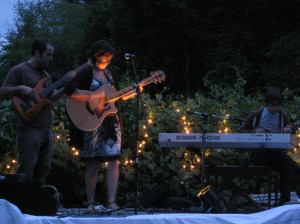
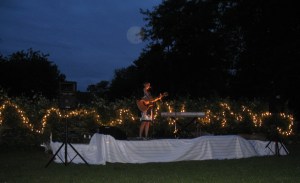
There is something about outdoor music, especially when the weather is perfect and the bugs are held at bay. People pull out snacks, snap open lawn chairs and spread out blankets, complete with coolers and cameras. Laughter bounces off conversations and excitement mingles with anticipation. We are ready for music. The Soul of Me cd release party was like this – a combination of family and friends getting together like a gigantic gourmet picnic in the park and the thrill of new music. Hugging and catching up between sips of wine and bites of food. A backyard oasis of tiny white lights and chocolate covered strawberries. And That Voice.

The above setlist is not from the cd release party. I wasn’t willing to spend my time writing each song down… in the dying light and approaching dark. Instead, this is the track list for Rebecca’s new cd, Soul of Me. Rebecca sang all the songs except “No Such Fairytale” “Goodbye for the Last Time” and “Hold Me.” I was relieved she didn’t sing “Hold Me” because I was ripe for a good cry and I didn’t need to be turning on the waterworks at that particular time! She did throw in some extras like a cover mix, an oldie from Memories of Their Love and a little something about Gene Simmons in her grocery store…

Side story: When Rebecca introduced Chris from ‘The Everyday Visuals’ there was a moment of deja vu. How do I know you? Where do I know you from? Do I know you or is my mind playing tricks on me? As Chris began to sing and tell stories the nagging thought I had seen him before simply would not leave my mind. Turns out ‘The Everyday Visuals’ played in the Boston Pop’s cafe the same night Natalie played at Edgefest (the ticket to Natalie got you in to see ‘The Everyday Visuals’ as well). TEVs were the band I could have seen had my family been interested in a little more music after Natalie…

All in all it was a great night and I wish I could have stayed to see Rebecca’s after-show antics! Maybe next time.

RebeccaII


Don’t Look Back

Fossum, Karin. Don’t Look Back. Orlando: Harcourt, Inc. 2002.

This is one of those mystery books you read on a rainy Saturday afternoon in one sitting. The story flows in a simplistic but compelling manner; An easy read with a great story line. As someone from LibraryThing once said suggested for a genre, “a bring-to-the-beach kind of book.” In that case Don’t Look Back was summer fare read too early (for me). It is the mystery of the death of a teenage girl. Known throughout her small town she was loved by nearly everyone. How could someone so charming, so lovable, so perfect die so young? Inspector Sejer is the lead investigator on the case. With calm and quiet tenacity he unravels a seemingly sweet life only to reveal lies and suspicions. This is the kind of mystery that keeps the pages turning as things become more and more complicated. Originally written in Norwegian and translated by Felicity David, Don’t Look Back urges the reader to keep turning the pages until compulsively, the entire book has been read from cover to cover.

Favorite lines: “Puberty was a really rough time. She was a sunbeam until she turned thirteen, then she began to snarl. she snarled until she was fourteen, then she began to bark” (p 71). ”

BookLust Twist: From More Book Lust in the chapter, “Crime is a Globetrotter: Norway” (p 59).

Edited to add: I read this back in 2009 but what I just discovered five years later is that it is also included in Book Lust To Go in the chapter called “Norway: the Land of the Midnight Sun” (p 163). So there!

Slow Dancing on Dinosaur Bones

Witt, Lana. Slow Dancing on Dinosaur Bones. New York: Scribner, 1996.

I don’t understand the title of this book. It should have been something about ghosts or Indians or something like that. Aside from the random primordial slime comment, dinosaurs don’t really factor into the title, figuratively or literally. And aside from the title confusion I loved, loved, loved this book! It provided me with laughs, cries, anger, confusion, fear, and even triumph. It was the kind of book that I couldn’t put down, yet I was terribly afraid of what would happen next.

Slow Dancing on Dinosaur Bones is a quirky story about a small town community. There is Gilman, the singing, bootlegging, gruff-but-loveable mechanic; Gemma, the town beauty with a viper’s heart; Ten-Fifteen, Gilman’s best friend; Tom, the from-out-of-town philosopher-turned-carpenter; and Rosalyn, the torch singer with a nasty secret. It’s that secret that supplies the suspense. Rosalyn has an ex-lover looking for her. Fearing harm, her friends hide her and take turns protecting her and falling in love with her. Meanwhile, to add to the drama there is a big, nasty, corporate coal company threatening to drill on Gilman’s land and a skeleton waiting in a prayer chamber for a shot of whiskey. There’s good old fashioned sabatoge and danger mixed with ancient love and laughter.

Best moments: “He remembered the exact moment he had decided to leave the beach and look for trouble, this decision coming from his belief that something and nothing are the same thing” (p 85).
“Sometimes you want to ask a person something, but it can’t be said in words, and you don’t know if he would understand it, anyway, so you think of other things to say, except the words won’t come out because they are trapped behind the question you want to ask” (p 114).
“I confused her when I gave her a glimpse of who I really am. Maybe a person should never try to be honest to their parents” (p 119).

BookLust Twist: From More Book Lust in the chapter called, “Small-Town Life” (p 202).

Green Peace?

front doorWho would have thought I would enjoy digging in the dirt so much? Hand me a house complete with a hoe and I’m a happy girl. Who knew? Every morning I find myself standing on the stoop, checking the vital signs of my transplants, keeping tabs on the roses. I pluck wilting blooms from the hanging planter, willing more flowers to take their places. Bring on the color. Every night on my way to check the mail I double check my geraniums. My fight-breast-cancer pink blooms. Check for bugs. Check for dry soil. Do you need anything, I ask them. Water? Bug spray? Food? There is peace in all this puttering and pampering.
In the middle rhododendron bush a mother robin had built a nest. I had a perfect view of her from my window. Over time as I watched her sit on her eggs I would myself just how many babies did she have? I spied every day, hoping to catch a glimpse of her skyblue family. They hadn’t hatched by the time I went away, but when I came home three loud mouthed, scrawny, bald babies squawked from their cozy perch. Strange how a family of common birds could fill me with such caring. I kept a careful watch over them until one day the nest was silent. Empty. The babies had flown. Or so I hoped.
Out in the back there is a spindly dogwood (“It’s a tree and a bush, sir.”) that I have been mothering. When my mother was in town we noticed a strange vine had wrapped its tendrils around its fragile limbs. Invasive and attacking, this vine was literally choking the life out of my dogwood. We, my mother and I, set to work with a fierce counterattack. Armed with sharp (pink!) clippers we chopped and slashed our way through the vines and freed the dogwood tree from captivity. Since then I have been diligent in keeping the vines at bay. I hack anything that comes near.
A good friend has a garden of herbs on her front steps. I envy her because she grows all my favorites: cilantro, italian flat leaf parsley and basil. Could I do the same? the thought crosses my mind nearly everyday. What about the cats? The rabbits? And someone said something about a wild boar…something I need to think about.

So for now I will tend to my dusty miller, my roses – trees, bushes and flowers. This garden that has brought me a different kind of relaxation, a separate peace, if you will. Who knew?

And the Band Played On

Shilts, Randy. And the Band Played On: Politics, People, and the AIDS Epidemic. New York: St. Martin’s Press, 1987.

This book has always intimidated me. For three decades I have heard words like “powerful,” “scary,” “depressing,” and even “a necessary evil” to describe And the Band Played On. I was afraid to really know That much about “the gay man’s disease.” I was squeamish about the how vivid I imagined the details to be. I anticipated TMI – Too Much Information – about deviant sex and the agonies of dying. In other words I was in denial and afraid.

And the Band Played Onhas got to be one of the best pieces of journalism I have read in a long, long time. Shilts’ reporting of every aspect of the AIDS epidemic is nothing short of mesmerizing. From the very beginning controlling the spread  of AIDS never stood a chance. AIDS was to be ignored by everyone. If you were heterosexual you didn’t want anything to do with the gay man’s disease. If you were homosexual you didn’t want someone telling you how to have sex, disease or no disease. Shilts does a fantastic job bringing to light the political power struggles that kept education and research about AIDS in the dark for nearly a decade.

Intriguing lines: “A group of drag queens, dressed as nuns and calling themselves the Sisters of Perpetual Indulgence, had picked the day for their debut” (p 14). “Being gay in New York was something you did on the weekends, it seemed” (p 27). “When a London gay switchboard’s lines broke down because they were so overwhelmed with AIDS calls, telephone company employees refused to fix them because they were afriad of contracting AIDS from the wiring” (p 565).

PS~ Remember my statement about being afraid of TMI, of learning something I realllly didn’t want to know? Well, Shilts did not disappoint. Not only did I get the full description of what fisting (with the whole frickin’ arm) was all about, but I learned of the practice called rimming. Politely put, it’s the human to human equivalent of licking an overflowingly full porta-potty. Good lord.

PPS~ What changed everything for me: learning that Randy Shilts took an HIV test while writing And The Band Played On; that he insisted on not knowing the results until the book was finished so as not to bias his writing; that he learned he was HIV positive on the day he sent his manuscript in…and finally, that in 1995 he died just like the AIDs patients he vividly described in his book.

Talking Too Much

I have learned a valuable  lesson. When I say This. Stays. Between. Us. the words strung together to form a directive don’t matter. It’s almost as if you take the words as a euphemism for something else. What I say doesn’t mean sh!t. It’s almost as if you don’t trust what I’m telling you; so you do the exact opposite of what I ask. I feel like I am speaking a foreign language. But, here’s the thing: I get it. You want to be in the know. Knowing it all is your power. It’s your vice. You hate to be wrong, you love to be perfect. You need to run to those less knowing and share your information – holding the Guess What! over their heads. I get it. You can’t help it. Not in the least. This is a turning point. At least for me. I know what I need to do. It’s my turn to be didactic towards myself and moi. Shut the door, shut the mouth. Be more military. Have that attitude. What you don’t know can’t hurt you. Or me.

Terms of Endearment

McMurtry, Larry. Terms of Endearment. New York: Signet, 1975.

I really should have a “on a whim” category because this was not on my list to read this month. In fact, this was not on my list to read until May 2010. Here’s what happened. I was home, had no desire to slog through Herzog, saw Terms of Endearment on my mother’s bookshelf (saw it there for years and years), knew it was on The List somewhere, and in a split second decided to read it. I don’t regret the decision. I was able to read it, start to finish, within two days.

Terms of Endearment is the kind of book that makes you feel things. Larry McMurtry has the ability to make you change your mind about the people you meet…several times over. In the beginning I saw Terms as a story about a bunch of miserable people. I was shocked by the hatred these people carried around (see ‘shocking quotes’ below). I didn’t think I would like a single character. I saw Aurora as nasty and Emma as just plain pathetic. By the end of the book I had completely changed my mind about everything and everyone.
The premise for Terms of Endearment is really quite simple. It’s the story of a mother and daughter and the relationships that orbit around them. Aurora is a Boston widow transplanted to Houston, Texas. She has five different “suitors” who tolerate her abrasive tongue and haughty manner and despite all that, continuously vie for her hand in marriage. At first she appears caustic and self-centered. Selfish and conniving, she bends situations to suite her ever-changing needs. Her story takes up the first 324 pages and by the end of it you realize she is a woman of conviction who simply tells it like it is. Emma, her daughter, at first appears to be one of Aurora’s victims – always manipulated and belittled. The strength of their relationship and the depth of their love for one another isn’t readily apparent until life gets complicated for Emma. Emma hasn’t married well. She hasn’t been educated and she has bad hair. On the surface she is poor and pathetic. But, true to McMurtry form, by the end Emma is a strong, defiant woman.
My only disappointment about Terms of Endearment is the inclusion of Book II, Emma’s story. 324 pages are dedicated to Aurora while Emma gets the last 47. I don’t really understand the need for separate “books” when Emma’s story – her bad marriage to Flap, her pregnancy, her lifestyle and relationship with her mother – are all woven seamlessly into Aurora’s story. Emma’s portion of the book seems weak and it’s inclusion, an afterthought.

Shocking quotes: “She was convinced that she could have stood in the driveway dripping blood, both arms amputated at the elbow, and Cecil would still have driven up, said “Hi Toots,” smiled broadly, and squeezed her stump” (p 16).
“She would have liked to have a heavy chain in her hand, and if she had had one she would have hit him with it, right across the lower part of his spine. If it broke his back, so much the better” (p 32).

BookLust Twist: In Book Lust in the chapter called, “Three-Hanky Reads” (p236).

Left a Little Smaller

I don’t know how to take this new feeling. I’m not jealous. Just feeling misplaced a little. He didn’t ask if I wanted to see Virginia, the place for lovers. I wasn’t invited to drink bad mountain beer in a mile high town – either time. Fenway was phishy without fanfare from me. Is it my fault? Has it been my bad? Have I said no so many times that I’m no longer considered interested or, or more sobering thought:  it is that I’m no longer interesting? Did I say what I was thinking out loud? Did I admit to what I was struggling with all long?

I ran across a face I didn’t recognize right away. I had to stare. Still couldn’t believe it. Had to close my eyes to reconcile the difference in order to make the connection. Recognition came easier when I turned away completely. Was I really a person of interest to this person? Did I really capture the mind if not the heart? I can’t imagine what we talked about. What would we say now? I’m left a little smaller not even knowing who I was then or what I’ve become now.

I drank a whole bottle of wine and hung up the phone giddy and drunk. I was a mess but I didn’t care. No one noticed I didn’t brush my teeth. Left my contacts in. Passed out without a passing thought. No one cared. I woke up ready to run away. Run for miles and miles. No one noticed my energy. Maybe this whine is a good thing. Maybe there’s something to the bottle being your best friend. I’m left a little smaller for considering the thought. I made blueberry muffins instead.

“Did I drive you away? I know what you’ll say.” ~Coldplay

Where the Pavement Ends

BikesWarmbrunn, Erika.  Where the Pavement Ends: One Woman’s Bicycle Trip Through Mongolia, China & Vietnam. Seattle: Mountaineers Books, 2001.

Reading books such as Where the Pavement Ends has a confusing effect on me. On the one hand, I start to think of my personal landscape as being too small, too confining. The need for movement and travel start to stir within me. On the other hand, I realize I am coddled, comfortable – too careful to conquer the great unknown. The idea of going where I don’t speak the language has always intimidated me. Okay. Scares the pants off me.

Where the Pavement Endsis not only a memoir about one woman’s eight month trek across Mongolia, China and Vietnam. It is also a  compassionate commentary on Erika Warmbrunn’s five (and sometimes sixth) senses. She relates everything she sees (sharing some gorgeous photographs throughout the book), everything she hears, touches, smells and tastes. From learning to enjoy Mongolian tea to ignoring sheep’s tail and demanding to eat like the natives rather than a coddled Western tourist. From the spanning the vast landscapes and bustling cities mostly by bicycle (accepting rides every so often). Every leg of Warmbrunn’s journey reflects the culture she encounters. She relies on the kindness of strangers to have decent meal, a roof over her head and to expand her social awareness. She is eager to learn the language, drink in the customs, and learn something from everyone she meets.

A small sampling of the favorite lines: “…to make things new, you have to keep going further and further away from what you know” (p 11). This is the perfect definition of bravery, “I was completely intimidated, and I was absolutely at peace” (p 13). Another one, “In the absence of language, ritual becomes a way of communication, of making yourself a little less foreign” (p 42).

BookLust Twist: From Book Lust in the chapter called simply, “Bicycling” (p 35).

June (2009) is…

June promises to be a quiet month. Another charity walk (20 times smaller than the last walk). We opened the pool so I’m hoping to take my first dip (Kisa’s already been in). For music it is an amazing, totally kickazz cd release party from Rebecca Correia at the Bennett Farm! I’d like to try to get to Peaks for a weekend, too. Here are the books:

  • Slow Dancing on Dinosaur Bones by Lana Witt ~ in honor of small town month, if there is such a thing!
  • And the Band Played On by Randy Shilts ~ in honor of gay pride month (although my former stomping grounds holds its parade in May)
  • Don’t Look Back by Karin Fossum ~ in honor of the best time to visit Norway (supposedly)
  • Before the Deluge by Deidre Chetham ~ in honor of National River Cleanup month
  • Three Farmers on Their Way to a Dance by Richard Powers ~ in honor of Richard’s birth month

If there is time I will add Living High by June Burn ~ in honor of Cascadia.

For LibraryThing and the Early Review Program it’s a nonfiction about how to get along with your son’s wife. Yeah, yeah – doesn’t fit the profile, I know. That’s what makes this reviewing stuff so interesting (and fun)!

May (2009) was…

May was a combination of heaven and hell. May was a Mother’s Day without my mother. May was walking 60 miles and having my mother at the finish line. May was a trip homehome and almost too much time with my mother. The good and the bad. As much as we love each other there is only so much mother-daughter time we can bestow on one another.
My favorite moments of the month were learning gardening tips from mom (hello! I’m brand new to everything about it), and talking to strangers about the Just ‘Cause walk.  Here’s what I managed to read:

  • Speak by Laurie Halse Anderson ~ a touching, tragic story about one teenager’s horrible secret.
  • Off Keck Road by Mona Simpson ~ not my favorite – very bland.
  • Bordeaux by Soledad Puertolas ~ a really lonesome story based in Bordeaux, France.
  • Where the Pavement Ends: One Woman’s Bicycle Trip Through Mongolia, China and Vietnam by Erika Warmbrunn~ this was probably my favorite out of everything I read this month.
  • Quartered Safe Out Here by George MacDonald Fraser ~ Fraser’s recollections of the war in Burma as a 19 year old.
  • Terms of Endearment by Larry McMurty ~ something I picked up completely by accident, a year early!

For LibraryThing and the Early Review Program:

  • Lucky Girl by Mei-Ling Hopgood ~ this was such a pleasure to read I plan to reread it once it has been published.

I didn’t get to The Victorians by A.N. Wilson. It sat on the desk in my office for the entire month. I think I looked at the pictures.

Quartered Safe Out Here

Fraser, George MacDonald. Quartered Safe Out Here: a Recollection of the War in Burma. New York: Akadine Press, 2001. 

I was hoping to take this on my 60 mile cancer walk – thinking I would have quiet nights to read and recuperate. No such thing. I never opened a page. Instead, I took it home to Monhegan and on the second to last day got it read. Confession: no small feat because I found it dull, dull, dull.

Quartered Safe Out Here is George MacDonald Fraser’s “memoir” about being in Burma as a 19 year old soldier in World War II. While it’s a vivid and honest first hand account about being in the thick of battle, I found it slow moving and tiring. Fraser takes great pains to get every accent phonetically spelled out – so much so that the written page looks like a foreign language at times. But, it wasn’t the accents that I found the most tiresome. It was the fact that nearly every every other page contained a footnote containing a special explanation or definition. Fraser could have added another 50 pages if the footnotes were included in the body of the text. Probably the scene that held my attention the best was when Fraser was looking in bunkers for ‘Japs.’ His innocence to the danger is touching.

BookLust Twist: From More Book Lust in the chapter ” Living Through War” (p 154).

Off Keck Road

Simpson, Mona. Off Keck Road. New York: Alfred A. Knopf, 2000.

I didn’t realize this book is a novella. 167 pages long. A piece of cake to read on a quiet Sunday. The sad thing is I didn’t really get into it, despite it being a quick read. The story starts off being about Bea Maxwell but then veers away to take in other members on and off Keck Road. The character placement seems jumbled. New characters appear without clear introduction or connection to Bea. I felt I needed a chart to keep characters straight. However, character development was brilliant, intimate even. When we first meet Bea, she is a college girl, home on vacation in the 1950s. She has certain definable traits that stay with her throughout the rest of the novella, ending in the 1980s. It’s a portrait of a woman who never leaves her small town. Her life never really takes her beyond Green Bay, Wisconsin’s city limits without reeling her back in.

Favorite lines, “He was the kind of man who ceded his place in traffic. He never asserted himself in conflicts over lanes or parking spaces” (p 80).

BookLust Twist: From More Book Lust in the chapter, “Big Ten Country: The Literary Midwest (Wisconsin).
Also in the chapter, “Two, or Three, Are Better Than One” (p 226). Note: in this chapter Pearl suggests reading Off Keck Road together with Our Kind: a Novel in Stories by Kate Walbert; two stories about the lives of women.

Speak

Anderson, Laurie Halse. Speak. New York: Scholastic, 2003.

You have to admire Melinda. From day one of school she is harrassed and hated. She storms through the first marking period of high school, gnashing her teeth and muttering to herself. She has no friends and is openly tormented by everyone from peers to parents. Melinda has a secret that not only eats away at her little at a time, but by the end of the third marking period, steals away her voice until she is practically mute. While she puts on a good act of wit and sarcastic humor on the outside, inside she is a girl trapped by confusion and fear. As her grades plummet and her family life slowly falls apart, Melinda struggles to keep her sanity. Speak took me only a few hours to read. Anderson does an amazing job capturing the voice of a tormented teen. She portrays the relationships every young adult has to endure: teachers, principals, parents, ex-best friends…with such honesty I found myself cringing…

Favorite funny parts: “Our boys are unbeatable as long as they are the only team on the floor” (p 76). “We are reading The Scarlet Letter one sentence at a time, tearing it up and chewing on its bones” (p 100). And one sad line: “I stuff my mouth with old fabric and scream until there are no soulds left under my skin” (p 162).

BookLust Twist: From Book Lust in the chapter “Best for Teens” (p 23).

Bordeaux

Puertolas, Soledad. Bordeaux. Lincoln: University of Nebraska, 1998.

Despite being under 200 pages this took me a long, long time to finish. Maybe it’s the fact it was originally written in Spanish (Soledad Puertolas is one of Spain’s most acclaimed writers).  I’m thinking maybe something got lost in the translation. That’s always possible. I found the whole storyline to be choppy, disjointed, even abrupt in some places. It was if Puertolas took three short stories and tied them together by location. On the surface all three chapters focus on a single character located in the same city. They all have Bordeaux, France in common. It’s the villa that apparently ties these stories together.
First, there is Pauline Duvivier, an lonely elderly woman asked to do a favor outside her comfort zone – something scandalous involving adultery and blackmail. As the reader you really don’t get the whole picture. Then, there is Rene Dufour. He is unlucky in love, worse in relationships of any kind. You can’t help but feel sorry for him and wondering what’s wrong with him. The last character, Lilly Skalnick, is a young American traveling through Europe. She’s just as lost as the rest of them. As each character is introduced and explored  it is hard to ignore the social portrait being drawn. Every character is lost, lonely, searching for something or someone to satisfy an unknown longing.

Favorite lines: “Her father’s death had left her alone with herself, and she lamented then not having known that that life was, perhaps the one she would have chosen” (p 7), and “His blueish-gray eyes didn’t seem to place much trust  in the wisdom contained in books” ( 84).

BookLust Twist: From Book Lust  in the chapter, “Latin American Fiction” (p 144).