Rise of David Levinsky

Cahan, Abraham. The Rise of David Levinsky. Glouster: Peter Smith, 1969.

Written in 1917 The Rise of David Levinsky is the story of Russian born immigrant David Levinsky and his rise to riches in the garment industry in New York City. Cahan’s depiction of Levinsky remains one of the best accounts of not only immigrants seeking opportunity and fortune in America at the turn of the century, but also the Jewish experience on New York’s East Side as well. Cahan illustrates social attitudes towards poverty, religion, ethnicity and economic status through David’s character. Using his situation as an orphan, David accepts pity from those with means. He has an uncanny ability to sense the heart of others and use it to his advantage. It is interesting to watch his rise to wealth over the course of David’s lifetime.

Good lines: “I had a notion that a married woman, no matter how young, must have a married face, something quite distinct from the countenance of a maiden, while this married woman did not begin to look married” (p 67), and “Shall I turn my heart out to show you how hard it is to live without you?” (p 301). Both of these quotes evoke so much psychology!

BookLust Twist: From Book Lust in the chapter, “The Jewish American Experience” (p 132).

May (2009) is…

May is huge. Absolutely huge and positively late. So out of control! A 60 mile walk for Just ‘Cause has had me busy. The end of the school semester has had me frustrated. May also means time with my mom – which I simply cannot wait for. A retirement party for people I barely know. The pool opening. A birthday party with sushi and laughter. My kind of gig.

For books it is:

  • Off Keck Road By Mona Simpson ~ in honor of becoming a Wisconsin becoming a state.
  • Bordeauxby Soledad Puerolas ~ in honor of Cinco de Mayo
  • Rise of David Levinsky by Abraham Cahan ~ in honor of American Jewish heritage month
  • Speak by Laurie Halse Anderson ~ in honor of teen pregnancy month. Note: this book is not actually about a teen pregnancy but the book is recommended for teens. I’m stretching this one a little, I know!
  • The Victorians by A.N. Wilson ~ in honor of Queen Victoria
  • Where the Pavement Ends: One Woman’s Bicycle Trip Through Mongolia, China and Vietnam by Erika Warmbrunn ~ in honor of National Bicycle Month
  • Quarter Safe Out Here by George MacDonald Fraser~ in honor of Memorial Day.

There is also a LibraryThing Early Review book. Forgive me if I can’t plug the name right now.

Jameses

Lewis, R.W.B. The Jameses: a Family Narrative. New York: Farrar, Straus & Giroux, 1991.

Having read Lewis’s biography of Edith Wharton I knew what to expect when reading about the Jameses. Lewis approaches his subjects with an air of authority and an eye on detail and The Jameses: a Family Narrative was no different. Lewis covers the James family from 18th century Ireland up to the death of novelist Henry James in 1916. It is an impressive cast of characters. At best I could relate to Henry James, Sr., a man who railed against any model of institutionalized or organized religion. He spent a better part of his life on a quest to understand God, spirituality, and redemption. At times I found the rest of the narrative drawn out and too expansive. I have to admit, I did not finish.

Favorite quotes: “With Burnet as his agent, James bought Syracuse for $30,000” (p 12). Imagine that.

BookLust Twist: From More Book Lust in the chapter, “Literary Lives: The Americans” (p 144).

Flashman

Fraser, George MacDonald. Flashman. New York: Harper Collins, 1993.

This is one of those giggly books. The main character is so awful you can’t help but laugh at him and dare I say, even like him a little for his brazen attitude. The premise is Flashman is the first installment of the “Flashman Papers 1839-1842” a sort of journal of Harry Flashman’s. Readers get a taste of Harry’s storytelling from the very start: British boy Harry Flashman manages to get himself drunk, expelled from school and into his father’s mistress’s bed in less than the first dozen pages. What first appears as a punishment for another indiscretionary roll in the hay ultimately becomes Harry’s greatest triumph. He is sent to be a secret agent in Afghanistan and manages to emerge a brave hero after the Retreat from Kabul. Harry is so shameless he basks in the honor despite the fact his cowardice is the only thing that saved him. But, his story is told with such honest sarcasm you can’t help but enjoy his villainy.

Two of Harry’s lesser laughed at traits are his womanizing and his racial comments. One has to keep in mind the Victorian era in which these events take place. Women and minorities are not seen as equals on any level.

Typical Flashy moment: “She stood glaring at me. Her bosom was what the lady novelists call agitated, but if they had seen Judy agitated in a negligee they would think of some other way of describing feminine distress: (p 29).

BookLust Twist: From Book Lust in the chapter, “George MacDonald Fraser: Too Good To Miss” (p 94).

Tattoo Machine

Johnson, Jeff. Tattoo Machine: Tall Tales, True Stories, and My Life in Ink. New York: Spiegel and Grau, 2009.

When I first requested this book it was one I felt inadequate to review. In the world of tattoos I have just one. One small, no bigger than a quarter, simple black and white outline of a sleeping cat. It’s not even in a dangerous place of pain. It’s snuggled on the fatty flesh of my hip. No tender skin of an ankle, inner arm or neck was sacrificed to the needle. I am largely unqualified to even begin to understand the culture of a tattoo, let alone the artist behind one. That being said, I wanted to request Tattoo Machine as a place to start. It’s if I’m saying to Jeff Johnson, “Okay. I’m game. Tell me your story and maybe I’ll learn something breathtaking in the process.” For the simple act of getting a tattoo was enough to take my breath away.

Johnson’s style of writing is very tell it like it is. He’s straightforward to the point of unflinching. Drugs, sex, rock and roll are frequent guests to the party but the guest of honor is all about getting and giving tattoos. Johnson reconfirms the stereotype that tattoo artists are seen as dangerous, on the edge kind of people. EMTs are wary of teaching them CPR. But, the unavoidable truth is that there is another side to tattoo artists. Artists such as Johnson can be well-read, intellectual, funny and yes, even sensitive. 

My only real complaint? Johnson includes an incredibly helpful lexicon of commonly used words and phrases in the world of tattooing. However, that dictionary comes after he has already written a chapter or two using the secret, somewhat strange language. The dictionary should come first.

ps~ Can I say I am disappointed I didn’t get any temporary tattoos with my advance proof? That would have been so cool!

April 2009 was…

I can’t believe how fast the time is flying by. Unbelievable. April flew by me on very windy wings. Thanks to a mini mental health holiday I was able to get through some pretty good books:

  • Astonishing Splashes of Colour by Clare Morrall ~ this was fascinating. I definitely want to read more of Morrall’s work.
  • An Omelette and a Glass of Wine by Elizabeth David ~ witty, and global. This made me hungry for really well designed food.
  • The Punch: by John Feinstein ~ The book that got me obsessed with December 9th, 1977.
  • The Noblest Roman by David Halberstam ~ prohibition, prostitution and politics, southern style.
  • The Jameses: a Family Narrative by R.W.B. Lewis ~ I now know more about Henry James and his ancestors than I ever thought possible and I didn’t even finish the book.
  • Flashman by George Fraser MacDonald ~ the first in the Flashman series. Strange.
  • Ancestral Truths by Sara Maitland ~ really intense book!
  • The Apple That Astonished Pairs by Billy Collins ~ a book of fascinating poetry.

In honor of National Poetry month it was:

  • “Table Talk” by Wallace Stevens
  • “Tract” by William Carlos Williams
  • “I Go Back” by Sharon Olds
  • “Colette” by Edwin
  • “Church Going” and “I Remember, I Remember” by Philip Larkin
  • “Why Do So Few Blacks Study Creative Writing” by Cornelius Eady

For the Early Review program:

  • Fatal Light by Richard Currey. This had me by the heart. It’s the 20th anniversary of its publication and just as relevant today as it was back then. It’s fiction but not. If you know what I mean. I think that it’s important to note that I was supposed to get a February pick but because I moved it got lost in the shuffle (translation: I didn’t get the forwarding thing set up in time and it went back to the publisher). Fatal Light is actually a March pick.

Rock Me Baby

I ask a lot of my friends. I really, really do. Support this unsigned artist. Donate to my run walk. Come to this new restaurant with me. Hear this crazy-azz dream I had. Calm me down. Pick me up. Givegivegive. It’s amazing the amount of love I asked for from my friends. It’s amazing how amazing my friends really are.
Why all this gushing? Not only did the great ones donate to my 60 mile, three day walk for Just ‘Cause, they rallied together to support Sean Rowe’s cd release of ‘Magic.’
We piled in the magic truck and bombed our way to Cohoes, NY. Laughing all the way, we weaved in and out of traffic and got there in record time. Just in time to miss just one song. We got there in time to catch ‘Jonathan’ and get caught up in the electric vibe. Sean sounded great and I couldn’t wait for every word. After waiting for brownies and a monkey-something-er-rather we got settled by the stairs. I think B had bathroom duty without realizing it. Crammed in I couldn’t see Sean but, I don’t need to see the man to hear the words and feel the sound.
After the first set my friend I have dubbed God (don’t ask) snagged spots at the top of the stairs for all of us. Great spot! The view looking out over the crowd was great. The sound was phenomenal. The fresh air from the back door was heavenly. The company was cool.
Wait. Let me talk about that for a minute. I always stress about bringing someone new to see unknown music. It’s always a gamble. I took someone to see sirsy a few years back. Virgin territory. She walked out halfway through the first set and never came back. So I worry. I convince someone to make the trek and maybe they’ll hate it. Hate me. Not so Sean night. B doesn’t know me all that well. Knows the music all that less. Maybe even knows Cohoes not at all. Not only did he subject himself to all that, he survived it all. He had good things to say about the venue, better things to say about the beer, and the best things to say about Sean. It rocked. He rocked.
But, back to Sean. He also rocked in all the right ways. I love the new version of ‘Jonathan.’ I say new because I’m used to the pared down, sparse and folky version of the song. This version builds in intensity that matches the lyrics and the passion. It’s perfect. In some ways it’s even better than the version I’m used to. ‘Trademark of Fools’ almost didn’t make it out of Sean’s mouth. Luckily, the motto is “the crowd is always right” and we got him to get it out. As usual ‘Wet’ wrecked me. Happens everytime. Having the fortress of friends around me really, really helped. Manda, your tissue delivery was well timed. I would have snotted Ruby if you hadn’t magically appeared!

I had to ask Sean for a setlist and here’s the laid back, way-cool answer:

hmmmm. i don’t know if i quite remember
1st set:
duct tape man
jonathan
you’re so real
blue grass baby
draw the line
vincent black lightning
trademark of fools
why i sing the blues

set 2:
old shoes
night
there is a man
my father’s name
the long haul
true colors
jackson
wet

i may be leaving something out and some of the tunes i may have the order slightly wrong but i think this is pretty accurate. hope that helps. xo

Sorry this isn’t much of a review. Now that the album is out I want to sit silent and listen to it from start to finish. I’ll write something more Magic-centric then. For now, trust me when I say it is AMAZING!
xo

Colette

Hirsch, Edward. “Colette.” On Love. New York: Alfred A. Knopf, 1998.

 Probably the thing that grabbed me first about “Colette” is the fact it’s a mother talking to her daughter about marriage. The dos and don’ts on love. For a man writing from the female perspective it’s pretty cynical. There is a hint of humor when the mother mentions “one of her husbands” implying she hasn’t been all that expert on relationships either.

Favorite line: “Never underestimate the mysteries of love” (p 84)

BookLust Twist: From More Book Lust in the chapter, “Poetry Pleasers” (p 189).

Writing While Walking

I set up a blog page just for my donors. I guess I’m saying this here so I don’t have to explain my time there. Aside from the cd release party for Sean (already written but Sean just sent me the set list), I won’t be over here that much – except maybe for book reviews. I think it will be good for me to get away because this walk for Just ‘Cause has brought me to a better place.

Apple That Astonished Paris

Collins, Billy. The Apple That Astonished Paris. Fayetteville: University of Arkansas Press, 1988.

Such a slim, unassuming little book of poetry! Who knew it would pack a punch of powerful words neatly disguised in short and sweet poems? I have decided Billy Collins is one of my favorite poets. His poetry is not pretentious. It’s within reach; a drinking buddy; a lovable troublemaker disguised in a string of words. There is wild imagination (walking across water and thinking of what the fish below see), seriousness (a former teacher looks back on the “community” of students he has taught), nostalgic (remembering a Tuscany vacation), clever (questioning Basque language), humorous (Smokey the Bear is fed up with warning tourists about forest fires) and moving (how cancer is a bad word). Each poem is about a page long or less. Short enough to read again and again. Let the words soak in and open your mind to fun poetry.

Favorite lines:
“…a jaded traveler with an invisible passport” (p 6).
“The evening hangs in the air like lace” (p 13).
“My sentiments are tangled like kites in the branches of her incomprehension” (p 21).

BookLust Twist: From Book Lust  in the chapter called, “Kitchen-Sink Poetry” (p 139).

Ancestral Truths

Ancestral TruthsMaitland, Sara. Ancestral Truths. New york: Henry Holt & Co., 1993.
To be quite honest I don’t know how this came into my hands. I’ve already read one book in honor of National Sibling Month. This was supposed to be on the list for next year, or maybe even the year after that. I wasn’t supposed to read two sib books in one month. But, suddenly there it was and after I picked it up I couldn’t put it down.

Ancestral Truths is a bizarre tale about a woman who starts a journey climbing a mountain in Zimbabwe with her lover and ends it with her alone with an amputated hand and the nagging doubt of murder in her heart. Reliving her days in Italy and on Mount Nyamgani while on holiday with her large family in Scotland, Clare Kerlake tries to figure everything out. Did she kill her boyfriend? Can she live without her right hand? She comes from a large family and they all have baggage so it’s no surprise when the plot gets a little preachy and over the top. Religion, feminism, mysticism and witchcraft all play a part in this novel. It gets heavy at times but well worth slogging through.

Favorite parts: “She was an amputee, a cripple, stared at discreetly and pitied; or completely ignore, invisible in the embarrassment of strangers” (p 10). “‘You named me,’ Joseph once said irritably, ‘not only  after the only married male virgin in the Church’s calendar, but after the only bloke in history who would take his pregnant  girlfriend on a trip without booking in advance'” (p 110). Last one, “Clare had been embarrassed, self-conscious in her laughter while Julia was free in hers” (p 286).

BookLust Twist: From Book Lust in the chapter called, “Brothers and Sisters” (p 47).

Learning to Say IT

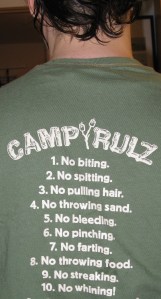
no whining
I had to say no several times yesterday. What a weird concept. Usually I skirt around the issue, not wanting to come right out with not participating. How liberating, how honest to just say no. Not now. Nope. Why haven’t I thought about this before? Why haven’t I dared?

In the case of the work whiners it was easiest when I could look at the time and say we need to continue this tomorrow. My charges? To find out what makes some so damn inefficient. Easier said than done. No Grace under pressure. I had to admire this one administrator. In mid-sentence she was told she needed to be somewhere else. It didn’t ruin her day. It didn’t ruin her attitude. She was able to slide over to a new way of thinking. When I asked her how she managed she looked at me and deadpanned, “interruption is not a word in my vocabulary.” I love it. Word to the wise. Wise up.

It’s harder to say no to friends. I had plans to get together with someone who really means a lot to me. Yet, I need to stay on my training schedule. I couldn’t have done both successfully. It bothered me that the training won out. It bothered me to have to tell her no. After all, she is my inspiration. She is my hero. Yet, I put her off, hero or not. This is the way it had to be. No, I said. I need to train. Her graceful acceptance allowed me to walk nine miles. I got it done because I didn’t give in.

Later, an invitation to chat. Under any other circumstances I would have loved sparring with this flirty friend. He’s quick with the compliments and quicker with the innuendos. I love the sass. I love the challenge this conversation always presents to me. Who can be the most indulgent, the most daring? But, sigh of all sighs, I had to tell him and his innuendos no. I needed a warm bath and a hot cup of tea. As I let the water wrap itself around my tired legs I thought about this new no I seem to have. While I don’t necessary like it or want it, it works for now. For now.

I Remember Church Going

Larkin, Philip. “Church Going.” The Less Deceived. New York: St. Martin’s Press, 1965,

Larkin, Philip. “I Remember, I Remember.” The Less Deceived. New York: St. Martin’s Press, 1965.

The beginning of “Church Going” is the most fascinating. The author visits a church (not his first, nor his last) and describes what he sees and does in this latest church. There is a sense he doesn’t quite believe in the place or his unspoken reason for being there. There is a skepticism in his tone that suggests a deeper disbelief. It begins with the very first line, “Once I’m sure there’s nothing going on” [in the church] (p 28).

“I Remember, I Remember” is a little more straightforward but as equally honest. The speaker is traveling with a friend and discovers a forgotten place from childhood. Immediately, the remembering begins. My favorite line is delivered by the friend, “You look as if you wish the place in hell” (p 38). I can think of a few places in my life where I would have that look!

BookLust Twist: From More Book Lust in the chapter, “Poetry Pleasers” (p 189).

Fan Man

Kotzwinkle, William. The Fan Man. New York: Equinox, 1974.

My first thought of  The Fan Man was what drug induced craziness is this? It also happened to be my last thought when I finished Fan Man. It is chaotic and garbled. To say that I didn’t like it is not quite accurate. I get closer to the truth when I admit I didn’t understand it. Nancy Pearl described this as a book about the Age of Aquarius and maybe that’s the problem – despite being born under the sign of Aquarius, I don’t get the Age.

The Fan Man is also Horse Badorties. He is a slob, obsessed with 15 year old “chicks” he can introduce into his “love choir”, fans (the Japanese hand-held folding kind) and phones. At one part of the book he spends an entire night in a phone booth making random phone calls. At first I thought the obsession with 15 year olds was a metaphor for something else, something spiritual – especially in the context of a love choir.

BookLust Twist: From More Book Lust in the chapter called, “The Book Lust of Others” (p 33). The Fan Man happens to be a favorite of novelist Herbert Gold.

an omelette & a glass of wine

David, Elizabeth. An Omelette and a Glass of Wine. New York: Lyons, 1984.

I think when it comes to writing about food Elizabeth David is an icon. Her books are not only widely read, but evenly more widely discussed and considered bibles in the world of gastronomy. For a woman who cooked the way she did, living all over the world, it is no surprise she is still considered one of the best food writers of all time.
David’s “career” in food writing began in 1947 with a frustration. Unable to get meals she enjoyed she vented her frustration by writing down descriptions of the food she craved, “I sat down…and started to work out an agonizing  craving for the sun and a furious revolt against that terrible, cheerless, heartless food by writing down descriptions of Mediterranean and Middle Eastern cooking” (p 21). And so it began. 

Probably the best surprise to David’s writing is her humor laced with sarcasm. An Omelette and a Glass of Wine is comprised of essays the wrote for well-reputed publications such as Vogue and The Spectator. While the writing is knowledgeable and professional there is an air of whimsy and playfulness running throughout. Here is an example, just to get you started: “He [the waiter] has been five years with the French navy, alors vous comprenez madame je connais les vins, moi. What he doesn’t connait is that I like my Beaujolias cold, straight from my cellar” (p 42). In addition to having thoughtful, knowledgeable essays, An Onelette and a Glass of Wine is peppered (excuse the pun) with wonderful photographs and illustrations. This was a book I enjoyed savoring one essay at a time.

BookLust Twist: From Book Lust in the chapter called, “Food for Thought” (p 91).

If Elizabeth David was alive and I could ask her one question I would have to ask when, exactly, is mayonnaise season and how can I avoid it?