Broken Beautiful

I was invited to a Girls’ Night In last Friday. It sounded amazing. Pedicures, manicures, massage, pampering, girly time. Despite the temptation of all those pedicures and manicures I concentrated on another cure. By 5:30pm I was hitting the streets training for Just ‘Cause. I don’t think I can call walking “training” without a little smile on my face, but after five miles my hips told me differently. They gently reminded me I may not be able to finish twenty let alone times three. Doesn’t matter. I’m here for the cure. I’m broken but I’m still beautiful.

The Sunday sunshine saw me out again. This time I had kisa drop me off at the public library. I’d walk home from there. 5.5 miles if I did it right. I’m noticing my new neighborhood. My new town is beautiful but in a very broken way. Bottles dropped by alcoholics who have had more than their share. Gamblers casting off their loser scratch cards by the hundreds. Flattened things. Unrecognizable things. Dirty things. Things that make my eyes slide away. My favorite moment: a young cat peers out from under a sodden, mangled box with worry in his eyes. I smile with conspiracy. Have no fear. I won’t give you away. Stay stone still and no one will take you away to anywhere. We will walk on by. Promise.

I have decided there are more important things than worrying about what everyone else is doing. I watch people become sulky and sullen when they don’t get what they want and I’ve decided it’s none of their business anyway. Instead, I will pour my energy into something more worthwhile. Petty you is not pretty to me. Everyone will be in for a shock. Maybe I’ll get that pedicure after all. In pink. Then I can say I am living it right. Broken, but beyond beautiful.
Noblest Roman

Halberstam, David. Noblest Roman. Boston: Houghton Mifflin, 1961.

Noblest Roman is Halberstam’s first book. It is also one of the only two works of fiction he wrote. He would go on to prefer writing nonfiction after One Very Hot Day. It makes me wonder about the artistic preference. Why switch from fiction to nonfiction – never to go back again? It’s like the musician who prefers classical music after years of performing heavy metal. Or the watercolor painter who switches to pencil halfway through his career.

Okay. I’m off track.

Noblest Roman takes place in the south (Mississippi) and is a sly commentary on state level elections and the crookedness that comes about in small, rural communities – especially when bootlegging and prostitution are involved. I found the plot to plod and character development to be contradictory. Everything moved too slow for my taste and while one might argue that is the southern way, I found myself sleeping at the wheel too often. It is curious to note that Noblest Roman was inspired by true Mississippi events. Maybe Halberstam wasn’t that far away from nonfiction after all.

Favorite lines: “He changed the subject from Little Bilbo’s woman because listening to the old man talk about her was almost as bad as listening to her in person” (p 10). Had to laugh at that one.
“By all rights he should have been tired and unshaven and rumpled, but he looked fresh and rested. The campaign did not show on him” (p 49).
‘”I’m an old man, Angelo. Before I had a wife. Now I have a wife and a doctor”‘ (p 106).

BookLust Twist: From More Book Lust in the chapter, “David Halberstam: Too Good To Miss” (p 112).

Why so Few Blacks Study Creative Writing

Eady, Cornelius. “Why So Few Blacks Study Creative Writing.” The Gathering of My Name. New York: Carnegie Mellon University Press, 1991.

Such a long title for such a short poem! Here are the tags words I used for this poem: teacher, education, writing, students, culture, and faith. To me this was all about a growing frustration of a teacher; frustration with his students and their lack of interest in writing. I could almost see the blank stares, the “I don’t get it attitude.” I don’t think this is a cultural problem, but a culture-less epidemic that spans illiteracy and disinterest.

BookLust Twist: From More Book Lust in the chapter called, “Poetry Pleasers” (p 189).

Punch

Feinstein, John. The Punch: One Night, Two Lives, and the Fight That Changed Basketball Forever. Boston: Little, Brown & Company, 2002.

Once I learn of a story, an incident that captures my imagination I have to research it, follow it, own it. The story behind “the punch” was no different. What happened on December 9th, 1977 was such a huge deal I needed to see the actual punch itself. Was it really that bad? That shocking? That horrible? I needed to know. In truth, the video evidence is grainy, distorted. To me, there is no way of knowing just how terrible “the punch” really was from a human nature standpoint. Guess it’s a location thing – you had to be there. If anything, I would call the punch a perfect storm. All of the elements needed to make it a horrific moment were in place: Kermit didn’t know why Rudy was charging at him – out of the corner he saw a figure in red barreling towards him. In the game of basketball you are trained to be aware of your opponent’s existence at all times. Rudy was the opponent in red. Rudy didn’t know Kermit was going to turn around and sock him. He was unaware of the danger as he ran full speed down the court. Fist meets face at full speed. Add another element: strength. Kermit was a strong, powerful man. His punching fist would have floored anyone, even if it didn’t have uninterrupted impact. When he hit Rudy, there was nothing slowing either man down.

What makes the Punch such a fascinating read is not only the play by play of the punch and the events leading up to it, but Feinstein is adament about making the reader understand these two players as people. Sports writing meets biography. There is an urgency to make one understand that both of these men were passionate people before they were passionate players. Feinstein carefully illustrates the tough beginnings, the drive and potential each of these basketball stars demonstrated at an early age, including their schooling, family lives and social circles. Even black and white photographs help bring Kermit and Rudy into reality. What is gracefully missing is, of course, the punch itself.

One of my favorite aspects of the book is Feinstein’s casual tone. Here’s how he describes Kermit meeting his wife, “The story of how she ended up meeting Kermit is a complicated one. It happened because of a friend of a friend who had once dated someone who knew another friend of Kermit’s – or something like that” (p 139).

BookLust Twist: From Book Lust twice – both times in the chapter called, “Sports and Games” (p 225 & 226).

Cancer Come Get Me

Carver, Raymond. “What the Doctor Said.” All of Us, New York: Vintage Contemporaries, 2000.

“What the Doctor Said” is about a patient receiving word from his (?) doctor that he has cancer, a cancer so lethal the doctor “stopped counting” the tumors on one lung. You can’t pray but it won’t make a difference. It’s heart breaking and stark. The message is beyond clear. You. Are. Going. To. Die. No bones about it. No hope. No cure. No way out. Imagine that. You are D-E-A-D.

This poem is perfect timing for me. I have mentioned before I have signed up for a cancer walk. 60 miles in three days. The attitude is yeah-yeah another charity. I’ve even gotten an eye roll. I hear the words: So what? Big freakin’ deal. I shouldn’t take it personally, but it still amazes me. No one has asked how they can help. No one has asked ‘how can we donate to the cause?’ They can’t wrap their brains around the fact that this walk could save a life. This walk, this dollar donated might make a difference. It’s amazing. It’s as if the world has become cynical enough to say “you won’t make a difference so I won’t throw my money away.”

What happens when you get a life threatening illness? What happens when you are told you will die? How does it make you feel to have someone say it won’t help you? The attitude is “so why don’t you go ahead and die? It will be painful but just die because I can’t make a difference. I won’t make a difference.”

Drives me nuts.

Can’t Count

For lack of something better to say, here’s something I never posted.

I don’t want to count today’s run for anything except a cemetery visit. After kisa and I got the driveway, porches and walkways cleared of snow it seemed ridiculous to hop on an indoor treadmill. The sun was shining a brilliant blue. Not a cloud in sight. Birds darted among the bushes. 18 degrees felt like 800 after shoveling. Perfect for a graveyard run. Or so I thought.

Here are the things I have forgotten about since my last ‘coil run’ (I’m talking about the coils runners wear over their shoes to avoid slipping on ice – love them!):

  • coils “roll” on pavement
  • coils slip in fluffy snow
  • coils are perfect on icy ice

So, I tried to look for patches of ice to run on the entire time. It seems strange to say that, but it was true. The metal coils worked best when they could dig into the surface and hang on. Snow packed in between the coils and pavement just made the coils roll like springs. Running in snow was like running in very fine, very loose sand. My ankles grew sore and my calves tightened. Hell on the thighs, too.
I had completely forgotten what it was like to run outside in below freezing temps. Tears freeze halfway down the face despite feeling hot everywhere else. Snot starts to lodge itself like ice chunks. In the beginning, speaking of snot, I had a snot bubble that refused to pop. With every breath it grew and shrank like a giant bullfrog throat (crazy image, right? It’s true). It made me giggle until it started to freeze in my nose. Giggling turned to gross in a matter of seconds.
Running outside in the snow affords me the luxury in running in someone else’s footsteps for a while. Someone wearing coils like mine on shoes twice as big. For a while I could match his or her stride footstep for footstep and I fell into an easy rhythm. Then the packed snow ended and I lost my imaginary running mate. It was time for me to turn towards the cemetery.
Running up to the spot I spotted a man not wearing a coat…or a hat…or gloves. In this cold I had reason to worry. Instantly my heart began to race and panic threatened. We made eye contact, said hello and separated. Him leaving the graveyard, me going deeper into it. Remembering I had my phone with me I relaxed as the man continued to move further away.
On the way out I couldn’t believe my eyes. Mr. NoCoat was coming back. Panic was also back, so on gut instinct I bolted across the road and down a side street. I swear I watch too much crime television. I’m paranoid. Nevertheless I hated seeing the same stranger twice. Getting away from him was the only thing on my mind as I cut across another street and up onto a very public sidewalk. There I felt safe enough to slow back down to a breathable, less heart attack inducing pace.

I never did find Rick and Irene’s graves. The snow was too crusty for me to brush away. I never did see NoCoat again. I can’t count this as a real run. Emotions got the better of me. This would have been a 3.25 30 minute run had it not been for digging in the snow and trying to outrun my fear.

Tract

Williams, William Carlos. “Tract.” The Collected Earlier Poems of William Carlos Williams. New York: New Directions, 1951.

This is an ashes to ashes, dust to dust kind of poem. Williams is pleading with his community to spare the glitz and glamour when it comes to burying the dead. He believes in sending a body back to the earth in the simplest way possible. A gentle return, if you will. He asks that his townspeople remember the person for who they were and not who they wanted to be. Do not remember them by the status they kept in society, but rather by the things the departed held dear. Share emotions like grief for they are the true gifts of mourning.

BookLust Twist: In More Book Lust in the chapter, “Poetry Pleasers” (p 189).

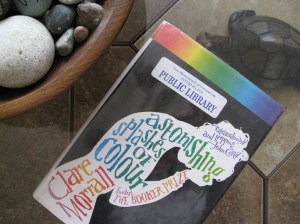
Astonishing Splashes of Colour

MorrallMorrall, Clare. Astonishing Splashes of Colour. New York:  Harper Collins, 2004.
This is the kind of book I could read a thousand times over. This is the style of writing I most identify with. Astonishing Splashes of Colour is so intimate and in-your-face I feel as if Morrall’s main character, Kitty, is leaning in to tell me deep and dark secrets, stories of embarrassing moments, and airing her dirty laundry with a wave of her hand and an air of factual nonchalance. She makes me squirm with her frankness, her vulnerability. Helpless and hopeless, Kitty is the me in the mirror.

Kitty is a thirty-something with something to hide. Her past has as many demons and devils as it does angels. Losing her mother at three years old, the knowledge of an older sister who ran away from home, the fact having four brothers who not only are disconnected from one another but only pretend to be connected to her, the frustrations of having a father who loses himself in painting and has episodes of pouting, the confusion of having an excessively neat husband who lives across the hall in a separate apartment, the heartbreak of a miscarriage Kitty insists on waiting for after school…then there are the colors. Kitty has the uncanny ability to see human emotion, human circumstance as a myriad of color. Her world is not black and white sane, but rather a rainbow of mental chaos. As if all this wasn’t enough everything turns out different from what one would expect. I couldn’t put it down…

Lines I can relate to: “I fight back a wave of giggles that threatens to ripple through me” (p 63). I laugh at inappropriate moments, too.
“I can’t decide which is worse, to not have a mother, or to not have children. An empty space in both directions. No backwards, no forwards” (p 65).
“I would have books around me even if I were blind. I need the smell” (p 138).

There are, of course, many more lines I could quote. This novel, this flash of brilliance definitely resonated with me.

BookLust Twist: From More Book Lust in the chapter called, “Sibs” (p 201).

Table Talk

table talk
Stevens, Wallace. “Table Talk.” Opus Posthumous. New York: Alfred A. Knopf, 1957.

I like the first line best, “Granted, we die for good.” I can just imagine two people sitting around a kitchen table talking about why they like certain things and how it all matters only when you are alive. While all poetry can be manipulated to suit the reader, I believe that Wallace’s philosophical nature comes through in “Table Talk.” There is an awareness to the good things in life; the joys of being alive. It’s almost as if this poem is more than good timing.

BookLust Twist: From More Book Lust in the chapter “Poetry Pleasers” (p 189).

Blind Faith

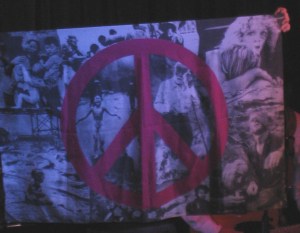
peaceWhat exactly does that mean, blind faith? Is it stupid trust? Is it unknowing confidence? Is it naive hope? What does it mean to have blind faith in something you don’t believe in? Such are the questions. Where are the answers? I am too headstrong for reasoning.
You accused me of something so blind, so stupid, so unknowing and naive. Where was the faith? The trust? The confidence? The hope that I would never steer you wrong. To do you wrong is to do an army of people wrong. Don’t get me wrong, but an army of people more precious than what I mean to you. That might not be saying much, but that’s what I mean without saying too much.

I have given up trying to be meaner than how angry I really am. It’s like too sweet frosting on a cake made without sugar. The compensation just doesn’t cut it. Proportionally, it doesn’t make sense. At the end of the day I find myself not really caring. That’s not mean, just real. Why get fired up over something I have no fire for? It’s like the person who hates without knowing. Hating just because it seems like the right easy thing to do. In the end, when it’s all said and done, was that hate worth anything to the hater? Not really sure. Wasted energy some would say. For a life too short, I would add.

What exactly am I trying to say? I’m not sure. Maybe I’ll never know. This is what came to mind when I thought about you. This is what popped out when I opened my mind to think. So, in the spirit of blind faith I say have faith no more. “Open up your eyes. See me for what I am. Cast in iron I won’t break and I won’t bend.” ~ Headstrong, 10,000 Maniacs.  Words by Natalie Merchant.

I Go Back

Olds, Sharon. “I Go Back to May 1937.” The Gold Cell. New York: Alfred A. Knopf, 1987.

I must have read “I Go back to May 1937” a dozen times. It’s so personal, so haunting, so intriguing. The narrator (presumably Olds) wishes she could go back to the time just before her parents got married just so she could stop them from getting that together. She wants to warn them of the hurt they will cause each other and their child. Instinctively you want to know more – hurt each other how? Physically? Mentally? Is she talking about divorce? She does say “he is the wrong man.” But!But.But, to stop her parents from falling in love and getting married is to undo her very existence. It’s a dilemma of curious proportions.

BookLust Twist: From More Book Lust in the chapter, “Poetry Pleasers” (p 189).

Industrial Valley

Kitty readsMcKenney, Ruth. Industrial Valley. New York: Harcourt, Brace & Co, 1939.

I love first editions of books. I don’t know why. As a rule I don’t collect books based on what edition they are, first or last. Generally, I like books for what is between the covers. Still. I can’t help but be a little excited by reading the first edition of Industrial Valley. Please don’t ask me why.

The controversy surrounding Industrial Valley reminded me of the controversy Billy Joel faced when he wrote “Allentown.” In the begining townspeople didn’t really care too much for Joel’s bleak description of factory life. Yet, it was the truth. Ashamed or proud, that’s how it was. Same with Akron, Ohio. “Rubbertown” as some would call it.
Industrial Valley was written in a diary-like format. Near daily events, both political and social, between January 1, 1932 and March 21, 1936, recount Akron’s depressed economic state. Some entries seem unrelated to the depression (a boy’s death after being hit by a truck) while others hammer home the effect the ecomony had on daily life in an obvious manner (the suicide of a man who couldn’t feed his family). In the end, it was the historic Goodyear strike that changed the industrial climate. Democracy reined.

Favorite lines: “The bitter realities of unemployment and salary cuts conquered, in the end, any sophorific West Hill could imbibe” (p 60).
“All of Akron jumped like a housewife getting a shock from a loose electric wire on her washing machine” (p 219).

BookLust Twist: From More Book Lust in the chapter, “Big Ten Country: The Literary Miswest (Ohio)” (p 29).

Can’t Explain

This guy looks like he wants to talk to me. I could sense him leaning on the bar, leaning closer, trying to catch my eye. My friend had asked if I would be okay while she smoked and even though I want to save her lungs and say no, I nod. Really, truthfully, I am nervous knowing he might try to talk to me as soon as she is gone. It has taken me four songs to decide I’m deaf in this rock and roll soaked bar. The bass pulsates under my feet, the drums vibrates my spine. I feel the music and it drowns out my ears. The guy inches closer. Please don’t talk to me because I won’t be able to figure out what you are saying. I won’t even read your lips. Please don’t stand so close to me. I flash a golden wedding ring and turn a cold shoulder. Not confident I pull out my phone and start a wordy conversation. Can I tell him I’m avoiding getting hit on? Can I tell him I’m using him to ignore the subtle advances of another? I didn’t mean to talk to him or him. I wasn’t going to go there because I promised myself I would leave well enough alone. He and they are well enough and I need to be left alone.
My friend returns and the music gets louder. I sip my wine and look casual and in control. Despite myself I keep talking to my phone. Like a drug I cannot stop. I am confident with him because I can ignore everything else. It’s a game we play. Lying. For good measure I send another message. Suddenly, this guy is tapping my shoulder and mouthing something under the music. I shake my head. I don’t understand you just like I knew I wouldn’t. He says it again. Something about do you dance? I don’t. No, I don’t. Not anymore. I am rooted to my barstool. My wine glass is stuck in my hand. I tap my ring against the glass and turn away.

A Month in the Life

You could say my obsession is my abode. You could say I’ve been too wrapped up in work. You might even say I have been a little fixated on health issues. All of the above I say. All of the above. Luckily, the proof is only in the house. I haven’t been keeping tabs on work or the workings of me. But, here’s the house and how it’s been:

2/23 Closing day. Breasts aside, we are a go.
2/24 Where to begin?
2/25 We have a phone
2/26 Get another truckload from the apartment
2/27 Get another truckload from the apartment
2/28 Get another truckload from the apartment
3/1 Seller here. First visitors. Washer/dryer are in
3/2 First snow storm. How do they handle snow around here?
3/3 Get another truckload from the apartment
3/4 Did first load of laundry
3/5 First cat puke – Get another truckload from the apartment
3/6 Change the freaking locks already
3/7 First day alone
3/8 Get another truckload from the apartment
3/9 Cat comes out
3/10 Ran on tread for the first time – mail didn’t go
3/11 Mail didn’t go
3/12 Mail didn’t go
3/13 mail went- get another truckload from the apartment
3/14 Double apartment trip – in-laws see the place
3/15 Dining room set came – faucet trouble
3/16 Get another truckload from the apartment
3/17 Hate not having the dish
3/18 Really hate not having the dish
3/19 Loving the microwave
3/20 Get another truckload from the apartment – Hello Coldplay
3/21 Get another truckload from the apartment – living room end tables arrive
3/22 Get another truckload from the apartment – Zeke comes home
3/23 This kitchen isn’t working
3/24 This kitchen isn’t working
3/25 This kitchen isn’t working
3/26 Thanks for the manuals
3/27 Get another truckload from the apartment
3/28 fixed the shed window – new security system
3/29 Homeshow
3/30 This kitchen might work
3/31 can we get rid of more boxes?
4/1 Hello chocolate for cheaper!
4/2 You shouldn’t have…
4/3 The first turtles come out. Art comes in!
4/4 More turtles
4/5 Get another truckload from the apartment (when will it end?)
4/6 Art gets its place

Drowning Season

Hoffman, Alice. The Drowning Season. New York: E.P. Dutton, 1979.

When I first started reading The Drowning Season I was reminded of Yellow Raft in Blue Water by Michael Dorris. Not for the style of writing, the use of language – but rather, the struggle between females within a family. In Yellow Raft you think you should despise the mother because of how she leaves her child. Then you learn of the mother’s past and you think you should hate the grandmother..until you hear her story. It’s all in the hands of perception. Same with The Drowning Season. Esther the Black was born to hate her grandmother. Her father named her as an insult to his mother, Esther the White. Everyone knows you don’t name a child after the living, only the dead. Because Esther the White rules the family with harsh words and a hating heart, even insisting that the family live in seclusion, Esther the Black has had a compromised upbringing. She longs for the day when she can escape not only Long Island, but her grandmother as well. But, then there is the grandmother’s view of the world. She bears resentment for having to raise her son’s child while he fantasizes about suicide every summer and his wife tilts the gin bottle back a little too often. Each generation, grandmother and granddaughter, has her own demons to battle. The Drowning Season is the story of how they go to battle against each other and eventually, when love conquers all, for each other.  

Favorite lines: “Phillip had named his daughter on a hot August day, with an ancient hostility and a smile” (p 5).
“And the beatings began when the house grew too small with winter…” (p49).
“Esther the Black was silent; she wished she could cry, but the sadness never seemed to reach her eyes – it stuck in her throat, unable to be moved” (p 196). 

BookLust Twist: From Book Lust in the chapter called, “A…My Name is Alice” (p 1) and the chapter called, “Families in Trouble” (p 82).