Time Traveler’s Wife

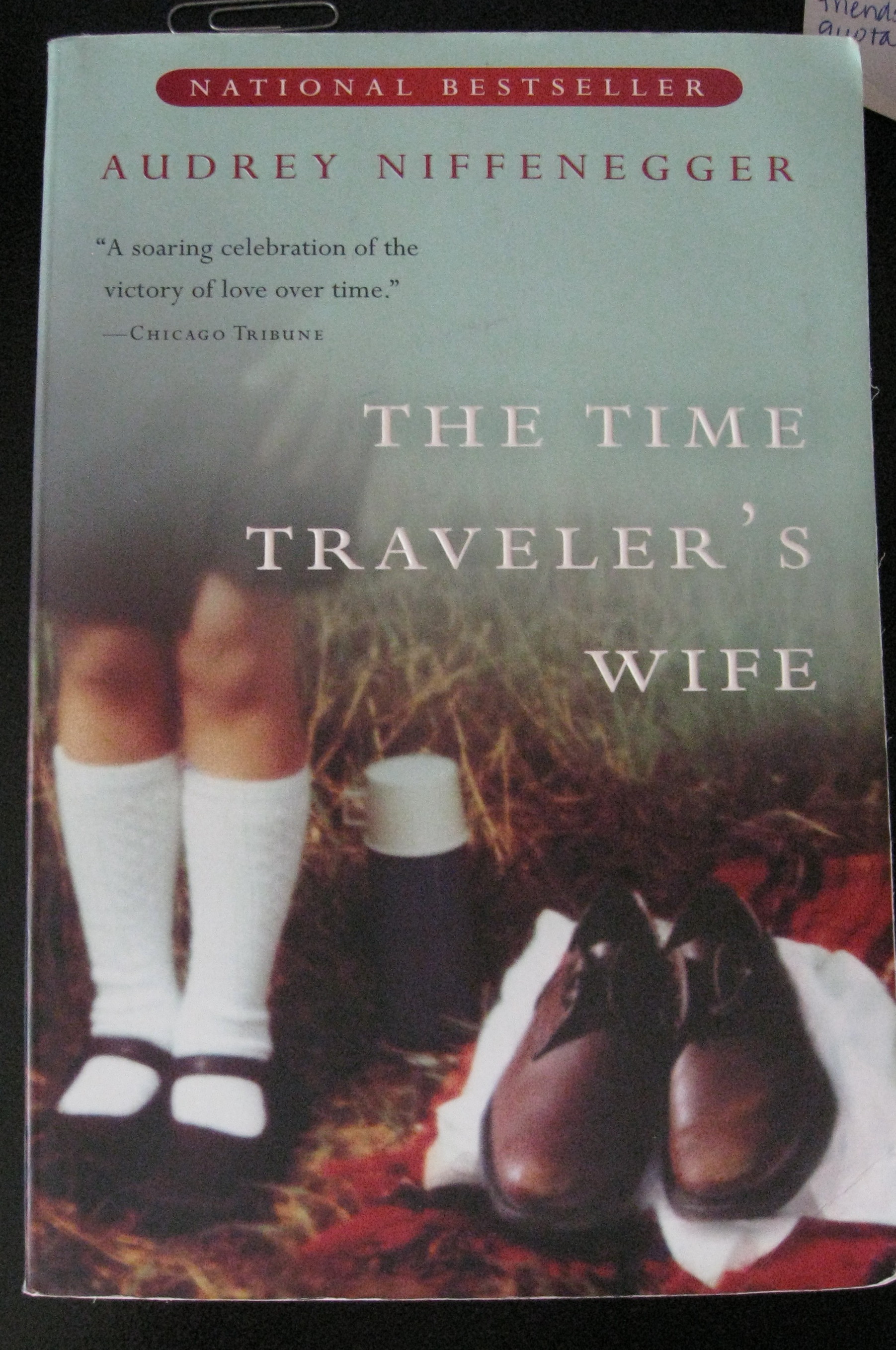
Niffenegger, Audrey. The Time Traveler’s Wife. Orlando: Harcourt: 2003.

This was a reread for me. I first read it on a cruise and it seemed only fitting to reread it on my vacation in California. The first time I read The Time Traveler’s Wife I ached to map out a time line for the story. I wanted to chart Henry’s comings and goings. Reading it a second time was no different.
The Time Traveler’s Wife is the intricate love story of Henry DeTamble and Clare Abshire. Henry is a Chicago librarian who visits the opera, beats people up, and just happens to have a genetic disorder that not only causes him to involuntarily time travel, but gives him the ability to duplicate and visit himself at various stages of his life.
Clare Abshire is an artist and the object of Henry’s affection. Henry’s ability to time travel brings the couple together when young Clare is as young as six years old. As a result, Clare must endure waiting for Henry to time travel back to her. Her wait is made easier by a list of dates of when Henry will return.
While the main story focusses on Henry and Clare’s unusual romance life and world events go on around them. Sex, drugs and rock and roll give way to the aids epidemic and advances in science. Soon doctors are looking for a cure for Henry’s genetic disorder. Because Henry cannot control his time travel he seems to disappear during times of stress or some other great emotion. For example, haunted by the memory of his mother’s tragic death, Henry visits the scene of the accident again and again. Throughout it all, Clare stays by his side as best as she can given the unusual circumstances.

BookLust Twist: In More Book Lust twice. First, in the chapter called “Maiden Voyages” (p 158), and again in the chapter called “Time Travel” (p 221). How appropriate!

Amateur Marriage

Tyler, Anne. The Amateur Marriage: a Novel. New York: Ballantine, 2004.

It’s weird to say I finished this book poolside in Las Vegas, Nevada. Who would have predicted that? Certainly not me.

This is a book I will definitely read again someday. When thinking about this review I wanted to box this story into a corner and call it a sad book, but I couldn’t. It’s such an accurate portrait of how a marriage (and ultimately, a life) can end up that I can’t just call it “sad.” How can I when it’s beautiful, funny, tragic, infuriating, intelligent, frightening and honest all at the same time?
Michael and Pauline are two teenagers whose lives collide at the start of World War II. Their romance is the result of a marriage between a fear of the future and the desire to be someone else at that very instant. Michael wants a girlfriend, any girlfriend. Sensing Pauline’s fascination with the war effort he spontaneously enlists. Pauline wants a soldier for a boyfriend. Any soldier. The culture and uncertainly of the times have thrown these two people together in such a way that neither of them can back out, despite the growing realization they were never meant to be together.
One things leads to another and soon thirty years have gone by. Pauline and Michael divorce and life goes on. And on. While the marriage didn’t survive more than halfway through the novel, Michael and Pauline go on. Their relationship from beginning to end and beyond is captured beautifully.

Favorite quotes: “You know how men are about wearing ties on a Saturday” (p 31).
“I’ve reached the stage where I got so hungry that I’ve gone beyond  hunger” (p 71) …and Kisa didn’t think that was possible!
“Sometimes, Pauline got a feeling like a terrible itch, like a kind of all-over vibration, and she thought that any moment she might jump clear out of her skin” (p 71).

BookLust Twist: From More Book Lust in the chapter “Marriage Blues” (p 161). 

Act of the Damned

Antunes, Antonio Lobo. Act of the Damned. New York: Grove Press, 1995.

I have to admit this was not one of my favorite books this month. Maybe something was lost in the translation (literally from Portuguese to English), but there were too many layers of storytelling going on. Dr. Nuno Souza, a dentist, tells his story in first person, but his imagination works overtime to include an Edward G. Robinson, a cigar smoking, gun toting tough guy. Nuno is married to Ana, but has a drug addicted girlfriend on the side.
Even though Nuno is telling the story in the first part, it’s Ana’s family that is the center of the story. Her family is beyond corrupt. Incest and greed come second nature to these people. Ana’s mother is the voice in part two. I think what makes the story so confusing is that no one really uses names. When Ana’s mother tells the story she uses family connections, “my brother-in-law, sister-in-law, my husband, his father, her brother…” Later, Ana herself tells the story…then someone else who uses the same technique…

These are the quotes that caught my attention:
“I opened the drawer to take out a shirt and tie, and was met by enough sicks for an army of ankles” (p 5).
“I laid down the receiver while the two voices tussled, scratched and bit each other in an electric desert of screws and wires” (p 17).
“‘I want her out by the thirtieth at the latest. She can go to tell and listen to conversations down there'” (p 42).
“I wiped the smile off my mouth with a napkin” (p 71).

BookLust Twist: From Book Lust from the chapter “Families in Trouble” (p 83).

Tomato Girl

Pupek, Jayne. Tomato Girl. Chapel Hill: Algonquin Books, 2008.

What a beautifully written, tragic first book! The characters are so true to life and so compelling I was picturing them in a movie. It’s told in first person from the point of view of 11 year old Ellie. With the help of a series of seamless recollections Ellie recounts her life with a mentally ill mother and a cheating father. Ellie’s father is taken with, and soon overcome by, a teenage girl who delivers tomatoes to the store he manages. From the moment the “tomato girl” comes into Ellie’s life every day is stacked with another unbelievable tragedy, a level of sadness leading to horror much deeper than the one before. It is hard to imagine the amount of pain this child has to endure at such a tender age. Pupek writes with sentences full of foreshadowing. They hang heavy like dark clouds, bloated with the storm that will erupt any minute.
My only complaint is absence of addressing molestation. Ellie is “grabbed” by boy hard enough to leave a bruise. At the same time her period has started (her first). When Sherrif Rhodes discovers the blood, and Ellie tells him of the rough boy, the Sheriff doesn’t take Ellie to a hospital to be examined by a real doctor. She is brought to a black woman who practices witchcraft. Because the story is set in the late 60’s and racism is hinted at I was surprised Sherriff Rhodes would bring a child to her rather than the local hospital. This is the only part I wish was explained better.

ps~ there are a ton of those “gotcha” sentences that I love so much. Too many to mention.


An Academic Question

Pym, Barbara. An Academic Question. New York: E.P. Dutton, 1986.

When this book landed on my desk I nearly laughed. It’s only 182 pages long with a decidedly easy-to-read large font. Needless to say I read it in a day!
Here are some things that intrigued me about the book before I read it: Barbara Pym died of breast cancer when she was only 66 years old. Her last book, An Academic Question was published six years after her passing and is actually a blend of two different manuscripts.
Here’s what I put on LibraryThing: An Academic Question at first read appears to be about a lonely, bored, mother of one, who is feels neglected her professor husband. Her friends are bland, her hobbies even moreso. It’s only after she agrees to help her husband find information to support an article he is drafting do things really start to get interesting. As with any academic, there is competition to get published and for Caro’s husband the pressure is on. Human emotion is played out in subtle detail as Caro deals with jealousy, betrayal, and the need for approval from everyone around her.

One of my favorite scenes is when Caro is in the audience, listening to a young professor give a lecture. Bored with the beautiful lecturer’s topic, Caro starts to focus in on how the striking woman is dressed. Upon noticing a pale pink rose pinned between her breasts Caro decides the color matches the roses she has in her own garden. Soon she is imagining her own husband placing the rose…and speculation and imagination create jealousy which becomes an accusation later on…It truly is a classic way jealousy manifests itself.

BookLust Twist: From Book Lust in the chapter, “Barbara Pym: Too Good To Miss” (p 196).


92 in the Shade


McGuane, Thomas. Ninety-Two in the Shade. New York: Farrar, Straus & Giroux, 1972.

June is fishing month. Go figure. Ninety-Two in the Shade is about a man (Thomas Skelton) who has always wanted to run a guided fishing tour off the Florida Keys. Not the fishing I had pictured for the month of June, but a form of it, I guess. Thomas is new to the business and even newer to competition. He is not without his share of problems. The opening “scene” is Thomas waking up in a hotel and finding four people standing naked in a tub. Right away you know this isn’t your typical River Runs Through It fishing story! Other quirks: violence that does (or doesn’t) happen, relationships that are (or aren’t) good, and the entire book is absent of chapters. I may have come across other books like this but never noticed this chapterlessness before. The only reason why this seems odd is because not having chapters makes it difficult to know where to stop!

I did a little extra research and found out that Ninety-Two in the Shade was made into a movie not long after it was written and while it’s Thomas McGuane’s third work of fiction many critics consider it his best.

I never did get used to McGuane’s “gritty” style of writing, but here are some quotes (and scenes) that caught me: “He walked to Homestead, then right on through town, tripping his brains out in the emptiness of 5 a.m.” (p 4).
A conversation between Skelton and “his girl.” May it confuse you as much as it did me:
Miranda~ “Tom, I had this incredible orgasm.”
Tom~ “Do I have to hear about your organism too?”
M ~ “Just this one. It was like a whole dream of sweet things to eat…Spun sugar, meringue, whipped egg whites…”
T ~ “How about when your chum shot off? Was it a blintz or an omelet?”
M~ “Ask him.”

To say that Ninety-Two in the Shade isn’t without humor would be a lie: “You should never kill somebody if it isn’t funny” ( 34).

BookLust Twist: In both Book Lust and More Book Lust. Book Lust: in the chapter “Montana: In Big Sky Country” (p 156) because Thomas McGuane is from Montana. This, by the way, takes care of a November read because that’s when Montana became a state and Ninety-Two in the Shade was on the November list. More Book Lust: in the chapter “Gone Fishin'” (p 101).

Things They Carried

O’Brien, Tim. The Things They Carried. New York: Broadway Books, 1998.

I admit it. I have picked this book up three different times now. Technically, I should have read it in March to celebrate the day U.S. troops pulled out of Vietnam (March 1975), but as you can tell, there were plenty of other things to reach for in March…
Nope, I cracked this book open for no other reason than sheer boredom. I finished Peter Pan and The Ground Beneath Her Feet and decided I wasn’t up for The Joy Luck Club…at least not right now. The Things They Carried has been hanging around my office for months now. It just seemed to say “read me” and the time was right. I am so very glad.

This was an amazingly moving book. I had a hard time getting into it the first two times I picked it up, but the third time was a charm because after that I couldn’t put it down. Tim O’Brien writes with such ferocious honesty. He calls it a fiction but it easily could have been the truth. The shocking violence, the depths of sadness, the urgency to survive, the humble efforts to maintain sanity and the humor that survives it all…each chapter is a short story of all of these things. Each story stands alone, complete as it is, yet connects beautifully to the story before it as well as the one after it. Peter S. Prescott from Newsweek said the stories “bounce off each other…” and I would agree.
I could quote nearly each story, but here are my favorites:
“They carried all they could bear, and then some, including a silent awe for the terible power of the things they carried” (p 7). The reason why this quote stuck with me is because O’Brien spends the opening chapter listing everything a soldier carried in the Vietnam war. Both the physical and mental, the essential and the sentimental. This quote sums up how they never forgot why they were carrying everything else.
“The problem, though, was that a draft board did not let you choose your war” (p 44). I found this to be one of the most humanitarian statements of the book. O’Brien had just finished explaining that some wars were justified, like stopping Hitler, but in this case he was drafted to fight a war he didn’t understand.

BookLust Twist: From Book Lust in the chapter “Vietnam” (p 239).
ps~ one of the reasons for starting the Book Lust challenge was to find writers I could fall in love with. I wanted one book that would spark an obsession. Much like Margaret Atwood’s The Handmaid’s Tale or Barbara Kingsolver’s Animal Dreams or Katherine Weber’s Objects in the Mirror are Closer than They Appear. All of these books created a rabid need to read anything else written by the authors. I found such an obsession with The Things they Carried. I will go on to get my hands on any and everything Tim O’Brien has written before and since.

June is…

June is:

  • Fishing Month (92 in the Shade by Thomas Mcguane)
  • Barbara Pym’s birth month (An Academic Question)
  • National Family Month (Act of the Damned by Antonio Lobo Antunes)
  • The most common month to get married in (Amateur Marriage by Anne Tyler)

If there is time I’ll also reread Time Traveler’s Wife by Audrey Niffenegger

June is also another LibraryThing Early Review:

  • Tomato Girl by Jayne Pupek

Personally, I ended May on a crappy note so June is ME month. It’s also vacation month! Hello Vegas! Hello San Diego! I’m hoping to see some very special people. June is also house-hunting month (like we haven’t been doing that already!). The farm starts up this month and I started a new blog about the fantastic four which I am really, really excited about, too! Like I said, ME month! 8)

May Was…

A month of allergies. Lilacs. The end of the school year (yay). Dreams coming true. The final Chuck Lelas walk. A new haircut. The serious house hunt. Family time. Natalie Merchant performing with the Boston Pops and ten good books (Nine and a half…).

  • Educating Esme: Diary of a Teacher’s First Year by Esme Raji Codell (National Education Month)
  • Plain Speaking by Merle Miller (Harry Truman’s birthday, Merle Miller’s birthday, on the heels of a book about Roosevelt…it just made sense).
  • True Confessions: a Novel by Mary Bringle (Mothers & Daughters)
  • Dreamland by Kevin Baker (History. I have to admit, tail between my legs, that I didn’t finish this one. Once I found out what the reader doesn’t find out I didn’t want to continue. BooHiss).
  • Ground Beneath Her Feet by Salman Rushdie (Music month)
  • Murder on the Leviathan by Boris Akunin.

Books added to the list because I gave up on Dreamland:

  • Peter Pan by J.M. Barrie (celebrating Barrie’s birthday)
  • The Things They Carried by Tim O’Brien for no ther reason than it was a great book!

For LibraryThing & the Early Review Program~two books!:

  • Best Girlfriends Getaways Worldwide by Marybeth Bond (really, really fun travel guide)
  • Home Girl: Building a Dream House on a Lawless Block by Judith Matloff. Interesting, considering I’m dreaming of houses these days…


Peter Pan

Barrie, J.M. Peter Pan. Toronto: Bantam books, 1980.

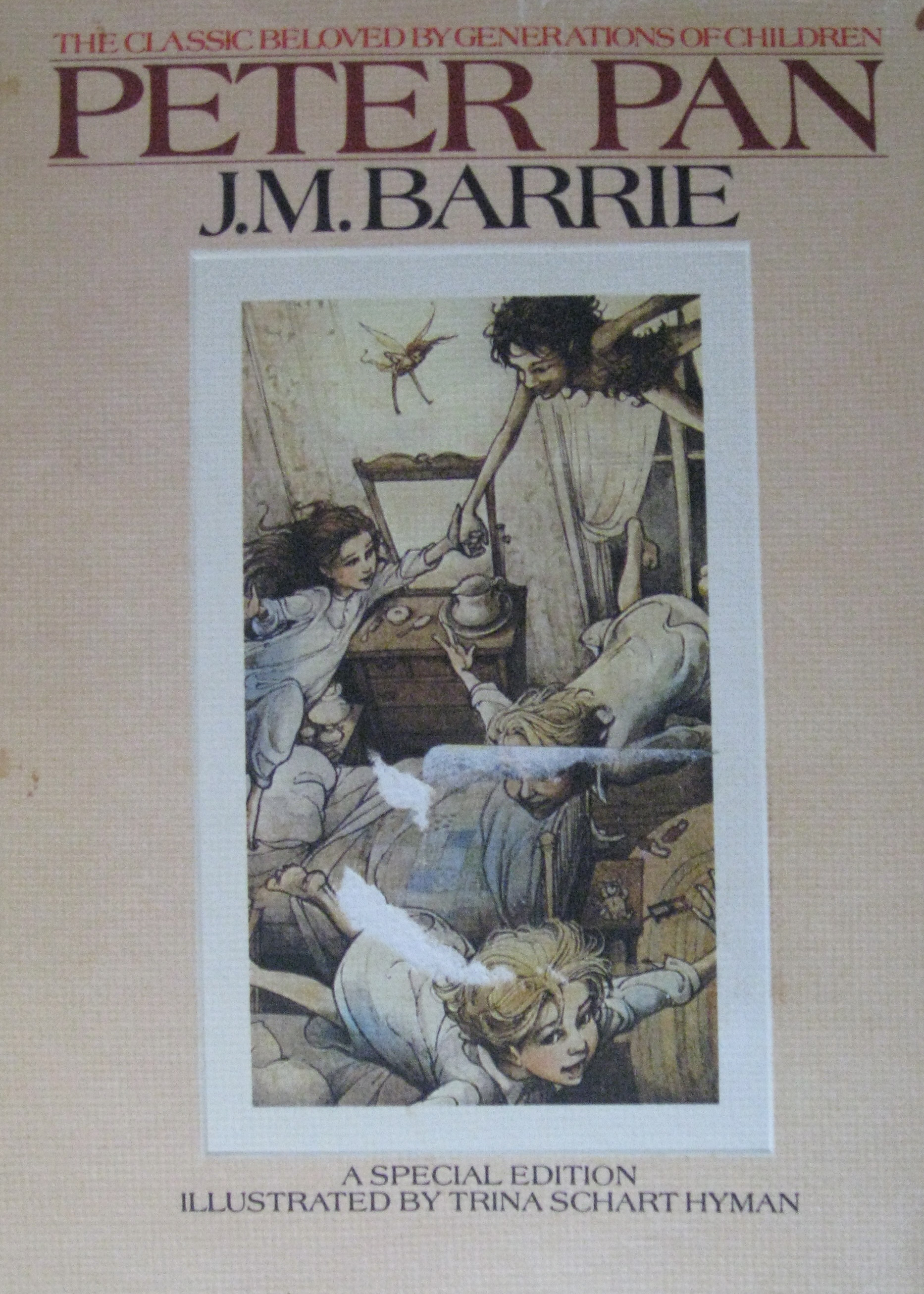
Barrie was born in May. I needed a quickie read for the end of the month. Choosing Peter Pan was a no-brainer. The version I chose to read was an illustrated deluxe addition. Full of both color and black and white illustrations: “Special edition illustrated by Trina Schart Hyman.” Really.

Because Peter Pan is such a well loved, well (over?) produced story, everyone knows the basic plot: three kids unhappy with the way their father has treated the family dog run away with an orphan boy to his Neverland (not to be confused with Michael’s Never Land Ranch). Peter and his Lost Boys are looking for a mother and they think they have such a figure in Wendy, one of the Darling children. It’s a magical adventure full of danger in the form of pirates, “redskins” and a ticking crocodile. Even the fairies and mermaids are not to be trusted.

Upon rereading Peter Pan I was surprised by how slow the story moved in certain sections. Because of the glossed-over, dumbed-down, glitzed-up theater/movie/storybook versions that have popped up over the years I had forgotten Barrie’s original 1911 language and long since deleted details. It was hard to picture reading this aloud to a young child. Peter Pan seemed slightly evil (being described as cunning and sly), Tink seemed downright dirty as she responded to her own jealousy over Wendy (gleefully leading Wendy to her death). True to fairy tale form, it does have a happy ending. Sort of.

One of my favorite images from the book that I’ve never forgotten is how Peter describes fairies as being the shattered pieces of a baby’s first laugh, “You see, Wendy, when the first baby laughed for the first time, its laugh broke into a thousand pieces. and they all went skipping about, and that was the beginning of the fairies” (p 29).

BookLust Twist: From More Book Lust in the chapter “Fantasy for Young and Old (p 83). 

Ground Beneath Her Feet

IMG_1374
Rushdie, Salman. The Ground Beneath Her Feet. New York: Henry Holt & Co., 1999.

May was deemed National Music Month by someone out there so, in honor of that tidbit I chose The Ground Beneath Her Feet as my “music book.” This was my first time reading Salman Rushdie & I have to confess, if all his other books are so lengthy and detail driven, I am going to have a hard time getting through them. This one was a whopping 575 pages long and and and! I knew the ending in the first chapter!

The Ground Beneath Her Feet is an epic rock and roll love story. Spanning several lifetimes Rushdie tells the love story of Ormus and Vina, two musicians from Bombay. Their story is like a gigantic flood, catching up and describing in detail: cultures, mythologies, histories, industries (agriculture (goats!), music and beyond), the landscapes of India, England and America, their societies, religions, ancestries of families, personalities, births, deaths, emotions, tragedies, triumphs, anything and everything from  the mid 1950s until the early 1990s.  This is a sweeping story that cannot be pigeon-holed into a romance, mystery, or comedy. It is all these things and thensome. Suicides and secrets, miscarriages and murders, wealth and poverty, sane and strange, greedy and generous, brothers and sisters, twins and torture, and of course, sex, drugs and rock and roll.

My favorite quotes circled and scrutinized love:
“In love one advances by retreating” (p 15).
“when it comes to love there’s no telling what people will convince themselves of” (p 30).
“But as the years passed we became each other’s bad habit” (215).

And one quote about my fave, the drums: “It is as if the drums have been yearning to speak to him, and he to them. Finally, he thinks: at long last, here are friends” (p 287).

BookLust Twist: From Book Lust in the chapter “Music and Musicians” (p 164).


Home Girl

Matloff, Judith. Home Girl: Building a Dream House on a Lawless Block. New York: Random House, 2008.

I could not put this book down. From start to finish it had me looking to answer that What Happened Next? question.
Matloff trades in one adventurous life (as a foreign correspondent) for another (home owner and wife in New York City). The exchange seems benign until the reader (and Matloff herself) realizes the Victorian she is buying is decrepit; in need of repair in every possible way, the new neighborhood is a one of the biggest drug zones in the country, and on a daily basis she must protect her property from the addicts who have called it home. If that wasn’t enough, Matloffmust walk a fine line of graceful respect and distance with the dealers on the street while becoming a mother, a crime fighter and witness to the tragedies of September 11th. Throughout it all, Matloff remains humbled and humorous.

Other observations: The picture on the inside cover indicates the title would have been Home Girl: Building a Dream Home in a Drug Zone. Not sure what I think about that.
I hope they keep the author’s note. Matloff’s sentiment about wishing the events weren’t true really intrigued me…really made me want to read the book.
Of course, there were quotes I absolutely loved, but I’ll keep them to myself until the book is published.

Murder on the Leviathan

Murder on the LeviathanAkunin, Boris. Murder on the Leviathan. New York: Random House, 2004.

Oddly enough, I chose this book because it was written by an author who spent a great deal of time in Moscow and a guide book advised me that now was the best time to visit Russia. There was no other reason to read this at this particular time. But, having said that, I’m glad that I did. It was fun.
Murder on the Leviathan starts out violently, a record of an examination of a crime scene set in 1878. I think the murders of ten people ranging from ages 6 to 54 in one Parisian house would cause a stir even in the 21st century. Oddly enough, this is not the murder the title of the book refers to. Commissioner Gauche discovers a clue that leads him to the Leviathan, a giant steamship headed for Calcutta. As he sets sail with a host of interesting passengers (in first class) he soons discovers each and every one of them is a potential suspect. It gets interesting when people start dying on the ship. A Russian detective soon joins Gauche on the hunt for the killer.

I didn’t find any quotes to include, but I did have to look up “gutta-percha” shoes. Depending on who you ask, gutta percha is described as tree gum, rubber, or plastic.

BookLust Twist: In More Book Lust in the chapter “Crime is a Globetrotter”, subsection, “Russia” (p 59).

Dreamland

DreamlandBaker, Kevin. Dreamland. New York: Harper Collins, 1999.

It makes sense that a historian like Kevin Baker would write something as epic and sweeping as Dreamland. It is a beautifully blended tale of fiction and reality. Events like the Triangle Shirtwaist fire and people like Sigmund Freud and politics like Tammany Hall exist in harmony with fictional Coney Island gangsters and seedy carnival performers. It’s a world of underground rat fights, prostitution, gambling, and the sheer violent will to survive. It’s dirty and tragic. A love story hidden behind the grime, the colorful lights, the tricks, and the chaotic noise of New York.
Favorite lines that moved me: “That is always the thing with depravity: just when you think you’ve plumbed the very depths, there is always someplece lower to fall” (p 26).
“I sat behind the left ear of Satan, and watched the sun come up over Sheepshead Bay, and dreamed of an empire of little men and little women, ruled by a mad queen” (p 34).

BookLust Twist: From Book Lust in the chapter “American History: Fiction” (p 21). I think Pearl’s description says it all, ” Dreamlandvividly describes the lives of poor immigrants families on the Lower East Side of New York City, circa 1910, who find their lives somewhat more bearable by the promise of excitement of Coney Island” (p 21).

True Confessions

True Confessions
Bringle, Mary. True Confessions. New York: Donald I. Fine, 1996.

This sounds like it would be the title of a very juicy blog. Something I haven’t already spilled in some sordid way or another. Unfortunately, it’s only the latest challenge book for Book Lust. I read this in honor of Mother’s Day and I have to admit it was a strange choice. The inside book cover describes True Confessions (in part) as “…a mother who loves her to death and an ex-mother in-law who doesn’t approve…” So, yes, mothers are part of the story, but you never really meet either mother. As a result I didn’t get that loved to death feeling from mom, nor the disapprovefrom the ex-mother in-law.
But here’s the story in a nutshell: Grace teaches writing in New York, lies to her mother about her location (mom thinks she’s in England), struggles with relationships and fantasizes about being a story in a magazine she is obsessed with called – you guessed it – True Confessions. Grace doesn’t have direction. In the beginning she seems shallow and self-absorbed. Of course there is a period of growth through odd incidents such as her friend’s affair revealed on television, a kidnapping, and even a death. When it is all said and done, Grace emerges a stronger, wiser person.
Critics describe the book as funny, but I have to admit the first laugh-out-loud moment I had was when Grace is in Central Park with her friend Naomi. Naomi has two children, but acts like she wasn’t meant for motherhood: “Grace always felt grateful to Naomi for refusing to submit to the role which it would have been so natural for her to assume” (p 68). On describing her daughter Alice, Naomi says, “Sometimes I think we have her on loan, like a library book…sometimes…it’s not even a book I want to finish” (p 68). There is more. Naomi rants about trying to keep kids away from television. “…unless you want them to be social pariahs they’ll be contaminated sooner or later” (p 69.
Another favorite line: “lunacy is quite impartial. Warps in the genes, screwy endocrines – they don’t count” (p72).

BookLust Twist: From Book Lust in the chapter “Mothers and Daughters” (p 160).