March ’11 was…

What can I say about March? The snow is (finally, finally) beginning to melt and kisa and I are starting to think spring even though it’s still cold, cold, cold and more snow is expected for tomorrow. We made some pretty sobering decisions. No huge projects for Hilltop and no expensive vacations. We’re taking a year off from spending. It’s a good choice, I think, given all the work drama we both have been through recently. Family life is starting to even out. For awhile I wasn’t feeling the proverbial pressures, but then again I had been shutting my phone off at night! March was also a Natalie night with the best company a girl could ever have.  Here’s the list for March books:

  • Jane Eyre by Charlotte Bronte ~ in honor of Book Month. I had forgotten about all the sighing and sobbing! *sigh*
  • Blind Descent by Nevada Barr ~ in honor of Barr’s birth month. I will never look at cave exploring the same way again!
  • Flint by Paul Eddy ~ in honor of Eddy’s birth month.
  • The Bold Vegetarian: 150 Innovative International Recipes by Bharti Kirchner ~ in honor of March being “noodle month.” I kid you not.
  • Cross Creek by Marjorie Kinnan Rawlings ~ in honor of Florida becoming a state. This was made into a movie…interesting.
  • God’s Bits of Wood by Sembene Ousmane~ in honor of African American Writers Month.
  • Cloudsplitter by Russell Banks ~ in honor of March being family month. This was a behemoth to read – over 700 pages!
  • Raising Holy Hell by Bruce Olds ~ in honor of family month (read with Cloudsplitter because they were on the same topic).
  • Cosi fan Tutti by Michael Dibdin ~ in honor of March being Dibdin’s birth month.

Confessional: I skipped Famished Road by Ben Okri and added God’s Bits of Wood by Sembene Ousmane instead. Somehow I had forgotten that I had already tried that book a few years ago. It just wasn’t my thing. However, I did write a review for LibraryThing. I just wish I had remembered that before ordering it a second time. I hate making more work for librarians! Here’s what I said for LT:
The Famished Road by Ben Okri is all about spirits. Azaro is a child in Africa struggling between two worlds: that of the spiritual and that of the Earthly. His parents on Earth are well meaning, but poverty driven, people. the basic theme of Famished Road is the definitive difference and ultimate struggle between good and evil. Azaro’s personal struggle is with spirits that can only exist if Azaro is dead. Azaro’s father struggles with abuse and power. Starting as a boxer he soon delves into the world of politics to gain power. Madam Kato is a simple bartender who begins her part of the story by wanting more profit but as a result of greed, sinks lower and lower. Along with the ever-entwining magical realism is the drifting of morality.

Other books I read in March not on the BookLust list: Miss Timmins School  for Girls: a novel by Nayana Churrimbhoy ~ an Early Review book for LibraryThing. This was great! Definitely one of my favorite reads of the month. I also started reading Clean Food by Terry Walters and Now Eat This by Rocco Dispirito (reviews coming soon).

Les bouts de bois de Dieu

Ousmane, Sembene. God’s Bits of Wood. Trans. Francis Price. Botswana: Heinmann, 1960.

God’s Bits of Wood has multiple layers. At face value it is a story of a Western African 1947-8 railroad strike. The story focuses on several key players but the most important individuals are Ibrahima Bakayoko, a locomotive engineer who becomes the union leader during the strike, and on the other side of the conflict, Dejean, the French colonial manager. Because the story takes place in several different areas (Bamako, Thies and Dakar) the overall impact of the strike is generalized to a population. The story reaches past an African railroad strike in order to analyze clashes that go beyond worker/employer relations. The social economic and political contexts are analyzed and illustrated. It is more than a description of the initiatives of the railroad workers versus the initiatives of the colonial administration. Feminists have a field day with re-imagining gender relations as the women of West Africa transform themselves into powerful members of society – the social function to the story as it pertains to Sengal and Africa as a whole.

I have to admit it was driving me nuts that I didn’t understand the title “God’s Bits of Wood.” I needed to know what it meant. I was picturing a forest, a campfire, a dilapidated shack. All things wood…in bits. I was happy to learn, early on, that the wood of  God’s bits of wood are actually people. Gotcha.

Favorite lines: “And the men began to understand that if times were bringing forth a new breed of men, they were also bringing forth a new breed of women” (p 34). I think that sums up the entire book.
Other favorite lines: A line from Hadrame, “This strike is a war if eggs against stones!” (p 42).

Author fact: It was interesting to read that Ousmane has been a fisherman, a plumber, a bricklayer, an apprentice mechanic, a docker, as well as a trade union leader and a filmmaker in addition to be a successful writer.

BookLust Twist: From Book Lust in the chapter called “African Literature in English” (p 16).

March ’11 is…

I consider March to be a month of all things serious. I will be serious about training for the Just Cause 60-mile walk. I will be serious about keeping up with my PT. I will be serious about the goals I set for myself (written and unwritten). Oh so serious! For books the list for March is modest:

  • Jane Eyre by Charlotte Bronte ~ in honor of March being Book Reading Month. Isn’t this just the most classic book with which to start the month?
  • Flint by Paul Eddy ~ in honor of March being Action Hero Month. I forget who told me that. I know I just ran with it! Grace Flint is the hero of the month.
  • Famished Road by Ben Okri ~ in honor of African Writer’s month. Again, I don’t know where I got that info. I’m just going with it!
  • Blind Descent by Nevada Barr ~ in honor of March being Barr’s birth month
  • Cosi Fan Tutti by Michael Dibdin~ in honor of March being Dibdin’s birth month

There is still the LibraryThing Early Review book that is still missing in action AND I just received word I have been chosen for one for March as well. As always, I won’t name them until I see them!

In other news, there is news on the job front. I suppose that should be on the list of serious as well. *sigh*

Nov ’10 was…

More head in the sand, tail between my legs reading for the month. While it wasn’t an easy month I am happy to say it was better than October by a long shot!

  • The Harmless People by Elizabeth Marshall Thomas ~ in honor of November being the best time to visit Africa. This was an eye opener. I will never look at people the same way again.
  • The New Well-Tempered Sentence: A Punctuation Handbook for the Innocent, the Eager, and the Doomed by Karen Elizabeth Gordon ~ in honor of Writing month. Information I will keep in mind but, because I’m a rebel, probably ignore. Case in point – this sentence!
  • Balsamroot: A Memoir by Mary Clearman Blew ~ in honor of Montana becoming a state in November. This was more about a favorite aunt’s slow decline than about Blew’s own personal life.
  • On the Road by Jack Kerouac ~ in honor of November being National Travel month. This was, I think, my favorite book of the month.
  • The Healing by Gayl Jones ~ in honor of November being Jones’s birth month. This was the hardest one of the bunch to read. I’ve decided I don’t care for stream of consciousness!
  • Ruby by Ann Hood ~ in honor of November being National Adoption month. This was a psychological book that had me pondering life’s bigger questions. It took me a weekend to read.
  • Brothers and Sisters by Bebe Moore Campbell ~ in honor of November being the month of Campbell’s passing. Once I got passed the stereotypical characters this was a great book!

For LibraryThing and the Early Review program: Final Flight: The Mystery of a WWII Plane Crash and the Frozen Airmen in the High Sierra by Peter Stekel. This book had everything I could want in a nonfiction: truth and mystery embedded in a well told tale. It was great!

Harmless People

Thomas, Elizabeth Marshall. The Harmless People. New York: Alfred A. Knopf, 1970.

Elizabeth Thomas put a lot of heart and soul into the writing of The Harmless People. Her research was not done from a cold, calculating, scientific perspective. From the very first pages one can feel the intensity of the respect she has for the lives and cultures Kalahari Bushmen. Thomas seems driven to convey a message more important than all the others about the reclusive tribes and that is they are gentle people. Harmless. Their tribal name for themselves is Zhu twa si, meaning the harmless people. There are many occasions for Thomas to illustrate this. In order to study each Kalahari tribe Thomas first had to find them which proved to be difficult because they had a tendency to run and hide at the first sign of stranger intrusion. Even after finding these people she (and her crew of scientists and researchers) had to convince them she wasn’t there to create conflict or enslave them or steal from them. It took a great deal of time to gain their trust just so that Thomas could live among them.

Favorite lines, “…Bushmen would not try to fight because they have no mechanism in their culture for dealing with disagreements other than to remove the causes of the disagreements” (p 22), and “We would have liked to look around, but the best thing we could do was keep our big boots and our bodies away from their delicate, fragile, almost invisible community” (p 41).
Most disturbing moment? Believe it or not, when Thomas describes the killing, cooking and consumption of a turtle. I could barely read the words.

BookLust Twist: From More Book Lust in the chapter called, “Africa: a Reader’s Itinerary” (p 4).

Ancestral Truths

Ancestral TruthsMaitland, Sara. Ancestral Truths. New york: Henry Holt & Co., 1993.
To be quite honest I don’t know how this came into my hands. I’ve already read one book in honor of National Sibling Month. This was supposed to be on the list for next year, or maybe even the year after that. I wasn’t supposed to read two sib books in one month. But, suddenly there it was and after I picked it up I couldn’t put it down.

Ancestral Truths is a bizarre tale about a woman who starts a journey climbing a mountain in Zimbabwe with her lover and ends it with her alone with an amputated hand and the nagging doubt of murder in her heart. Reliving her days in Italy and on Mount Nyamgani while on holiday with her large family in Scotland, Clare Kerlake tries to figure everything out. Did she kill her boyfriend? Can she live without her right hand? She comes from a large family and they all have baggage so it’s no surprise when the plot gets a little preachy and over the top. Religion, feminism, mysticism and witchcraft all play a part in this novel. It gets heavy at times but well worth slogging through.

Favorite parts: “She was an amputee, a cripple, stared at discreetly and pitied; or completely ignore, invisible in the embarrassment of strangers” (p 10). “‘You named me,’ Joseph once said irritably, ‘not only  after the only married male virgin in the Church’s calendar, but after the only bloke in history who would take his pregnant  girlfriend on a trip without booking in advance'” (p 110). Last one, “Clare had been embarrassed, self-conscious in her laughter while Julia was free in hers” (p 286).

BookLust Twist: From Book Lust in the chapter called, “Brothers and Sisters” (p 47).

November Was…

Death of Spuke
November was an amazing election, the slow death of Spuke, an incredible Thanksgiving meal, a few birthdays missed, more houses than I care to admit to seeing, more paperwork than I care to admit to reading, and last but not least, a little bit of music (Sean!). We didn’t get the house and I had to take a few days to get over that…even though I wasn’t 100% in love with the house. How weird is that? Ah well.

For books read, here’s the list:

  • Behind the Scenes at the Museum by Kate Atkinson ~ I went back and forth about this book…almost as much as the plot did.
  • The Darling by Russell Banks ~ Loved, loved, loved this book – full of suspense and great characters.
  • As I Live & Breathe: notes of a patient-doctor by Jamie Weisman ~ read this in one day!
  • Passionate Nomad: The Life of Freya Stark by Jane Fletcher Geniesse ~ such an amazing biography!
  • A Continent for the Taking: the Tragedy and Hope of Africa by Howard French ~ Very similar to The Darling. Same time period, same “characters” and events.
  • Best Essays of the Century edited by Joyce Carol Oates ~ while I only read a sampling of essays they were all good.
  • The Bronte Myth by Lucasta Miller ~dry and long.

For the Early Review Program (yay!):

  • Beyond Belief: Finding the Strength to Come Back by Josh Hamilton ~ really fast but amazingly good read.

For fun:

  • Bridge to Terabithia by Katherine Paterson ~ a great story from my childhood about friendship. This was on my challenge list. I just decided to read it out of order one day.

Nine books…sort of. I’ll have a confession for next month 😉

The Darling

Banks, Russell. The Darling. New York: Harper Collins, 2004.

I hate using words like “gripping” and “suspense-filled” to describe a book, but this time I can’t help it. The Darling was both of those things and much, much more. Once I started reading it I dropped every other book and concentrated on devouring the words of Russell Banks. While his plots are always over the top I like that hairy edge of reality and suspension of belief.

It’s a political thriller, a sweeping epic spanning the decades of one woman’s life, and a social commentary on Africa, racism and greed. It’s all of these things. Dawn Carrington is Hannah Musgrave who is also “Scout.” Dawn/Hannah/Scout is a woman with a past as complicated as her many names. Brought up by affluent, almost snobby parents as Hannah she is drawn to the underworld of political terrorism as Dawn. On the run after being indicted for a bombing gone bad, Dawn flees to Liberia and, by marrying a government official, becomes Missus Sundiata, her fourth recreation. Told from future to past and back again Dawn/Hannah takes you on her unapologetic journey through deceit, corruption, power and humanity.

Part of the reason why I liked The Darling so well is because it was written by a man. Russell Banks is able to capture the voice of a woman as a wife, mother, and an individual fiercely protective of her independence and individuality. Even if she doesn’t know who she really is. The first person voice is reminiscent of Barbara Kingsolver’s Taylor Greer or Margaret Atwood’s Handmaid.

Favorite lines:
“I was not a natural mother. Was not programmed like most women with a mother’s instincts and abilities…It’s as if I was, and still am, missing the gene” (p 171).
“But how I wished I were invisible. My white skin was a noise, loud and self-proclaiming” (p 177).
“I woke just before dawn with a boulder of rage lodged in the middle of my chest and a desire to break someone’s skull with it” (p 236) – that sounds like something I would say!
“That’s the real American Dream, don’t you think? That you can start over, shape-change, disappear and later reappear as someone else” (p 255).

Another section I had a love-hate relationship with was Hannah/Dawn’s father passing away from a stroke. The detail of his death was almost too painful to read, having watched my father slip away much in the same way.

BookLust Twist: From More Book Lust in the chapter “Men Channeling Women” (p 166).

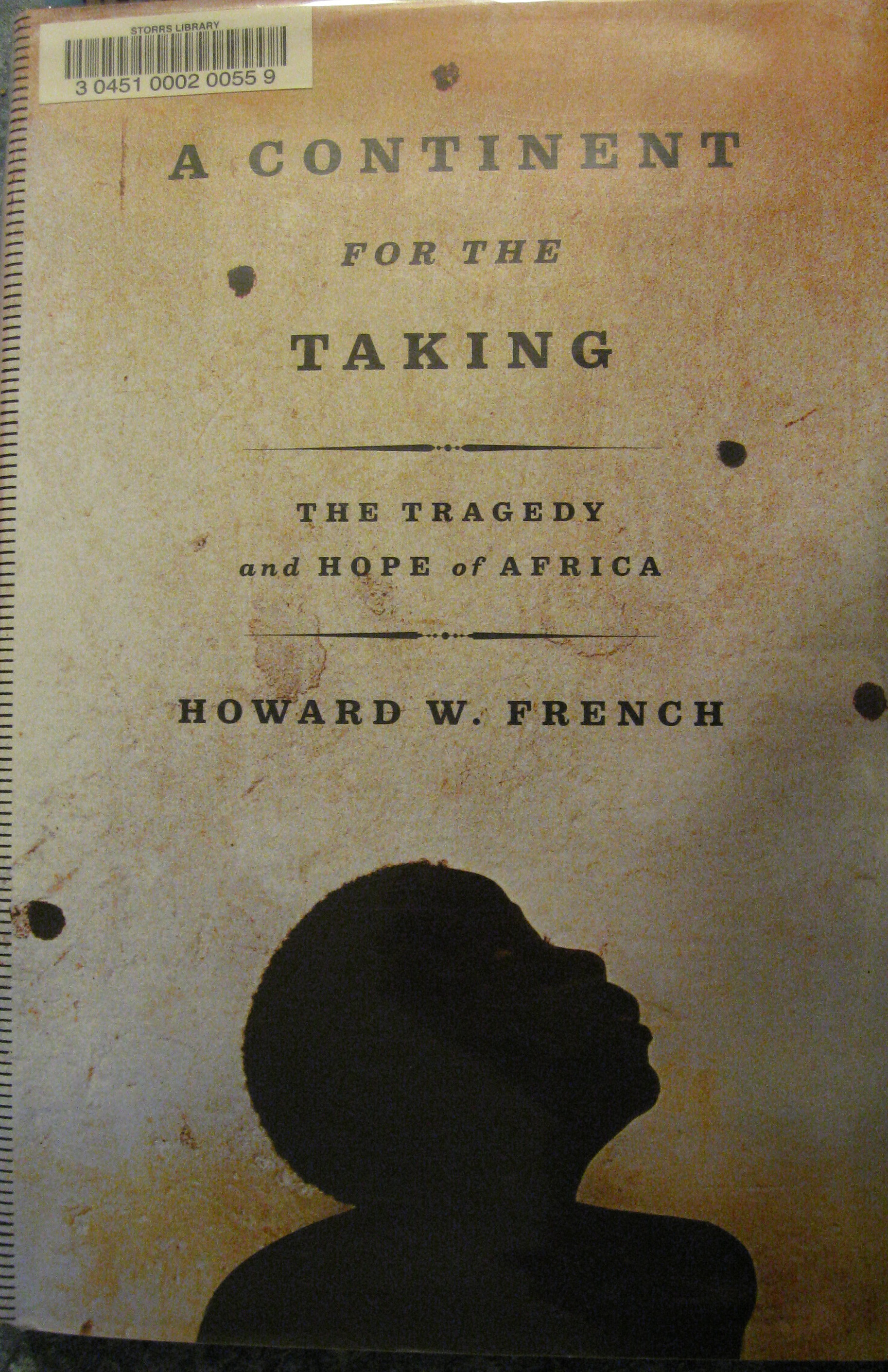
Continent for the Taking

img_4235French, Howard W. A Continent for the Taking: The Tragedy and Hope of Africa. New York: Alfred A Knopf, 2004.

Howard French’s portrayal of Africa is both professional and passionate. He is scholarly and sentimental. There is a deep knowledge about, and an undeniable kinship with, this continent yet French is able to objectively portray it all. He takes the reader through the events of horrific genocide as well as the equally deadly outbreaks of AIDS and Ebola diseases. French skillfully demonstrates how political infrastructures prove to be volatile and fragile yet Africa’s deep seeded cultural roots remain unfailing.

For me, this was a hard read. I simply couldn’t wrap my brain around the threat of senseless violence everyone, regardless of race, age, caste, or sex, had to endure. When these attacks rained down no one was safe. Survival depended on the ability to outwit, outrun, outhide the attacker.

Passages that struck:
“For Mariam, Africa would forever be home, the place where she returned to recharge” (p 5). Despite its unflinching violence, political unrest, and never-ending poverty there is an allure.
“The advantage of a good travel companion goes beyond plain company; his real value is in the kind of moral encouragement he provides…” (p 83).

BookLust Twist: From More Book Lust in the chapter called, “Africa: A Reader’s Itinerary” (p 4).

African Generosity George

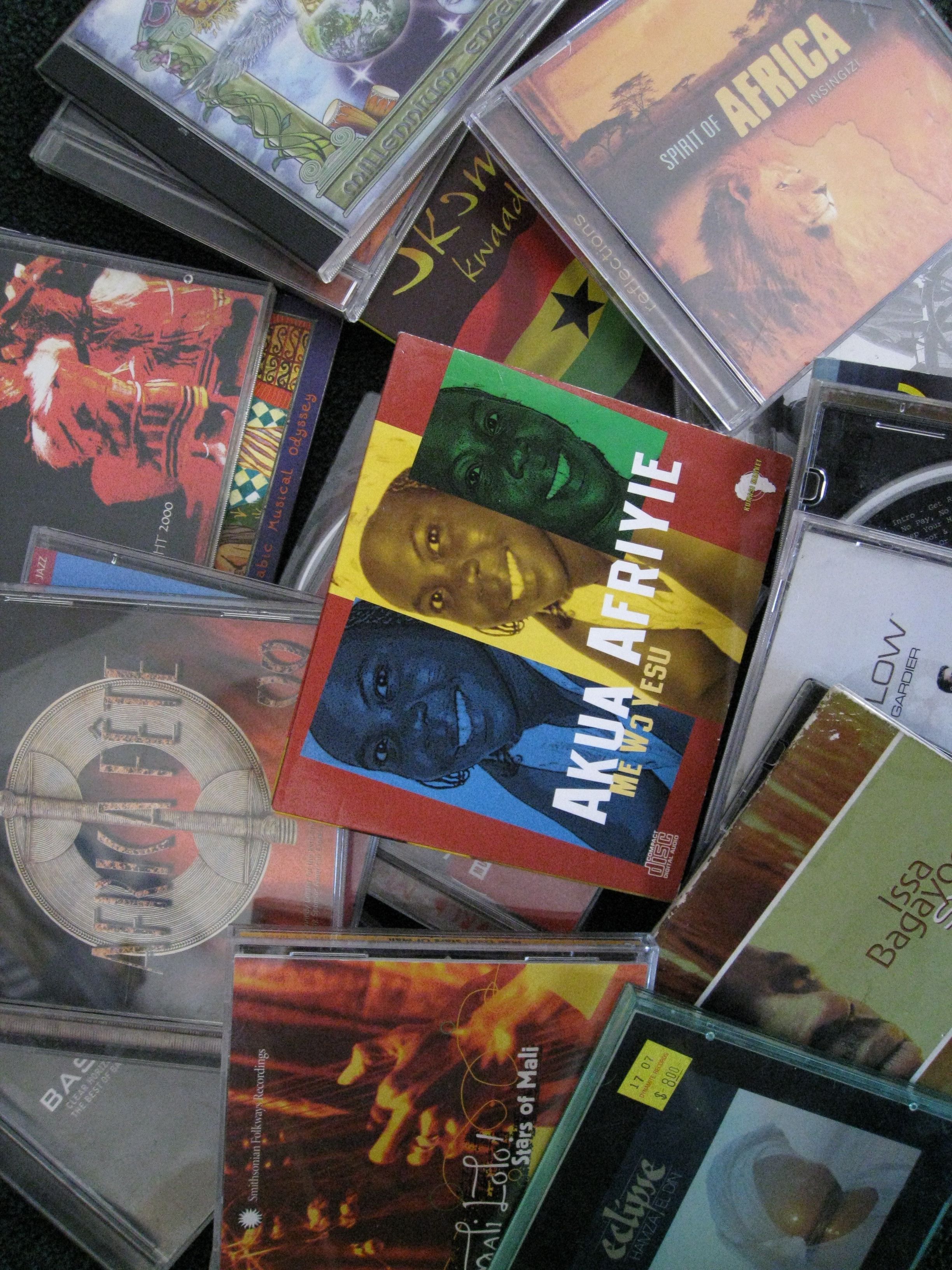
African GenerosityI was going to ask everyone I knew to play the music game again. This time with a twist: give me African music for my next 5k. Darfur. The rules would be simple: stay away from South Africa, get as close to Sudan as possible, and mention nothing that would put me to sleep. No zzzzs please. I thought it would be a fun challenge & had bets going that not many people would suggest anything.
But, before I could post anything, before I could put my musical dare in print, a guy named George blew the challenge away. I mentioned my run, mentioned my music, mentioned my need and before I knew it had more music than I knew what to do with. Well, I have a plan, now. Between now and next Saturday I’ll listen to as much as I possibly can and make a mix from what moves me. George knows music.

Bill Bryson’s African Diary

African DiaryBryson, Bill. Bill Bryson’s African Diary. New York, Broadway Books, 2002.

I added this to the December list when I read a review describing it as “short.” It’s much shorter than I thought – only 49 pages of “diary” and a few more pages of statistical information. So short that I was able to read it over a lunch break. I’m glad it was a quick read because I couldn’t put it down. I’m a sucker for charitable tactics, especially unique ones, and this book definitely qualifies. CARE International (a non-profit organization dedicated to fighting global poverty) funded Bill Bryson’s trip to Nairobi, Africa with the request that he write about his eight day adventure. Bryson is known for his travel literature, his humor, and his expressive way of describing life around him. He would certainly be able to describe the poverty, the landscape, and best of all, the people of Africa. Many reviewers called this book a charity puff-piece, a lengthy advertisement for the work of CARE, and were bitter about the $12 price tag. What they missed out on was the stunning photography, the wry humor and the painless way to do good (all royalties and profit from the sale of the book went to CARE International).
Speaking of humor, here are a few of my favorite lines: “…tireless commitment to mediocrity” (p 2), “you had to be really unlucky to be shot and stabbed” (p 4), “Kenyan Railways has something of a tradition of killing its passengers” (p 21) and, “Watamu was tranquil to the point of being comatose” (25). There are other funny moments: “flying toilets,” and flying for real, to name two.

For more information on CARE, International go here.

BookLust Twist: From More Book Lust and the chapter “Bill Bryson: Too Good to Miss” (p 36). This being my first introduction to Bryson I am looking forward to more.

Abyssinian Chronicles

Abyssinian ChroniclesIsegawa, Moses. Abyssinian Chronicles. New York: Alfred A Knopf, 2000.

This took me absolutely forever to read. In the beginning Athenian Murders seemed more interesting. No, I take that back. It seemed a faster read. Honesty is the best policy. Then, I started Autumn Across America. Juggling two “landscapes” as sweeping as Abyssinian and Autumn wasn’t easy. Both are elaborate, even panoramic, if you will. Very descriptive. But, enough excuses – back to Abyssinian Chronicles.
This is story of Mugezi. It is more than a coming-of-age chronicle. It is Mugezi’s life story from childhood to harsh adulthood in the span of twenty years and the necessary means it took to survive each and every day. In addition, it weaves in the landscape of Uganda, the politics of the 1970s, society, religion, violence,  and the family traditions of African clan. It is panoramic and profound. Isegawa’s language is harsh, his subjects, brutal. For example, the children Mugezi looks after are caller “shitters.” A line that made me laugh outloud was Muzegi’s aunt’s warning to a woman who was letting herself go, “If she did not take care, Nakibuka thought, soon birds would be nesting in her hair, baby hippos snorting in her belly and hyenas rubbing their rumps in her armpits” (p 162). If you are anything like me, you read that sentence and said “whaaaat?” I read it twice, said “whaa?” and then laughed out loud. I have no idea what it means (especially the hyena part) but it was funny. Female cattiness. I can relate to that. But, probably the section I can relate to the most is a tie between politics and family. First, politics: “Local politics were also at work: you never bit the hand that fed you… Consequently, there was much turning of the other cheek and much patience in the hope that everything would turn out right in the end” (p 218). Words I should take to heart in my present situation. Now, family: “Grandpa’s old lawyerly dreams boiled inside me. I felt I had stepped onto holy ground” (p 341). I felt that way when I was training for the Leukemia Society…something about fighting the ghosts of cancer, cradled in my grandmother’s name…

BookLust Twist: From More Book Lust and the chapter “Africa: A Reader’s Itinerary” (p 3). While I called Isegawa’s novel panoramic and sweeping Pearl describes it as sprawling and ambitious. Either way it’s 462 pages long. I think you get the point.

Africa News Cookbook

Africa News Service, Inc. The African News Cookbook: African Cooking for Western Kitchens. New York: Penguin, 1986.African cookbook

Another BookLust pick. There is something magical about this book. Maybe it’s from the introduction, “Cooking by the book is not the African way” (p.xiii). It’s romantic to learn the ingredients, forget the recipe and go with the heart; that’s what this book seems to be telling me.
On a serious side it’s crammed with interesting facts usually not associated with a cookbook. For starters there is a list of African nations and their capitals. Because this cookbook focuses on a geographical location there are maps. Because it focuses on a culture there are stories about African Women and food, and even how to eat with joy.
Probably my favorite aspect of this cookbook is the recognition of the origin of each recipe. From Malawi comes Masamba; from Algeria comes Dess b’l-besla. I think of Aubrey from Malawi who would write letters on onion paper and dream of traveling to Algeria.

BookLust Twist: From More Book Lust under the category of, “Africa: A Reader’s Itinerary” (p.2)

Things Fall Apart

Achebe, Chinua. Things Fall Apart. Portsmouth: Reed Publishing, Inc. 1992.

achebe I started The Plague (you all have read Albert Camus) before I got sick. Not a good thing while you’re puking as you can surely imagine. So, I’ve started Things Fall Apart, instead. It’s another Booklust choice (of course). My library has a pretty cool edition complete with a list of principal characters, a glossary of terms, a background history of culture, and suggestions for further reading – all before you even get into the story by Achebe. I’m only at the part where it’s announced that Ezeugo, the wife of Ogbuefi, is murdered. Page eight. More later.
12/7/06: Puzzlement: Okonkwo learns that when is father is called, “agbala” it’s not only another name for a woman, but it’s also a term for a man without a title, a purpose. A seemingly derogatory term for sure. But, wait! The Oracle was also called Agbala and people came from all over to consult it. Maybe being called, “agbala” isn’t so bad after all.

Booklust Twist: this is categorized as “African Literature in English” and as a companion read with Heart of Darkness by Joseph Conrad, The Poisonwood Bible by Barbara Kingsolver, and King Leopold’s Ghost by Adam Hoschild (Book Lust, p.15 & 63).