July ’11 was…

Where the fukc do I start (besides the fact that I’m posting this very late)? July 2011 was hell with a twisted sense of humor. Chronological speaking the first week of July was first a new car, then a wedding, then a quick trip to Monhegan and Kennebunkport (not impressed). A first week of fireworks and fun. The second week of July was an eight hour drive to Chautauqua, New York to see (from dead center second row, thank you very much) Miss Natalie Merchant at her best. A stunning performance I won’t soon forget. The third week was another trip to Maine, burying my grandfather, having my house robbed, and struggling to make sense of administrative setbacks. Week four was Kisa having to replace a tire on the truck, replace a cracked skimmer on the pool, our hot water heater flooding the basement in the middle of the night and lots and lots of home security upgrades. The ongoing issue is Jones freaking out. I don’t know what happened during the robbery but I do know he’s not the same. Insane to get out, he claws and cries and scrambles frantically at every door and window. He acts like a tortured prisoner. In the midst of all this chaos I have tried my best to keep reading. It was only semi-successful. Many fitful starts, few finishes:

  • Where the Heart Is by Billie Letts ~ in honor of it being a book within reach while I was on Monhegan. I think this should be a movie.
  • House of Mirth by Edith Wharton ~ in honor of New York becoming a state in July. Greedy book. I didn’t completely finish it. I got the point three quarters of the way through it and got the point.
  • Bonfire of the Vanities by Tom Wolfe ~ in honor of Burton Bennett’s birthday. This was made into a movie & no, I didn’t finish the book or see the movie. Another greedy book.
  • Giovanni’s Room by James Baldwin ~ in honor of it being a book in the library. I was ten pages shy of finishing this one.
  • It’s Not About the Bike: My Journey Back to Life by Lance Armstrong ~ in honor of the Tour de France. I will never look at this book the same way again for it was what I was reading on the ride home from the burial…and yes, I finished it …when we pulled into the driveway.
  • Hitty: Her First Hundred Years by Rachel Field ~ in honor of going to Rachel’s “home” state, Maine.
  • The Corrections by Jonathan Franzen ~ I barely finished this (supposed to be read in August in honor of Franzen’s birth month). I’m waiting for the movie version.

And for LibraryThing and the Early Review Program:

  • Deadly Indifference: The Perfect (Political) Storm: Hurricane Katrina, the Bush White House and Beyond by Michael D. Brown and Ted Schwarz ~ I didn’t finish this. After awhile it got really repetitive with all the blame and finger pointing.
  • Pretty by Jillian Lauren ~ I loved this book. I loved how raw and messed up it was.

We ended July the exact same way we started it – with a road trip and awesome music. A blog about Rebecca Correia’s fantastic farm show will be posted on the other side.

Crooked Letter, Crooked Letter

Franklin, Tom. Crooked Letter, Crooked Letter. New York: William Morrow, 2010.

Confession: I couldn’t put this down. A friend from Germany was in town, someone I hadn’t seen in almost three years and all I wanted to do was read Crooked Letter. I don’t normally want to ignore friends!

Crooked Letter takes place in rural Mississippi bouncing between the early 1970s and the late 2000s. From the very first sentence you are pulled into something sinister. Hints of evil lurk between the lines. Larry Ott has always been strange. A social outcast since grade school Larry pulls outrageous stunts, desperate to be noticed; bringing snakes to school, scaring girls with a grotesque Halloween mask. When a pretty high school classmate disappears Larry is suspected of murder. Unbelievably, he is the last person to be seen with her. While her body was never found and Larry’s guilt couldn’t be proven, he remained the town’s only suspect. Fast forward 25 years and another pretty young girl has gone missing. When she is found, raped and murdered, on Larry’s property it seems like an open and shut case. Except, Larry has a silent almost forgotten ally – Silas “32” Jones, a former classmate and one-time secret friend. Secret because in 1970s deep south Mississippi pockets of racism were more than alive and well. It wasn’t acceptable for white Larry to be seen with black Silas. As Chabot, Mississippi’s only constable Silas sets out to learn the truth, even if it means digging up the ugly past. Tom Franklin is very thorough with descriptions of each character’s personal life . You are pulled into Larry Ott’s mechanic shop and can smell the grease just as easily as riding along with Constable Silas Jones as he works his investigation. This is a story first and foremost about friendship and guilt and forgiveness. It is also a story about the harsh realities of racism and poverty and the scars that run deep.

I only found one bothersome discrepancy. Larry Ott is described as 41 years old. Miss Voncille is described as a woman in her “early 50s.”  That would mean at the very minimum there is a ten-year age difference between Larry and Voncille. But because they both attended the same high school Constable Silas asked Voncille if she knew Larry. Here’s the thing –  Larry would have been a toddler when Voncille started high school. If their ages had been reversed it would have allowed for the “legend” of Larry and his weirdness to be played up – Voncille could have heard stories of Larry despite the fact he graduated ten years ahead of Voncille.

In a way I could relate to Larry, especially his obsession with books. His father didn’t want him “wasting” the day by reading either.

Best line I hope is kept, “When he left, Larry lay amid his machines, thinking of Silas, how time packs new years over the old ones but how those old years are still in there, like the earliest, tightest rings centering a tree, the most hidden, enclosed in darkness and shielded from the weather” (p 251).

Poison Oracle

Dickinson, Peter. The Poison Oracle. New York: Pantheon Books, 1974.

What an easy premise: a murder is committed and only an animal witnessed the crime. The reader knows from the beginning, well in advance there will be murders. At least two of them. There are frequent reminders to these crimes throughout the book if only to keep the upcoming events in place and anticipated. The story centers around Dr. Wesley Naboth Morris. He is a zoo keeper who speaks Japanese; tutors his Oxford classmate’s son, an Arab prince in English and is, by trade, a psycholinguist. His side project is working with Dinah, a chimapanzee, to determine if primates can learn coherent sentences using plastic symbols. It is Dinah who witnesses the promised murders. The story begins with an interesting twist when a Japanese airliner is hijacked and makes an emergency landing at the Sultan’s palace. To further complicate The Poison Oracle the Sultan’s palace is surrounded by the Swampmen. Living in the swamps these tribes are outsiders to the palace. They are different from the community of Arabs that border their swamp – divided by skin color, culture, and most obvious of course, language. Some end up as servants in the palace but most are misunderstood and feared to be evil. The Poison Oracle is a story about language but it is also a story about oil. The Arabs believe there is oil in the marshland. A war with the marshmen would drive their tribes out. Dr. Morris has the thankless task of trying to solve the mystery of the murders, but also acting communicator with the marshmen.

Favorite line, “To connect cause with effect is to drive out fear” (p 117). It is funny how I connected with this line because cause and effect are the last three words of the book.

BookLust Twist: From More Book Lust in the chapter called, “Animal Love” (p 14).

Firewall

Mankell, Henning. Firewall. Trans. Ebba Segerberg. New York: The New Press, 1998.

I have to say it again. I think something got lost in the translation of this book.

Kurt Wallander is a Swedish detective trying to solve a series of mysterious deaths. At first the only common factor is the time frame in which these people died. A man falls dead after using an ATM, a cab driver is beaten to death, and someone has apparently committed suicide at a power station all within a matter of days. But, as the investigation continues pieces of the puzzle fall into place. Somehow the picture reveals an absurd terrorist plot.

What makes Firewall so entertaining is Kurt Wallander’s personality. He is a short tempered detective, good at what he does but not as great at being a divorced dad to his near-adult daughter. She finds him overbearing and lonely. I found Wallander and his Swedish police work very strange. For starters, Wallander is accused of not doing things by the book and for the most part those accusations hold true. Over and over he considers sharing information about the various investigations with his colleagues but over and over again he finds reasons not to. Also, computers connected to the crimes aren’t confiscated, potential witnesses and suspects aren’t detained for questioning, and despite rooms being searched several times, key evidence is not discovered right away. Case in point: an office was searched several times and yet Wallander finds a postcard under a computer keyboard days later.
I found some parts of Firewall predictable. Wallander is single. At his daughter’s urging he joins a dating service. Within days he gets a letter from a potential match. Right away I knew this “response” was trouble, for the letter is slid under his door – no return address or postmark. Wouldn’t Wallander have read how the service works and wouldn’t he have found a nondescript letter without a postmark a little suspect?
All in all Firewallwas a good vacation read. It was fast paced and highly entertaining.

Favorite line: “A person who died eventually became a person who had never existed” (p 7).

BookLust Twist: From More Book Lust in the chapter called, “Crime is a Globetrotter: Sweden” (p 59).

Affliction

Banks, Russell. Affliction. New York: Harper & Row, 1989.

Wade Whitehouse could be an ordinary guy. He could be that small town, hard-working, have a beer with the boys, all-around nice guy. Except bad luck not only follows Wade like a hungry dog, it bites him when he’s down. No matter how caring Wade Whitehouse is on the inside, no matter how well-meaning he is, when things go wrong people know not to stand in his way. The smarter ones walk away. The entire tiny town of Lawford, New Hampshire knows Wade and his troubles. It’s no secret he has a mean streak that runs to the center of his very core. Alcohol and a nagging toothache only widen that streak until it takes over his whole being. In theory it’s not all Wade’s fault. Abused by his father during his formative years, Wade loses his wife, home and daughter when he himself turns violent. All he wants is more time with his daughter, a decent paycheck and a simple way of life. When none of these things come easily Wade sets out to unveil the truth and right the wrongs, using violence as the vehicle to do so. What makes Wade’s story so fascinating is that it is told from a younger brother’s perspective. Being in Massachusetts he is a comfortable distance from both his brother and the memories that have scarred him as well.

BookLust Twist: From More Book Lust in the chapter called, “Oh, Brother” (p 180).

Belshazzar’s Daughter

Nadel, Barbara. Belshazzar’s Daughter. New York: Felony & Mayhem, 2006.

The pronouncement, “The Donna Leon of Istanbul” meant nothing to me, I am sorry to say. It didn’t make me like to book any better. Nor did the curious “icon” information. According to the publisher the icon of a gun meant I was holding a book from the “Hard Boiled” category, meaning the language was going to be stronger, the bad guys a little badder, the violence a little more graphic. An “R” rating, if you will – only I would give this book an “X” rating for the weird sex scenes. Natalia seems to like her sex with a gun and rough…and that’s all I’ll say about that.

The overall story of Belshazzar’s Daughter was a little tedious. Technically, there is no daughter of Belshazzar in the story. It’s the story of Englishman Robert Cornelius and his obsession with Natalia Gulcu. It is also about Inspector Ikmen and his quest to solve the brutal murder of an elderly Jew. Robert Cornelius happens to be in the area when the crime is committed and becomes a suspect due to his prejudice-laced past. The crime scene is overly horrific and obviously hate-driven with addition of a giant swastika, but Inspector Ikmen isn’t convinced. Using historical profiling, Ikmen starts to unravel the mystery of who killed Leonid Meyer. At the same time Natalia’s family history is revealed. Their history is stranger than even the murder.

With the addition of several smaller plots Belshazzar’s Daughter is a drawn-out thriller-mystery. The sex scenes are over the top while the characters are watered down to the point of stereotyping. First, I found myself annoyed with just the character of Robert and his blinded obsession with the heaving bosoms of Natalia, but by the end I didn’t care for any of them.

BTW: I didn’t find any quotes that jumped out at me.

BookLust Twist: From More Book Lust in the chapter “Crime is a Globetrotter: Turkey” (p 61).

Little Friend

Tartt, Donna. The Little Friend. New York: Alfred A. Knopf, 2002.

In a nutshell The Little Friend is about Harriet Cleve Dufresnes, a twelve-year-old girl who decides she simply must solve the mystery of who killed her nine-year-old brother when she was just an infant. All Harriet knows of the incident is that little Robin was found hung from a tree on Mother’s Day and nobody knew why. During her attempts to solve the mystery Harriet and her sidekick Hely get themselves into troubles far more adult than their years. Larger Mississippi-southern issues such as poverty and prejudice encircle  more complicated crimes such as deception, drugs, and death.

I love the way Donna Tartt writes, but was confused by plot. 555 is a long time to be reading about a mystery that doesn’t really get solved. The ambiguous ending is ripe for a sequel. Yet, there are seemingly unimportant characters that float in and out of the plot without an apparent role in the story (like Harriet’s sister Allison). Could they come back with a stronger presence in another book? One other concern is that The Little Friend is supposed to be a story set in the 1970’s. Were there meth labs back then?

When you first meet Harriet you think she has all the beginnings of a serial killer: “She could set the house on fire if she wanted to, and no one would be there to stop here” (p 67), and “…this was the hallmark of Harriet’s touch: she could scare the daylights out of you, and you weren’t even sure why” (p 74).

BookLust Twist: There is no doubt in my mind that Nancy Pearl loved this book and thought of it often. Case in point: it’s mentioned in Book Lust in the chapters “Families in Trouble” (p 82) because after little Robin is found murdered, nothing is ever the same for his family, and “Girls Growing Up” (p 102) because Harriet, Robin’s sister, grows up between the 555 pages of The Little Friend, as well as in the introduction (p xi) where Pearl says she knew she would love The Little Friend from the very first sentence. Little Friend is also mentioned in More Book Lust in the chapters “Lines that Linger; Sentences that Stick” (p 143) – the same first sentence Pearl mentioned in Book Lust, and “You Can’t Judge a Book by Its Cover” (p 238) because of its creepy doll face – a total of five mentions between the two Lust books. I can’t blame Pearl because Little Friend does fit nicely into each and every chapter mentioned.

March 2009 was…

March was all about the new house. Moving, moving, moving. Living in limbo. For books it managed to be:

  • The Concubine’s Tattoo by Laura Joh Rowland ~ fascinating tale that takes place in 17th century Japan (great sex scenes to get your libido revving). So good I recommended it to a friend.
  • The Bethlehem Road Murder by Batya Gur ~ Israeli psychological thriller.
  • The Drowning Season by Alice Hoffman ~ a grandmother and granddaughter struggle to understand one another.
  • Daniel Plainway or The Holiday Haunting of the Moosepath League by Van Reid ~ this was a really fun book with lots of subplots and meandering stories.
  • The Famished Road by Ben Okri ~ I will admit I failed on this one. Magical realism at this time is not a good idea.I need to keep my head grounded, so to speak.
  • The Old Gringo by Carlos Fuentes ~ This was a powerful little book, one that I definitely want to reread when I get the chance.
  • Lone Star by T.R. Fehrenbach ~ The history Texas. More than I needed to know. More than I wanted to know.
  • Saint Mike by Jerry Oster~ an extra book in honor of hero month. I was able to read this in a night.
  • Industrial Valley by Ruth McKenney ~ in honor of Ohio becoming a state in the month of March.
  • The Fan Man by William Kotzwinkle ~ in honor of the Book Lust of others. Luckily, it was only 182 pages.

For the Early Review program:

  • When the Time Comes: Families with Aging Parents Share Their Struggles and Solutions by Paula Span ~ this was gracefully written. Definitely worth the read if you have elderly people in your care.

For fun:

  • Dewey: The Small-Town Library Cat Who Touched the World by Vicki Myron ~ really, really cute story. Of course I cried.

I think it is fair to say work had me beyond busy. But, I will add it was a learning experience and for that, I am glad. Reading these books during the crazy times kept me grounded and for that, I am doubly glad and grateful.

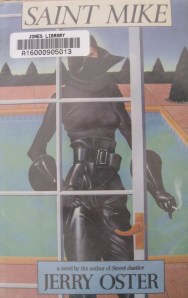
Saint Mike

saint mikeOster, Jerry. Saint Mike. New York: Harper & Row, 1987.

I love it when a book has me scratching my head and asking why in the first chapter. In Saint Mike it actually took the last paragraph at the end of the first chapter before the “huh?” kicked in, but just imagine this: two knights jousting in a field. At the end of the battle one of the knights unscrews his sword to reveal a vial of cocaine. After a good snort he gives it to his jousting mate and tells him they’ll get breakfast afterwards. The kicker is, the scene is neither here nor there in the overall description of the book as described by Nancy Peal in Book Lust, “When Susan Van Meter’s federal narcotics investigator husband is found murdered…she leaves her research position and takes on the task of tracking down and bringing to justice the murderer” (p 6).
I enjoyed every page of Saint Mike. With such a heavy plot (drugs, murder, avenging wife, federal agents) I didn’t expect such playful, witty, sexy language. Granted, there are some really weird scenes (yes, the armor comes back and someone dies by the sword in the most unusual way, but that’s all I’ll say about that). Overall it was an entertaining, fast read.

Favorite scene: I urge every parent of a child on the verge of becoming a teenager to read pages 12-14. Susan is trying to get her daughter up for breakfast, “The sound of drugs and drug paraphernalia and semiautomatic weapons being thrown out the window” (p 13). It’s hysterical.
Favorite line: “Rita tossed her head like a fandango dancer. “It is not just the penis that is flawed; it is the whole organism.”” (p 15).

BookLust Twist: From Book Lust in the chapter called, “Action Heroines” (p 5).

Bethlehem Road Murder

Gur, Batya. Bethlehem Road Murder. New York: Harper Collins, 2004.

I have a confession to make. Bethlehem Road Murder is the last book in a series recommended by Pearl. I should have read this one last. Dead last. Instead I read it first. Oh well.

I read Bethlehem Road Murder at the same time as The Concubine’s Tattoo and immediately I was struck by a huge similarity between the two stories (besides the fact they are from the same chapter in More Book Lust). Both books are centered around the murder of a woman. Both women were strikingly young and beautiful. Both women had experience as fighters (one in the army, one as a samurai). Both women had secret lovers and complicated histories. Both women were in the early stages of pregnancy at the time of death (which always throws a wrench into the question of motive).

Bethlehem Road Murder takes place in Jerusalem in a community locked in the ancient culture of Israeli society. They have their own way of governing; their own way of thinking. In the middle of this community lies a mystery. A beautiful woman is brutally murdered. Chief Superintendent Michael Ohayon must investigate the crime and solve the mystery while keeping within in line with the constraints of the rules of a close-knit community. Political and religion tensions between Jews and Arabs only serve to complicate the case. Of course, no murder mystery would not be complete without a little romantic intrigue and psychological guess work. Gur does not disappoint.

Favorite lines: “Each time he stood over a corpse…he imagined he felt every bone of his body and his skull laughing derisively beneath his flesh” (p 7). “Don’t you know that all real estate agents are crooks?” (p 9). I had to laugh at that one because just having gone through the process of buying a house for the first time my realtor is a saint!

Note: I think this was the first book I have ever read that included a no-nonsense account of most every detail of an autopsy.

BookLust Twist: In More Book Lust in the chapter called, “Crime is a Globetrotter: Israel” (p 58).

Concubine’s Tattoo

Rowland, Laura Joh. The Concubine’s Tattoo. New York: St. Martin’s Press, 1998.

In addition to being a great 17th century Japanese murder mystery The Concubine’s Tattoo is a commentary on honor and relationships. Sano Ichirois the shogun’s investigator who has recently celebrated an arranged marriage. In both his professional and personal life Sano must balance a code of conduct that is morally, politically and, of course, honorably sound. Sano’s latest case (on the night of his wedding no less) is the murder of the shogun’s favorite concubine. Entwined in this murder are complications concerning an heir, long standing cultural differences and rivalries. Rowland displays Sano’s progress on the case through the eyes of Sano’s new wife Reiko, his enemy Chamberlain Yanagisawa, his partner Hirata, and Sano himself as well as many other fascinating characters. One of the best enjoyments of Rowland’s book is her vivid, descriptive use of imagery. The details are so sensuous and alluring. They exquisitely cater to all five senses. Here are two quotes I particularly liked, “Her voice was a husky murmur that insinuated its way into Hirata’s mind like a dark, intoxicating smoke” (p 86), and “The cold air had a lung-saturating dampness” (p 166). 

One other detail I thought I should point out – Rowland is not afraid to describe vivid sex scenes of varying natures. Man on man, woman on woman, husband and wife, illicit seductions, and even rape. The scenes while reminiscent of lusty bodice-rippers are not overly flowery or “heaving.”

BookLust Twist: In More Book Lust in the chapter called, “Crime is a Globetrotter: China” (p 60).

Red Death

Mosley, Walter. A Red Death. New York: Norton, 1991.

This was a quick read for me. I was first introduced to Walter Mosley’s work this past summer while renting a cottage on the island. It was a paperback in the cottage’s collection and I “borrowed” it for awhile. I like the orginality of Mosely’s voice. It is complicated and cunning, sarcastic and sexy, tough and tender all at once.

Red Death is Walter Mosley’s continuation of his debut novel, Devil in a Blue Dress. In Devil in a Blue Dress we meet Ezekiel “Easy” Porterhouse Rawlins, a hard drinkin’, hard lovin’ unofficial Los Angeles detective who has an eye for the ladies and is a magnet for trouble. In Red Death Easy gets himself tangled in yet another scandal, this one political. Taking place in the 1950s, Easy faces the paranoia brought on by Communism and the ever present racial tensions as he deals with not only the IRS, but the FBI. Both want him, but for very different reasons. As always, Easy doesn’t shy away from trouble. Once again, Easy is sexy and dangerous all at once.

Favorite lines: “I like to use my legs , especially when I had thinking to do” (p 24).
“He loved us in the strange way that he felt everything” (p 74).
“Dreams are wonderful things, because they’re a different way of thinking” (p 235).
“I made like I was friends with people and then I planned to do them dirt” (p 276).

BookLust Twist: From More Book Lust in the chapter, “Walter Mosley: Too Good To Miss”

Crime Novels

Polito, Robert. Crime Novels: American Noir of the 1930s & 40s. New York: Library of America, 1997.

Something scary for Halloween. Six different stories about crime. Three of them are novels already on my list. Go figure.

  1. The Postman Always Rings Twice by James M. Cain
  2. They Shoot Horses Don’t They? by Horace McCoy
  3. The Big Clock by Kenneth Fearing

and three others:

  • Thieves Like Us by Edward Anderson
  • Nightmare Alley by William Lindsay Gresham
  • I Married a Dead Man by Cornell Woolrich

From The Postman Always Rings Twice~ I have always wanted to know what this story was all about. Written in 1934 it tells the sexy, gritty tale of Frank Chambers, a drifter who finds himself grounded by Cora Papadakis, a married woman. Cora’s beauty and instant mutual attraction leads to Frank’s uncharacteristic staying put. Soon the adulterous couple is contemplating murder. The plot is timeless. Desire has led them to the devil’s doorstep.
Favorite lines: “I kissed her. Her eyes were shining up at me like two blue stars. It was like being in church” (p13).
“Then the devil went to bed with us, and believe you me, kid, he sleeps pretty good” (p 70).
What Nancy had to say about : “…filled with desperate, scheming men and women…” (Pearl, Nancy. Book Lust, p66).

From They Shoot Horses Don’t They?: This was a bizarre, psychological tale about two kids with very different dreams. Robert is looking to be a film producer and Gloria wants to be an actress. They pair up and enter a Hollywood dance contest knowing Hollywood bigwigs would be in attendance. The contest is all about making money, working the contestants like racehorses, making bigger and better stunts to attract sponsors and a bigger audience. Analogies to horse racing are abundant. From the title of the book it is obvious what happens in the end, but it’s a fascinating read just the same.
What Nancy had to say, “…wonderfully grungy dance-marathon nightmare novel” (Book Lust p 67).

From Thieves Like Us ~ : I found this to be a very slow moving, almost methodical story. Written in 1937 it tells the tale of three bank robbers: Elmo Mobley, T.W. Masefeld and Bowie A. Bowers. While the story of these thieves as fugitives on the run is interesting, what makes the entire piece come alive is the vivid imagery used to describe the landscape these men hide in. Across Texas and Oklahoma’s back country there are many farmhouses and hideaways to keep the story moving. Favorite lines: Oddly enough, the dedication caught my eye: “To my cousin and my wife, because there I was with an empty gun and you, Roy, supplied the ammunition and you, Anne, directed my aim” (p 216). Here’s where my sick mind went with this: Roy (the cousin) had an affair with Anne (the wife). Don’t mind me.
Second favorite line: “The moon hung in the heavens like a shred of fingernail” (p 224). There have been a lot of interesting moon descriptions, but I liked this one a lot.

The Big Clock by Kenneth Fearing started out slow. George Stroud works for a conglomerate of magazines in their Crimeways department. He is a simple family man with a wife and daughter, but his dreams and ambitious are big. When he has an affair with his boss’s girlfriend and she winds up bludgeoned to death things get a little tricky. It’s a story of conspiracy and cat and mouse. George must prove his innocence when everything points to the contrary. Once it gets going it’s fascinating!
From The Big Clock: “The eye saw nothing but innocence, to the instincts she was undiluted sex, the brain said here was a perfect hell” (p 383), “He said how nice Georgette was looking which was true, how she always reminded him of carnivals and Hallowe’en” (p 385) and “I could feel the laborious steps her reasoning took before she reached a tentative, spoken conclusion” (p 393).
What Nancy Pearl had to say, “…edgy corporate-as-hell thriller” (Book Lust p 66).

Nightmare Alley was intriguing on many different levels. It was the ultimate “what goes around comes around” story. The lives of carnival entertainers serves as the backdrop for Stanton Carlise’s rise and fall. He joins the carnival and soon picks of the tricks of Zeena, the Seer. Once Stan the Great learns the craft (an inadvertently commits murder) he leaves the carny and sets out on his own as a Mentalist, becoming greedier and greedier for taking the sucker’s buck. Soon he passes himself off as a priest with the capability of bringing loved ones back from the dead. Constantly running from troubles in his own life Stan gets himself deeper and deeper until no one is trustworthy.

I Married a Dead Man by Cornell Woolrich was probably my favorite. You don’t know much about Helen Georgesson before she assumes the identity of Patrice Hazzard. The facts are Helen is a pregnant girl, riding the rails with 17 cents to her name. A chance encounter and a terrible accident leave Helen with a case of mistaken identity. For the opportunity to start life anew and give her baby a better life Helen accepts Patrice’s identity as her own. Living the life of luxury doesn’t come easy when Helen’s past comes to town and threatens to unveil her true self.

BookLust Twist: Crime Novels: American Noir of the 1930s & 40s can be found in Book Lust in the chapter, “Les Crimes Noir” (p 65).